
UNITED STATES
SECURITIES AND EXCHANGE COMMISSION
WASHINGTON, D.C. 20549
FORM
OR
For
the fiscal year ended
OR
OR
Date of event requiring this shell company report
For the transition period from to
Commission
file number:
(Exact name of Registrant as specified in its charter)
N/A
(Translation of Registrant’s name into English)
(Jurisdiction of incorporation or organization)
(Address of principal executive offices)
Telephone:
At the address of the Company set forth above
(Name, Telephone, E-mail and/or Facsimile number and Address of Company Contact Person)
Securities registered or to be registered pursuant to Section 12(b) of the Act.
| Title of each class | Trading Symbol(s) | Name of each exchange on which registered | ||
| The | ||||
| The |
Securities registered or to be registered pursuant to Section 12(g) of the Act.
None
(Title of Class)
Securities for which there is a reporting obligation pursuant to Section 15(d) of the Act.
None
(Title of Class)
Indicate the number of outstanding shares of each of the issuer’s classes of capital or common stock as of the close of the period covered by the annual report.
As
of June 30, 2025, the issuer had 37,430,968 ordinary shares and 18,844,987 warrants issued and outstanding. As of the date of this annual
report, the issuer has
Indicate by check mark if the registrant is a well-known seasoned issuer, as defined in Rule 405 of the Securities Act.
Yes
☐
If this report is an annual or transition report, indicate by check mark if the registrant is not required to file reports pursuant to Section 13 or 15(d) of the Securities Exchange Act of 1934.
Yes
☐
Indicate by check mark whether the registrant (1) has filed all reports required to be filed by Section 13 or 15(d) of the Securities Exchange Act of 1934 during the preceding 12 months (or for such shorter period that the registrant was required to file such reports), and (2) has been subject to such filing requirements for the past 90 days.
Indicate by check mark whether the registrant has submitted electronically every Interactive Data File required to be submitted pursuant to Rule 405 of Regulation S-T (§232.405 of this chapter) during the preceding 12 months (or for such shorter period that the registrant was required to submit such files).
Indicate by check mark whether the registrant is a large accelerated filer, an accelerated filer, a non-accelerated filer, or an emerging growth company. See definition of “large accelerated filer,” “accelerated filer,” and “emerging growth company” in Rule 12b-2 of the Exchange Act.
| Large accelerated filer | ☐ | Accelerated filer | ☐ | |
| ☒ | Emerging growth company |
If
an emerging growth company that prepares its financial statements in accordance with U.S. GAAP, indicate by check mark if the registrant
has elected not to use the extended transition period for complying with any new or revised financial accounting standards provided pursuant
to Section 13(a) of the Exchange Act.
Indicate
by check mark whether the registrant has filed a report on and attestation to its management’s assessment of the effectiveness
of its internal control over financial reporting under Section 404(b) of the Sarbanes-Oxley Act (15 U.S.C. 7262(b)) by the registered
public accounting firm that prepared or issued its audit report.
If
securities are registered pursuant to Section 12(b) of the Act, indicate by check mark whether the financial statements of the registrant
included in the filing reflect the correction of an error to previously issued financial statements.
Indicate by check mark whether any of those error corrections are restatements that required a recovery analysis of incentive-based compensation received by any of the registrant’s executive officers during the relevant recovery period pursuant to §240.10D 1(b). ☐
Indicate by check mark which basis of accounting the registrant has used to prepare the financial statements included in this filing:
| ☒ | International Financial Reporting Standards as issued by the International Accounting Standards Board ☐ | Other ☐ |
| * | If “Other” has been checked in response to the previous question, indicate by check mark which financial statement item the registrant has elected to follow. Item 17 ☐ Item 18 ☐ |
If
this is an annual report, indicate by check mark whether the registrant is a shell company (as defined in Rule 12b-2 of the Exchange
Act). Yes ☐ No
TABLE OF CONTENTS
| INTRODUCTION | iii | |||
| PART I | 1 | |||
| ITEM 1. | IDENTITY OF DIRECTORS, SENIOR MANAGEMENT AND ADVISERS | 1 | ||
| ITEM 2. | OFFER STATISTICS AND EXPECTED TIMETABLE | 1 | ||
| ITEM 3. | KEY INFORMATION | 1 | ||
| ITEM 4. | INFORMATION ON THE COMPANY | 27 | ||
| ITEM 4A. | UNRESOLVED STAFF COMMENTS | 47 | ||
| ITEM 5. | OPERATING AND FINANCIAL REVIEW AND PROSPECTS | 48 | ||
| ITEM 6. | DIRECTORS, SENIOR MANAGEMENT AND EMPLOYEES | 65 | ||
| ITEM 7. | MAJOR SHAREHOLDERS AND RELATED PARTY TRANSACTIONS | 70 | ||
| ITEM 8. | FINANCIAL INFORMATION | 73 | ||
| ITEM 9. | THE OFFER AND LISTING | 73 | ||
| ITEM 10. | ADDITIONAL INFORMATION | 74 | ||
| ITEM 11. | QUANTITATIVE AND QUALITATIVE DISCLOSURES ABOUT MARKET RISK | 80 | ||
| ITEM 12. | DESCRIPTION OF SECURITIES OTHER THAN EQUITY SECURITIES | 80 | ||
| PART II | 81 | |||
| ITEM 13. | DEFAULTS, DIVIDEND ARREARAGES AND DELINQUENCIES | 81 | ||
| ITEM 14. | MATERIAL MODIFICATIONS TO THE RIGHTS OF SECURITY HOLDERS AND USE OF PROCEEDS | 81 | ||
i
| ITEM 15. | CONTROLS AND PROCEDURES | 81 | ||
| ITEM 16. | [RESERVED] | 81 | ||
| ITEM 16A. | AUDIT COMMITTEE FINANCIAL EXPERT | 81 | ||
| ITEM 16B. | CODE OF ETHICS | 82 | ||
| ITEM 16C. | PRINCIPAL ACCOUNTANT FEES AND SERVICES | 82 | ||
| ITEM 16D. | EXEMPTIONS FROM THE LISTING STANDARDS FOR AUDIT COMMITTEES | 82 | ||
| ITEM 16E. | PURCHASES OF EQUITY SECURITIES BY THE ISSUER AND AFFILIATED PURCHASERS | 82 | ||
| ITEM 16F. | CHANGE IN REGISTRANT’S CERTIFYING ACCOUNTANT | 82 | ||
| ITEM 16G. | CORPORATE GOVERNANCE | 82 | ||
| ITEM 16H. | MINE SAFETY DISCLOSURE | 83 | ||
| ITEM 16I. | DISCLOSURE REGARDING FOREIGN JURISDICTIONS THAT PREVENT INSEPCTIONS | 83 | ||
| ITEM 16J. | INSIDER TRADING POLICIES | 83 | ||
| ITEM 16K. | CYBERSECURITY | 83 | ||
| PART III | 84 | |||
| ITEM 17. | FINANCIAL STATEMENTS | 84 | ||
| ITEM 18. | FINANCIAL STATEMENTS | 84 | ||
| ITEM 19. | EXHIBITS | 84 |
ii
INTRODUCTION
In this annual report on Form 20-F, unless the context otherwise requires, references to:
| ● | “AI” means artificial intelligence; | |
| ● | “BPO” means business process outsourcing; | |
| ● | “Business Combination Agreement” means the Business Combination Agreement, dated as of November 12, 2023, as amended by the First Amendment to the Business Combination Agreement, by and among Tristar, Helport AI, First Merger Sub, Second Merger Sub, Helport, Purchaser Representative, and Seller Representative (as defined below); | |
| ● | “Business Combination” or “Transactions” means, collectively, the transactions contemplated by the Business Combination Agreement, including the First Merger and the Second Merger, which were consummated on August 2, 2024; | |
| ● | “BVI” means British Virgin Islands; | |
| ● | “BVI Companies Act” means the BVI Business Companies Act (as amended); | |
| ● | “Closing” means the closing of the Transactions; | |
| ● | “Contact center seats” or “Seats” means the number of workstations or positions available within a contact center where customer service representatives or agents interact with customers through various communication channels like phone calls, emails, live chat, or social media platforms, a metric which indicates the capacity or scale of a contact center in terms of the simultaneous interactions it can handle or the number of customer service representatives it can accommodate at any given time to address customer inquiries, provide support, or handle incoming communication channels; | |
| ● | “First Amendment to the Business Combination Agreement” means the first amendment to the Business Combination Agreement, dated as of December 18, 2023, by and among Tristar, Helport AI, First Merger Sub, Second Merger Sub, Helport, Purchaser Representative and Seller Representative; | |
| ● | “First Merger Sub” means Merger I Limited, a British Virgin Islands business company, an exempted company incorporated with limited liability in the Cayman Islands and a wholly-owned subsidiary of Helport AI prior to the consummation of the Business Combination; | |
| ● | “Group” are to Helport AI (defined below) and its subsidiaries, collectively; |
iii
| ● | “Helport AI” are to Helport AI Limited, a British Virgin Islands business company; | |
| ● | “Helport” are to Helport Limited, a British Virgin Islands business company, which is a wholly owned subsidiary of Helport AI; | |
| ● | “Helport Singapore” are to Helport Pte. Ltd., an exempt private company limited by shares incorporated in Singapore, which is a wholly owned subsidiary of Helport Limited; | |
| ● | “Helport U.S.” are to Helport AI Inc., a limited liability company incorporated in the state of Delaware, on September 15, 2023, and an indirectly wholly-owned subsidiary of our Company; | |
| ● | “Indonesian Rupiah” and “IDR” are to the legal currency of Indonesia; | |
| ● | “Ordinary Shares” or “Helport AI Ordinary Shares” are to the ordinary shares of Helport AI Limited, par value $0.0001 per share; | |
| ● | “PHP” are to the Philippines peso, the legal currency of the Philippines; | |
| ● | “Second Merger Sub” means Merger II Limited, a Cayman Islands exempted company and a wholly-owned subsidiary of Helport AI prior to the consummation of the Business Combination; |
| ● | “Singapore dollars,” “SGD,” and “S$” are to the legal currency of Singapore; | |
| ● | “Tristar” or “Purchaser” means Tristar Acquisition I Corp., a Cayman Islands exempted company; | |
| ● | “U.S. dollars,” “US$,” “$,” and “dollars” are to the legal currency of the United States; | |
| ● | “Warrants” or “Helport AI Warrants” means the 18,844,987 warrants of Helport AI, each entitling the holder thereof to purchase one Ordinary Share at a purchase price of $11.50 per whole share; and | |
| ● | “we,” “us,” “our,” “our Company,” or the “Company” are to one or more of Helport AI and its subsidiaries, as the case may be. |
This annual report on Form 20-F includes our audited consolidated financial statements for the fiscal years ended June 30, 2025, 2024, and 2023. In this annual report, we refer to assets, obligations, commitments, and liabilities in our consolidated financial statements in U.S. dollars. Certain dollar references are based on the exchange rate of Singapore dollars to U.S. dollars, as well as the exchange rate of the PHP to U.S. dollars, in each case determined as of a specific date or for a specific period. Changes in the exchange rate will affect the amount of our obligations and the value of our assets in terms of U.S. dollars which may result in an increase or decrease in the amount of our obligations (expressed in dollars) and the value of our assets, including accounts receivable (expressed in dollars).
This annual report contains translations of certain amounts in Singapore dollars and the PHP into U.S. dollars at specified rates. Unless otherwise stated, the following exchange rates are used in this annual report:
| As of and for the fiscal years ended June 30, | ||||||||||||
| US$ Exchange Rate | 2025 | 2024 | 2023 | |||||||||
| At the end of the year – SGD | SGD1.2719 to $1.00 | SGD1.3552 to $1.00 | SGD1.3523 to $1.00 | |||||||||
| Average rate for the year – SGD | SGD1.3248 to $1.00 | SGD1.3482 to $1.00 | SGD 1.3642 to $1.00 | |||||||||
| At the end of the year – PHP | PHP 56.6889 to $1.00 | - | - | |||||||||
| Average rate for the year – PHP | PHP 57.7734 to $1.00 | - | - | |||||||||
iv
Part I
ITEM 1. IDENTITY OF DIRECTORS, SENIOR MANAGEMENT AND ADVISERS
Not Applicable.
ITEM 2. OFFER STATISTICS AND EXPECTED TIMETABLE
Not Applicable.
ITEM 3. KEY INFORMATION
A. [Reserved]
B. Capitalization and Indebtedness
Not applicable.
C. Reasons for the Offer and Use of Proceeds
Not applicable.
D. Risk Factors
Risks Relating to Doing Business in the PRC
You may experience difficulties in effecting service of legal process, enforcing foreign judgments, or bringing actions in China against Helport AI or its management that reside outside the United States based on foreign laws. It may also be difficult for you or overseas regulators to conduct investigations or collect evidence within China.
As a company incorporated under the laws of the British Virgin Islands, we conduct our operations through our subsidiary in Singapore, but are reliant upon customers who are based in China. In addition, three out of Helport AI’s five directors and officers, namely Guanghai Li, Di Shen, and Xinyue (Jasmine) Geffner, reside in the PRC. All or a substantial portion of the assets of Helport AI’s directors and officers are located outside the United States. As a result, it may be difficult for you to effect service of process upon those persons inside mainland China. It may be difficult for you to enforce judgments obtained in U.S. courts based on civil liability provisions of the U.S. federal securities laws against Helport AI and its officers and directors who do not currently reside in the U.S. or have substantial assets in the U.S. In addition, there is uncertainty as to whether the courts of the British Virgin Islands or the PRC would recognize or enforce judgments of U.S. courts against Helport AI or such persons predicated upon the civil liability provisions of the securities laws of the U.S. or any state.
1
The recognition and enforcement of foreign judgments are provided for under the PRC Civil Procedures Law. PRC courts may recognize and enforce foreign judgments in accordance with the requirements of the PRC Civil Procedures Law based either on treaties between China and the country where the judgment is made or on principles of reciprocity between jurisdictions. China does not have any treaties or other forms of written arrangement with the United States that provide for the reciprocal recognition and enforcement of foreign judgments. In addition, according to the PRC Civil Procedures Law, the PRC courts will not enforce a foreign judgment against Helport AI or its directors and officers if they decide that the judgment violates the basic principles of PRC laws or national sovereignty, security, or public interest. As a result, it is uncertain whether and on what basis a PRC court would enforce a judgment rendered by a court in the United States.
It may also be difficult for you or overseas regulators to conduct investigations or collect evidence within China. For example, in China, there are significant legal and other obstacles to obtaining information needed for shareholder investigations or litigation outside China or otherwise with respect to foreign entities. Although the authorities in China may establish a regulatory cooperation mechanism with counterparts of another country or region to monitor and oversee cross border securities activities, such regulatory cooperation with the securities regulatory authorities in the United States may not be efficient in the absence of a practical cooperation mechanism. Furthermore, according to Article 177 of the PRC Securities Law (“Article 177”), which became effective in March 2020, no overseas securities regulator is allowed to directly conduct investigations or evidence collection activities within the territory of the PRC. Article 177 further provides that Chinese entities and individuals are not allowed to provide documents or materials related to securities business activities to foreign agencies without prior consent from the securities regulatory authority of the State Council and the competent departments of the State Council. While detailed interpretation of or implementing rules under Article 177 have yet to be promulgated, the inability for an overseas securities regulator to directly conduct investigations or evidence collection activities within China may further increase difficulties faced by you in protecting your interests.
Recent greater oversight by the CAC over data security could adversely impact our business.
On December 28, 2021, 13 governmental departments of the PRC, including the Cybersecurity Administration of China, or the CAC, jointly promulgated the Cybersecurity Review Measures, which became effective on February 15, 2022. The Cybersecurity Review Measures provide that net platform operators engaging in data processing activities that affect or may affect national security must be subject to cybersecurity review by the Cybersecurity Review Office of the PRC. On November 14, 2021, the CAC published the Draft Regulations on the Network Data Security Administration (Draft for Comments), which provides that data processing operators engaging in data processing activities that affect or may affect national security must be subject to cybersecurity review by the relevant Cyberspace Administration of the PRC.
As part of our global expansion strategy, we have engaged customers located in countries other than the PRC, which began generating revenue in the fiscal year 2024. However, for the fiscal years ended June 30, 2025 and 2024, substantially all of our revenue was still generated from customers located in the PRC, even though we have no operating entity in the PRC. Our products do not collect personal data from contact center activities, nor do we store any data from such activities. Therefore, as of the date of this annual report, neither Helport AI nor any subsidiaries thereof have received any notice from any authorities requiring Helport AI or any of its subsidiaries to undergo cybersecurity review or network data security review. However, since the use of our AI Assist software involves the collection of data and information contained in the contact center operations of our customers in the PRC, we may be subject to certain laws and regulations in China in the future. If any such new laws, regulations, rules, or implementation and interpretation come into effect, we expect to take all reasonable measures and actions to comply and to minimize the adverse effect of such laws on our operations. We cannot guarantee, however, that we will not be subject to cybersecurity review and network data security review in the future. During any such review, Helport may be required to suspend its operations or experience other disruptions to its operations. Cybersecurity review and network data security review could also result in negative publicity with respect to Helport AI, and diversion of its managerial and financial resources, which could materially and adversely affect its business, financial conditions, and results of operations.
2
Changes in China’s economic, political, or social conditions or government policies could have a material adverse effect on our business and operations.
Although we have no operating entity in the PRC, a significant portion of our customers are located in the PRC. Accordingly, our business, financial condition, results of operations, and prospects may be influenced to a significant degree by political, economic, and social conditions in China generally. The Chinese economy differs from the economies of most developed countries in many respects, including the level of government involvement, level of development, growth rate, control of foreign exchange, and allocation of resources.
Although the Chinese government has implemented measures emphasizing the utilization of market forces for economic reform, including the reduction of state ownership of productive assets and the establishment of improved corporate governance in business enterprises, a substantial portion of productive assets in China is still owned by the government. In addition, the Chinese government continues to play a significant role in regulating industry development by imposing industrial policies. The Chinese government also exercises significant control over China’s economic growth by allocating resources, controlling payment of foreign currency-denominated obligations, setting monetary policy, and providing preferential treatment to particular industries or companies.
While the Chinese economy has experienced significant growth over the past decades, growth has been uneven, both geographically and among various sectors of the economy. Any adverse changes in economic conditions in China, in the policies of the Chinese government, or in the laws and regulations in China could have a material adverse effect on the overall economic growth of China. Such developments could adversely affect our business and operating results, reduce demand for their products, and weaken their competitive position. The Chinese government has implemented various measures to encourage economic growth and guide the allocation of resources. Some of these measures may benefit the overall Chinese economy but may have a negative effect on us. For example, our financial condition and results of operations may be adversely affected by government control over capital investments or changes in tax regulations. In addition, in the past the Chinese government has implemented certain measures, including interest rate adjustments, to control the pace of economic growth. These measures may cause decreased economic activities in China, which may adversely affect our business and operating results. These negative events and circumstances include, but may not be limited to, the following:
| ● | an economic downturn in China; | |
| ● | political instability that could adversely affect our ability to deliver our products to consumers in a timely fashion; | |
| ● | changes in laws and regulations, in particular those with little advance notice; | |
| ● | tariffs and other trade barriers which could make it more expensive for us to deliver our products to consumers; and | |
| ● | new administrative and compliance requirements resulting in an increase in transactional costs with our suppliers and customers. |
3
Uncertainties in the interpretation and enforcement of PRC laws and regulations and changes in policies, rules, and regulations in China, which may be quick with little advance notice, could limit the legal protection available to you and us.
The PRC legal system is based on written statutes. Unlike common law systems, it is a system in which legal cases have limited value as precedents. In the late 1970s, the PRC government began to promulgate a comprehensive system of laws and regulations governing economic matters in general. The legislation over the past five decades has significantly increased the protection afforded to various forms of foreign or private-sector investment in China. Since these laws and regulations are relatively new and the PRC legal system continues to rapidly evolve, however, the interpretations of many laws, regulations, and rules are not always uniform and enforcement of these laws, regulations, and rules involves uncertainties.
Although we have no operating entity in the PRC, currently a significant portion of the Company’s customers are located in China. Therefore, from time to time, we and our subsidiaries may have to resort to administrative and court proceedings in China to enforce their legal rights. Since PRC administrative and court authorities have significant discretion in interpreting and implementing statutory and contractual terms, however, it may be more difficult to evaluate the outcome of administrative and court proceedings and the level of legal protection we and our subsidiaries enjoy in the PRC legal system than in more developed legal systems. Furthermore, the PRC legal system is based in part on government policies, internal rules, and regulations (some of which are not published in a timely manner or at all) that may have retroactive effect and may change quickly with little advance notice. As a result, we and our subsidiaries may not be aware of their violation of these policies and rules until sometime after the violation. Such uncertainties, including uncertainties over the scope and effect of their contractual, property (including intellectual property), and procedural rights, and any failure to respond to changes in the regulatory environment in China could materially and adversely affect our business and impede our ability to continue operations.
Fluctuations in exchange rates could have a material and adverse effect on our results of operations and the value of your investment.
During the fiscal years ended June 30, 2025, 2024, and 2023, our sales to the China market accounted for substantially all of our revenue. Our sales to customers located in the PRC are denominated in the U.S. dollar, with the actual settlement amount converted to an amount denominated in Renminbi (“RMB”) at the time of payment. Our Singapore operating entity’s functional currency is the Singapore dollar. The functional currency of the Philippines branch of our Singapore operating entity is the PHP. The functional currency of our Indonesian subsidiary is the IDR. As a result, fluctuations in the exchange rate among the U.S. dollar, the Singapore dollar, the PHP, the IDR, and RMB will affect the relative purchasing power, in the Singapore dollar, the PHP, the IDR,or RMB terms, of our U.S. dollar assets. Gains and losses from the re-measurement of assets and liabilities receivable or payable in the Singapore dollar, the PHP, the IDR, or RMB are included in our consolidated statements of operations. The re-measurement has caused the U.S. dollar value of our results of operations to vary with exchange rate fluctuations, and the U.S. dollar value of our results of operations will continue to vary with exchange rate fluctuations.
4
A fluctuation in the value of the Singapore dollar, the PHP, the IDR, or RMB relative to the U.S. dollar could reduce our profits from operations and the translated value of our net assets when reported in U.S. dollars in our financial statements. This change in value could negatively impact our business, financial condition, or results of operations as reported in U.S. dollars. In the event that we decide to convert our Singapore dollar, PHP, IDR, or RMB into U.S. dollars to make payments for dividends on our Ordinary Shares or for other business purposes, appreciation of the U.S. dollar against the Singapore dollar, the PHP, the IDR, or RMB will harm the U.S. dollar amount available to us. In addition, fluctuations in currencies relative to the periods in which the earnings are generated may make it more difficult to perform period-to-period comparisons of our reported results of operations.
It is difficult to predict how market forces or any Singapore, Philippines, Indonesia, PRC, or U.S. government policy may impact the exchange rate among the U.S. dollar, the Singapore dollar, the PHP, the IDR, and RMB in the future. Any significant appreciation or depreciation of the Singapore dollar, the PHP, the IDR, or RMB may materially and adversely affect our revenues, earnings and financial position, and the value of, and any dividends payable on, our Ordinary Shares in U.S. dollars. To date, we have not entered into any hedging transactions in an effort to reduce our exposure to foreign currency exchange risk. While we may decide to enter into hedging transactions in the future, the availability and effectiveness of these hedges may be limited and we may not be able to adequately hedge our exposure or at all. If the exchange rate between the U.S. dollar, the Singapore dollar, the PHP, the IDR, and RMB fluctuates in an unanticipated manner, our business, financial condition, and results of operations could be materially adversely affected.
Each of our customers and suppliers has entered into an Authorization for Payment Agreement with our Singapore and U.S. operating entity and a third- party agent. Our financial condition and liquidity position may be subject to credit risks of the third-party agent.
Since we have not yet established relevant entities or subsidiaries in the PRC, and because a significant portion of our customers and suppliers are located in the PRC, each of our customers and suppliers has entered into an Authorization for Payment Agreement (collectively, the “Agreements”) with our operating entities, Helport Singapore and Helport US, and a third party agent, Xinsheng Technology (Tianjin) Co., Ltd. (“Xinsheng”), through whom we make payments to our suppliers and receive payments from our customers. The payment amount in each of the Agreements is denoted in U.S. dollars. For details, see “ITEM 4. Information of the Company—B. Business Overview—Major Supplier” and “ITEM 4. Information of the Company—B. Business Overview—Customers, Sales, and Marketing.” As of the date of this annual report, Xinsheng has fulfilled its obligations to transfer the payments guaranteed in each of the Agreements. However, there is no assurance that, in the future, we will be able to successfully enforce Xinsheng’s guarantee, or any other such payment agents’ guarantee. Third-party agents subject to such payment agreements are subject to their own unique operational and financial risks, which are beyond our control. In the event that such agents fail to function properly or breach or terminate their cooperation with us, we may be unable to recover payment from our customers or transfer payment to our suppliers in a timely manner, or at all. This could disrupt our cash flow and lead to a breakdown of our contractual relationship with customers and suppliers. If we are unable to address these issues in a timely and cost-effective manner, our business, financial condition, and results of operations may be adversely affected.
5
If the PRC government imposes further restrictions and limitations on our PRC customers’ ability to transfer or distribute cash overseas., our business, financial condition, and results of operations could be materially adversely affected.
The PRC government has imposed controls on the convertibility of the RMB into foreign currencies and, in certain cases, the remittance of currency out of China. For instance, the Circular on Promoting the Reform of Foreign Exchange Management and Improving Authenticity and Compliance Review, or “SAFE Circular 3,” issued on January 26, 2017, provides that banks shall, when dealing with dividend remittance transactions from a domestic enterprise to its offshore shareholders of more than $50,000, review the relevant board resolutions, original tax filing forms, and audited financial statements of such domestic enterprise based on the principle of genuine transaction. There is no guarantee that the PRC government will not further intervene or impose other restrictions on our PRC customers’ ability to transfer or distribute cash outside the PRC. In the event that the foreign exchange control system prevents our PRC customers from remitting their payments to Singapore, we may not be able to receive a substantial portion of our revenue. As a result, our business, financial condition, and results of operations may be adversely affected.
Risks Related to Our Business
Our failure to anticipate or successfully implement new technologies could render our contact-center solution services less competitive and reduce our revenue and market share.
We provide data-driven AI technologies to our customers endeavoring to maximize the revenue-generation and customer-retention potential capacities of their contact centers. See “ITEM 4. Information of the Company—B. Business Overview—Competitive Strengths,” As of the date of this annual report, we have two pending patent applications in Singapore. These applications are currently awaiting approval from the authorities. We have also designed and developed effective systems of Gateways to integrate our AI Assist software into contact centers. Nonetheless, the AI Contact Integrated Solutions Industry is characterized by rapid technological advancement, constant improvement of AI products’ learning capabilities and resultant heightening of customers’ expectations, disruption by innovative entrants, and evolving business models and industry standards. This requires us to anticipate well in advance, which technologies we must implement and take advantage of to make our AI products and services competitive in the market. As such, we need to continue to invest significant financial resources in research and development to keep pace with technological advances in order to make our technologies competitive in the market, especially those relating to the intelligence and analytic capability of our core AI product. However, development activities are inherently uncertain, and our expenditures on research and development may not generate commensurate benefits. Given the fast pace with which AI technology has been and will continue to be developed, we may not be able to timely upgrade our data analytics and AI-based technologies, or the algorithm or engines required thereby in an efficient and cost-effective manner, or at all. New technologies in our industry could render the technologies and services that we are developing or expect to develop in the future obsolete or uncompetitive, thereby potentially resulting in a decline in our revenues and market share.
6
Our reliance on developer partners for AI product and system development is significant. If these third parties, or their critical staff members, are unable or unwilling to continue their cooperation with us, it could have a detrimental effect on our business.
The business model we have implemented depends upon our collaboration with our developer partners. We currently rely on one key developer partner, Tianjin Youfei Shuke Technology Group (“Youfei Shuke”), to develop AI-driven products applied to our contact center solutions and our BPO platform. Our partnership typically involves co-modeling and co-developing efforts based on our designs of the AI product and its expected application, and Youfei Shuke’s provision of basic AI infrastructure. For details, see “ITEM 4. Information of the Company—B. Business Overview—Major Supplier.” While we retain a significant level of control over the core technology involved and the development process, the heavy involvement of our developer partner and the technical staff Youfei Shuke provides means that our engagement with them may expose us to risks beyond our control. For instance, miscommunication between our technical team and that of Youfei Shuke could result in the developed software deviating from our original design, leading to functional discrepancies or unforeseen issues arising only in the later stages of a development process, or only during real-world application scenarios. In such circumstances, the resolution of these potential issues could cost us in extra expenses, resources and time. This could also jeopardize our research and development efforts, or could potentially harm the reputation of our brand, which may negatively impact our revenue and results of operations.
We own the end product resulting from collaborative development efforts with Youfei Shuke, and all service agreements between Helport Singapore and Youfei Shuke include mutual confidentiality obligations. However, we cannot guarantee that Youfei Shuke will not breach these confidentiality obligations during the term of the agreements or after their expiration. If Youfei Shuke, in violation of their confidentiality obligations, appropriates our technology or the end product of co-development efforts for its own use or for the benefit of our competitors, we may lose our competitive edge in the industry and market share, which may lead to a reduction in our revenue and materially impact our business operations.
We engaged Youfei Shuke in three three-year service agreements in 2022. In 2025, we entered into 29 new one-year agreements with Youfei Shuke relating to general system developments, and, additionally, three individual one-year agreements were entered into for AI model training services, each tailored to a particular industry scenario for which a model will be applied. However, there is no assurance that we will continue to maintain our cooperation with Youfei Shuke after the term of the current agreements expire. Similar uncertainties may apply to our potential engagement with other developer partners in the future. However, as of the date of this annual report, we can provide no assurance that we will successfully enter into such engagements. Any such third-party developer partners will be subject to their own unique operational and financial risks, which will be beyond our control. If any such third-party developer partners fail to function properly or breach or terminate their cooperation with us, we must secure substitute developer partners to maintain our business. If we are unable to address these issues in a timely and cost-effective manner, our business, financial condition, and results of operations may be adversely affected.
7
We are in the highly competitive AI Contact Integrated Solutions Industry, and we may not be able to compete successfully against existing or new competitors, which could reduce our market share and adversely affect our competitive position and financial performance.
The contact-center AI technology industry worldwide is competitive and rapidly evolving, with new companies increasingly joining the competition in recent years. AI products and service models in the industry are constantly evolving to adopt new technologies, improve cost efficiency, and meet customers’ rising expectations for more intelligent products. We compete with a value proposition centered on increasing customers’ profitability, enhancing managerial efficiency, and reducing agent mistakes in customers’ contact centers. These metrics are often influenced by factors such as AI efficiency, system integration abilities and industry experience. As of the date of this annual report, we believe that we are well-positioned to effectively compete in the AI contact-center solutions industry primarily due to (i) our AI technology; (ii) our professional knowledge base; (iii) our industry experience and client base; and (iv) our business model and product offerings. See “ITEM 4. Information of the Company—B. Business Overview—Competition.” Nonetheless, as advancement in AI technology is often accompanied by revolutionary effects on its application, sudden and intensive competition can take place unexpectedly in the future. The increased competition may lead to increased costs for customer acquisition and retention, which may result in reduced margins and a loss of market share for us. We compete with other competitors on the following bases:
| ● | the effectiveness and quality of our AI solutions; | |
| ● | vertical industry knowledge and domain expertise; | |
| ● | operational capabilities; | |
| ● | business model; | |
| ● | brand recognition; | |
| ● | quality of services both in the initial system installment phase and the subsequent operation maintenance phase; | |
| ● | effectiveness of sales and marketing efforts; and | |
| ● | hiring and retention of talented staff. |
Our competitors may operate with different business models, have different service structures, and may be more successful or more adaptable to new regulatory, technological, and other developments. They may in the future achieve greater market acceptance and recognition and gain a greater market share. It is also possible that potential new competitors may emerge and acquire a significant market share. If existing or potential new competitors develop or offer services that provide significant performance, price, creative optimization, or other advantages over those offered by us, our business, results of operations, and financial condition could be negatively affected. Our existing and potential competitors may enjoy competitive advantages over us, such as greater brand recognition, larger customer base, and better value-added services. We may lose customers if we fail to compete successfully, which could adversely affect our financial performance and business prospects. We cannot guarantee that our strategies will remain competitive or successful in the future. Increasing competition may result in pricing pressure and loss of our market share, either of which could have a material adverse effect on our financial condition and results of operations.
8
The use of open-source software in our products may compromise our ability to protect the confidentiality of our proprietary information, potentially harming our business and competitive position.
The software we developed for our technology includes the use of open-source software that is subject to the terms and conditions of the applicable open-source software licenses that grant us permission to use such software. The owner of any such proprietary information or technology also might not enforce or otherwise protect its rights in the proprietary information or technology with the same vigilance that we would, which would allow competitors to use such proprietary information and technology without having to adhere to a license agreement with the owner.
In addition, some open-source licenses require that source code subject to the license be made available to the public and that any modifications to or derivative works of open-source software continue to be licensed under open-source licenses. These open-source licenses typically mandate that proprietary software, when combined in specific ways with open-source software, become subject to the open-source license. If we combine our proprietary solutions in such ways with certain open-source software, we could be required to release the source code of our proprietary solutions.
We take steps to ensure that our proprietary solutions are not combined with, and do not incorporate, open-source software in ways that would require our proprietary solutions to be subject to many of the restrictions in an open-source license. However, the manner in which these licenses may be interpreted and enforced is subject to some uncertainty. Additionally, we rely on software programmers, including the technical staff of Youfei Shuke, to design our proprietary technologies, and although we take steps to prevent our programmers from including objectionable open-source software in the technologies and software code that they design, write and modify, we do not exercise complete control over the development efforts of our programmers and we cannot be certain that our programmers have not incorporated such open-source software into our proprietary solutions and technologies or that they will not do so in the future. In the event that portions of our proprietary technology are determined to be subject to an open-source license, we could be required to publicly release the affected portions of our source code, re-engineer all or a portion of our technologies, or otherwise be limited in the licensing of our technologies, each of which could reduce or eliminate the value of our services and technologies and materially and adversely affect our business, results of operations and prospects.
Our inability to use software licensed from third parties, or our use of open-source software under license terms that interfere with our proprietary rights, could disrupt our business.
Our products, including our technology and methods used, include the use of open-source software that is subject to the terms and conditions of the applicable open-source software licenses that grant us permission to use such software. Although we monitor our use of open-source software, the terms of many open-source licenses to which we are subject have not been interpreted by U.S. or foreign courts, and there is a risk that such licenses could be construed in a manner that imposes unanticipated conditions or restrictions on our ability to provide our technology to our customers. Moreover, we cannot ensure that we have not incorporated additional open-source software in our products in a manner that is inconsistent with the terms of the applicable license or our current policies and procedures. In the future, we could be required to seek licenses from third parties in order to continue offering our solutions, which licenses may not be available on terms that are acceptable to us, or at all. Claims related to our use of open-source software could also result in litigation, require us to purchase costly licenses or require us to devote additional research and development resources to change the software underlying our technology, any of which would have a negative effect on our business, financial condition and operating results and may not be possible in a timely manner. We and our customers may also be subject to suits by parties claiming infringement due to the reliance by our products on certain open-source software, and such litigation could be costly for us to defend or subject us to injunctions enjoining us from the sale of our products that contain open-source software.
9
Alternatively, we may need to re-engineer our products or discontinue using portions of the functionality provided by our products. In addition, the terms of open-source software licenses may require us to provide software that we develop using such software to others on unfavorable terms, such as by precluding us from charging license fees, requiring us to disclose our source code, requiring us to license certain of our own source code under the terms of the applicable open-source license or requiring us to provide notice on our products using such code. Any such restriction on the use of our own software, or our inability to use open-source or third-party software, could result in disruptions to our business or operations, or delays in our development of future products or enhancements of our existing products, including the AI Assist software and the Helphub Crowdsourcing Platform (“Helphub”), which could impair our business.
Our business may rely on a primary supplier or a few customers that each account for more than 10% of our total purchases. Interruptions in operations in such major clients or supplier may have an adverse effect on our business, financial condition, and results of operations.
We rely on a few customers that each account for more than 10% of our total sales, who are all contact-center BPO companies for whom we provide our AI Assist product. For the fiscal year ended June 30, 2025, we had three significant customers, namely Beijing Baojiang Science and Technology Co., Ltd. (“Baojiang”), Shenyang Pengbosheng Network Technology Co., Ltd. (“Pengbosheng”), and Shenyang Blue Legend Information Technology Co., Ltd. (“Blue Legend”), which accounted for 27.5%, 25.8% and 16.2% of our total sales, respectively. For the fiscal year ended June 30, 2024, we had two significant customers, Baojiang and Pengbosheng, which accounted for 26.9% and 37.5% of our total sales, respectively. For the fiscal year ended June 30, 2023, we had two significant customers, Baojiang and Pengbosheng, which accounted for 28.4% and 46.3% of our total sales, respectively. No other customers accounted for more than 10% of our total sales during the fiscal years ended June 30, 2025, 2024, and 2023.
As an example of a typical transaction, in accordance with a System Information Technology Service Agreement dated February 1, 2022 between Baojiang and Helport Singapore, our Singapore operating entity, Helport Singapore is required to provide to Baojiang system functional modules for contact centers, as well as custom development and efficiency management services that accompany the modules. For details, see “ITEM 4. Information of the Company—B. Business Overview—The Business Model”. The final and billable service fees will be invoiced to Baojiang every month, and the invoiced amount shall be confirmed by Baojiang within three business days. The agreement includes a six-month trial period. If Baojiang decides to continue engaging Helport Singapore’s service after the trial period ends, the fees generated during the trial will become payable.
We also rely on Youfei Shuke as our provider of AI infrastructure and developer partner, who has been our primary technology supplier for the fiscal years ended June 30, 2025, 2024, and 2023. Our partnership typically involves co-modeling and co-developing efforts based on our designs of the AI product and its expected application, and Youfei Shuke’s provision of AI infrastructure. In the fiscal year ended June 30, 2025, there were 29 service agreements between Youfei Shuke and Helport Singapore, all of which relate to the development of AI-driven products designed to enhance our existing products and systems.
10
Since Youfei Shuke is our primary supplier, our engagement with it may expose us to risks beyond our control. There is the risk that Youfei Shuke may breach or terminate its contracts with us or experience significant disruptions to its operations, causing our contractual relationship to end with little or no prior notice. Since we retain significant control over the development process and the core technology involved, disruptions to our business operations and development efforts in such circumstances would be limited to some extent. However, the heavy involvement of Youfei Shuke in our research and development (“R&D”) projects as our developer partner, including the technical staff they provide, means that in the event Youfei Shuke disengages from us, we would need to find other technology suppliers as a substitute. If we cannot immediately engage alternative suppliers capable of providing and substituting all of Youfei Shuke’s functions after its potential disengagement, the process of our product development efforts could be delayed, disrupted, or even discontinued. This could render us less competitive and potentially reduce our market share and revenue. As a result, we are actively communicating with other capable suppliers with a view to diversifying our supply source.
In view of the above, there is no guarantee that we will not have a concentration of customers or suppliers in the future. Such customers and third-party suppliers are independent entities with their own operational and financial risks that are beyond our control. If any of these customers or suppliers breach or terminate their contracts with us, or experience significant disruptions to their operations, we will be required to find and enter into contracts with one or more customers or suppliers as replacement. It could be costly and time-consuming to find alternative customers and suppliers, and these customers or suppliers may not be available to us at reasonable terms or at all. As a result, this could harm our business and financial results and result in lost or deferred revenue.
We rely on third-party cloud computing platforms to develop software and store data. If we fail to maintain our relationships with these platforms, or if the service fees charged by these platforms change to our detriment, our business may be adversely affected.
We develop software and store data on third-party cloud computing platforms, such as AWS, Google Could Platform and Microsoft Azure. We use the infrastructure-as-a-service (“IaaS”) and platform-as-a-service (“PaaS”) they provide, including cloud server and cloud cybersecurity measures. IaaS offers on-demand access to cloud-hosted physical and virtual servers, storage and networking, which is the backend IT infrastructure for running applications and workloads in the cloud. PaaS offers on-demand access to a complete, ready-to-use, cloud-hosted platform for developing, running, maintaining and managing applications.
We are subject to these third-party platforms’ standard terms and conditions for application developers. Our business would be harmed if:
| ● | the platform providers discontinue or limit our access to their platforms; |
| ● | governments or private parties, such as internet providers, impose bandwidth restrictions or increase charges or restrict or prohibit access to those platforms; |
11
| ● | the platforms increase the fees they charge us, or may bill us more frequently for fees accrued if they reasonably suspect that our account registered with the platform is fraudulent or at risk of non-payment; |
| ● | the platforms modify their algorithms, communication channels available to developers, respective terms of service, or other policies; |
| ● | the platforms adopt changes or updates to their technology that impede integration with other software systems or otherwise require us to modify our technology for the continuing use of the platforms; |
| ● | the platforms impose restrictions or data storage; |
| ● | the platforms change how the personal information of end-users of the developed content is made available to developers; or |
| ● | we are unable to comply with the platform providers’ terms of service. |
If any of the above happen, we could be adversely impacted. Furthermore, any changes in the fee-charging terms stipulated by these platforms may materially impact our revenue and profitability, and cash flow. These platforms may also experience security breaches or other issues with their functionalities. In addition, disputes with the platforms, such as disputes relating to intellectual property rights, distribution fee arrangements, and billing issues, may also arise from time to time and we cannot assure you that we will be able to resolve such disputes in a timely manner or at all. If our collaboration with a third-party platform terminates for any reason, we may not be able to find a replacement in a timely manner or at all, and the progress of our developing projects may be adversely affected. This may disrupt our arrangements with developer partners, and may delay the launching of new products, which will have a material adverse effect on our business, financial condition, and results of operations.
Our business generates and processes a large amount of data, and it is required to comply with laws and regulations in multiple jurisdictions relating to data privacy and security. The improper use or disclosure of data could have a material and adverse effect on our business and prospects.
As a product for assisting contact-center agents, AI Assist only collects data from the contact center operating agents but does not collect any data from consumers who engage with the agents. Typically, the product collects data on agents’ operational activities, such as the actions they take and the length and frequency of call, and agents’ basic information, such as their name and contacts. These are common data collected for the type of business we are engaged in. Because AI Assist is installed on our customers’ own cloud database, the data collected by our product is stored on our customers’ cloud database. Our access to customers’ systems is limited, and we have no access to any of their operational data and confidential information. As a result, we do not store any customer or agent data. Data of contact center conversations is transmitted directly to providers of Automatic Speech Recognition technology such as AWS. Our technical staff in charge of assisting customers to build our AI technology into their system only operate on the premises of the customers and on their computer systems. For details, see “ITEM 4. Information of the Company—B. Business Overview—Data Privacy and Security.”
12
On December 28, 2021, 13 governmental departments of the PRC, including the Cybersecurity Administration of China, or the CAC, jointly promulgated the Cybersecurity Review Measures, which became effective on February 15, 2022. The Cybersecurity Review Measures provide that net platform operators engaging in data processing activities that affect or may affect national security must be subject to cybersecurity review by the Cybersecurity Review Office of the PRC. On November 14, 2021, the CAC published the Draft Regulations on the Network Data Security Administration (Draft for Comments), which provides that data processing operators engaging in data processing activities that affect or may affect national security must be subject to cybersecurity review by the relevant Cyberspace Administration of the PRC.
Although we have no operating entity in the PRC, currently substantially all of our revenue is generated from customers located in the PRC. Our products do not collect personal data from contact center activities, nor do we store any data from such activities. As of the date of this annual report, neither Helport AI nor has any subsidiaries thereof received any notice from any authorities requiring Helport AI or any of its subsidiaries to undergo any cybersecurity review or network data security review. However, since the use of our AI Assist software involves the collection of data and information contained in contact center operations of our customers in the PRC, we may be subject us to certain laws and regulations in China in the future. If any such new laws, regulations, rules, or implementation and interpretations come into effect that may impact Helport AI or any of its subsidiaries, we expect to take all reasonable measures and actions to comply and to minimize the adverse effect of such laws. We cannot guarantee, however, that such entities will not be subject to cybersecurity review and network data security review in the future. During such reviews, Helport Singapore may be required to suspend its operations or experience other disruptions to its operations. Cybersecurity review and network data security review could also result in negative publicity with respect to Helport AI and diversion of its managerial and financial resources, which could materially and adversely affect its business, financial conditions, and results of operations.
As a result of our plans for global expansion of our operations, we may be subject to a variety of laws and regulations in various jurisdictions where we operate, as well as contractual obligations, regarding data privacy, protection, and security. Some of these laws and regulations require obtaining data subjects’ consent to the collection and use of their data, honoring data subjects’ requests to delete their data or limit the processing of their data, providing notifications in the event of a data breach, and setting up the proper legal mechanisms for cross-border data transfers. Some downstream customers may refuse to provide consent to have the data of their contact-center agents collected or may restrict the use of such data. In many cases, these laws and regulations apply not only to the collection and processing of agent data from third-party downstream customers with whom we may not have any contractual relationship, but also to the sharing or transfer of information between or among us, our subsidiaries, and other third parties with which we have commercial relationships, such as our business partners and contact-center BPO customers. The regulatory framework for data privacy, protection, and security worldwide is continuously evolving and developing and, as a result, interpretation and implementation standards and enforcement practices are likely to remain uncertain for the foreseeable future.
The legislative and regulatory landscape for data privacy and security continues to evolve in jurisdictions worldwide, with an increasing focus on privacy and data protection issues with the potential to affect our business. In the United States, such privacy and data security laws and regulations include federal laws and regulations such as the federal Controlling the Assault of Non-Solicited Pornography and Marketing Act (“CANPAM Act”), the Telephone Consumer Protection Act, the Do-Not-Call Implementation Act, and rules and regulations promulgated under the authority of the Federal Trade Commission and state laws like the California Consumer Privacy Act (“CCPA”) and the varying data breach notification laws that have been enacted in all 50 U.S. states and the District of Columbia. Further, there currently are a number of additional proposals related to data privacy or security pending before federal, state, and foreign legislative and regulatory bodies, including in a number of U.S. states considering consumer protection laws similar to the CCPA. For example, in March 2021, Virginia enacted the Virginia Consumer Data Protection Act, and in June 2021, Colorado passed the Colorado Privacy Act, both of which are comprehensive privacy statutes that share similarities with the CCPA and CPRA and became effective on January 1, 2023 and July 1, 2023, respectively. Such legislation may add complexity, variation in requirements, restrictions, and potential legal risk, require additional investment in resources to compliance programs, may also impact strategies and availability of previously useful data, and could result in increased compliance costs and/or changes in business practices and policies.
13
Efforts to comply with these and other data privacy and security restrictions that may be enacted could require us to modify our data processing practices and policies and increase the cost of our operations. Failure to comply with such restrictions could subject us to criminal and civil sanctions and other penalties. In part due to the uncertainty of the legal climate, complying with regulations, and any applicable rules or guidance from regulatory authorities or self-regulatory organizations relating to privacy, data protection, information security, and consumer protection, may result in substantial costs and may necessitate changes to our business practices, which may compromise our growth strategy, adversely affect our ability to attract or retain customers, and otherwise adversely affect our business, reputation, legal exposure, financial condition and results of operations.
Any failure or perceived failure by us to comply with our standard privacy policies, our privacy-related obligations to customers or other third parties, or any other legal obligations or regulatory requirements relating to privacy, data protection, or information security may result in governmental investigations or enforcement actions, litigation, claims (including class actions), or public statements against us by consumer advocacy groups or others and could result in significant liability, cause our customers to lose trust in us, and otherwise materially and adversely affect our reputation and business. Furthermore, the costs of compliance with, and other burdens imposed by, the laws, regulations, and policies that are applicable to us may limit the adoption and use of, and reduce the overall demand for, our products. Additionally, if third parties we work with, such as our service providers or product developer partners, violate applicable laws, regulations, or agreements, such violations may put our users’ and/or employees’ data at risk, could result in governmental investigations or enforcement actions, fines, litigation, claims (including class action claims) or public statements against us by consumer advocacy groups or others and could result in significant liability, cause our customers to lose trust in us and otherwise materially and adversely affect our reputation and business. Further, public scrutiny of, or complaints about, technology companies or their data handling or data protection practices, even if unrelated to our business, industry, or operations, may lead to increased scrutiny of technology companies, including us, and may cause government agencies to enact additional regulatory requirements, or to modify their enforcement or investigation activities, which may increase our costs and risks.
In addition, in some cases, we are dependent upon our cloud computing platform providers, such as AWS, Google Could Platform and Microsoft Azure to solicit, collect, and provide us with information regarding our products that is necessary for compliance with these various types of regulations. Our business, including our ability to operate and expand internationally, could be adversely affected if laws or regulations are adopted, interpreted, or implemented in a manner that is inconsistent with our current business practices and that requires changes to these practices, the design of our products, features or our privacy policy. These platform providers may dictate rules, conduct, or technical features that do not properly comply with federal, state, local, and foreign laws, regulations, and regulatory codes and guidelines governing data privacy, data protection, and security, including with respect to the collection, storage, use, processing, transmission, sharing, and protection of personal information and other consumer data. In addition, these platforms may dictate rules, conduct, or technical features relating to the collection, storage, use, transmission, sharing, and protection of personal information and other customer data, which may result in substantial costs and may necessitate changes to our business practices, which in turn may compromise our growth strategy, adversely affect our ability to attract, monetize or retain customers, and otherwise adversely affect our business, reputation, legal exposures, financial condition and results of operations. Any failure or perceived failure by us to comply with these platform-dictated rules, conduct, or technical features may result in platform-led investigations or enforcement actions, litigation, or public statements against us, which in turn could result in significant liability or temporary or permanent suspension of our business activities with these platforms, cause our customers to lose trust in us, and otherwise compromise our growth strategy, adversely affect our ability to attract, monetize or retain customers, and otherwise adversely affect our business, reputation, legal exposures, financial condition and results of operations.
Customers we engaged are subject to our privacy policy and terms of service. If we fail to comply with privacy policy or terms of service in service agreements, or if we fail to comply with existing privacy-related or data protection laws and regulations, it could result in complaints by data subjects or proceedings or litigation against us by governmental authorities or others, which could result in fines or judgments against us, damage our reputation, impact our financial condition, and harm our business. If regulators, the media, or consumers raise any concerns about our privacy and data protection or consumer protection practices, even if unfounded, this could also result in fines or judgments against us, damage our reputation, and negatively impact our financial condition and damage our business.
14
The proper functioning of our technology systems and platforms is essential to our business. Any disruption to our information technology systems could materially affect our ability to maintain the satisfactory performance of our AI data analytic systems.
The proper functioning of our technology and analytics systems and platforms, such as the AI Assist software, Helphub, and the Gateways that allow our data to seamlessly flow to our customers’ systems, is essential to improve the efficiency of our administrative processes and product publishing services. See “ITEM 4. Information of the Company—B. Business Overview—The Business Model.” The satisfactory performance, reliability, and availability of our information technology systems are critical to our ability to maintain efficient and well-functioning contact centers for our customers and our own BPO platform, as these factors affect the ability of our software and platform to analyze user data in order to better understand both contact center interactions and platform user needs. Our technology or infrastructure, however, may not function properly at all times. Any system interruptions caused by computer viruses, hacking, or other attempts to harm the systems could result in the unavailability or a slowdown of our system or platforms and compromise the quality of the AI assistance services provided thereon. Our servers may also be vulnerable to computer viruses, physical or electronic break-ins, and similar disruptions, which could lead to system interruptions, software slowdown or unavailability, or loss of data. Any of such occurrences could cause severe disruption to the operational functioning of our software products. As such, our reputation may be materially and adversely affected, our market share could decline, and we could be subject to liability claims.
If we sustain cyber-attacks or other privacy or data security incidents that result in security breaches, we could be subject to increased costs, liabilities, reputational harm, or other negative consequences.
Our information technology systems and platforms may be subject to cyber-attacks, viruses, malicious software, break-ins, theft, computer hacking, phishing, employee error or malfeasance, or other security breaches. Hackers and data thieves are increasingly sophisticated and operate large-scale and complex automatic hacks. Experienced computer programmers and hackers may be able to penetrate our security controls and misappropriate or compromise sensitive proprietary or confidential information, create system disruptions, or cause shutdowns. They also may be able to develop and deploy malicious software programs that attack our systems or otherwise exploit any security vulnerabilities. Our systems and the data stored on those systems also may be vulnerable to security incidents or security attacks, acts of vandalism or theft, coordinated attacks by activist entities, misplaced or lost data, human errors, or other similar events that could negatively affect our systems and the data stored on or transmitted by those systems, including the user data of our products.
Although we have taken measures to protect sensitive data from unauthorized access, use, or disclosure, our protective measures may not be effective and our information technology may still be vulnerable to attacks. In the event of such attacks, the costs to eliminate or address the foregoing security threats and vulnerability before or after a cyber-incident could potentially be significant. our remediation efforts may not be successful and could result in interruptions or delays of services. As threats related to cyber-attacks develop and grow, we may also find it necessary to take further steps to protect our data and infrastructure, which could be costly and therefore impact our results of operations. In the event that we are unable to prevent, detect, and remediate the foregoing security threats and vulnerabilities in a timely manner, our operations could be interrupted or we could incur financial, legal, or reputational losses arising from misappropriation, misuse, leakage, falsification, or intentional or accidental release or loss of information maintained in our systems. The number and complexity of these threats continue to increase over time. Although we have not experienced any cyber-attacks or other privacy or data security incidents as of the date of this annual report, and we inspect our systems on a regular basis to prevent these events from occurring, the possibility of these events occurring cannot be eliminated entirely.
If we fail to manage our growth or execute our strategies and future plans effectively, we may not be able to take advantage of market opportunities or meet the demand of our customers.
Our business has grown substantially since our inception, and we expect it to continue to grow in terms of scale and diversity of operations. While our customers are currently mostly located in the PRC, we have engaged customers in the U.S. and Southeast Asia. This expansion increases the complexity of our operations and may cause strain on our managerial, operational, and financial resources. We must continue to hire, train, and effectively manage new employees. In the event that our new hires fail to perform as expected, or if we fail to hire, train, manage, and integrate new employees, our business, financial condition, and results of operations may be materially adversely affected. The expansion of our services will also require us to maintain consistency in the quality of our services so that our market reputation is not damaged by any deviations in quality, whether actual or perceived.
Our future results of operations also depend largely on our ability to execute our future plans successfully. In particular, our continued growth may subject us to the following additional challenges and constraints:
| ● | we face challenges in ensuring the recruiting, training, and retaining highly skilled personnel, including areas of procurement, sales and marketing, and information technology for our growing operations; |
15
| ● | we face challenges in responding to evolving industry standards and government regulation that impact our business and the AI Contact Integrated Solutions Industry in general; |
| ● | the expansion of our customer base is subject to potential customers’ stickiness to their existing contact-center systems and assistance products implemented therein, as well as the cost associated with subscribing to a new service; |
| ● | the execution of our future plans will be subject to the availability of funds to support the relevant capital investment and expenditures; and |
| ● | the successful execution of our strategies is subject to factors beyond our control, such as general market conditions and global economic and political developments. |
All of these endeavors involve risks and will require significant management, financial, and human resources. We cannot assure you that we will be able to effectively manage our growth or to implement our strategies successfully. There is no assurance that the investment to be made by us as contemplated under our future plans will be successful and generate the expected return. If we are not able to manage our growth or execute our strategies effectively, or at all, our business, results of operations, and prospects may be materially and adversely affected.
Unauthorized use of our intellectual property by third parties and expenses incurred in protecting our intellectual property rights may adversely affect our business, reputation, and competitive edge.
As of the date of this annual report, we own one domain name, Helport.ai. As of the date of this annual report, we have two pending patent applications in Singapore, which are currently awaiting approval from the authorities. We regard our intellectual property as important to our success, and we rely on a combination of intellectual property laws and contractual arrangements, including confidentiality and non-disclosure agreements, to protect our proprietary rights. For details, please see “ITEM 4. Information of the Company—B. Business Overview—Intellectual Property.”
Despite these measures, any of our intellectual property rights could be challenged, invalidated, circumvented, or misappropriated, or such intellectual property may not be sufficient to provide us with competitive advantages. Since our customers are currently mainly located in the PRC, we are also in the process of applying for patents in the PRC to protect our technological achievements. However, maintaining and enforcing intellectual property rights may be difficult in the PRC. Statutory laws and regulations are subject to judicial interpretation and enforcement and may not be applied consistently. Confidentiality, invention assignment, and non-compete agreements may be breached by counterparties, and there may not be adequate remedies available to us for any such breach. In addition, we may face challenges when defending our intellectual property rights outside Singapore and the PRC. We plan to expand our businesses to other markets across the globe, including, but not limited to, North America and Southeast Asia, and the process for applying for and registering intellectual property rights varies within each jurisdiction. We may not be able to timely protect our intellectual property rights in these jurisdictions if the expansion of our operations and ensuing intellectual property right infringements take place before we have managed to register our intellectual property rights. Accordingly, we may not be able to effectively protect our intellectual property rights or to enforce our contractual rights in all jurisdictions.
16
Policing unauthorized use of our proprietary technology and other intellectual property is difficult and expensive, and litigation may be necessary in the future to enforce such intellectual property rights. Future litigation could result in substantial costs and diversion of our resources and could disrupt our business, as well as materially adversely affect our financial condition and results of operations. Further, despite the potentially substantial costs, we cannot assure you that we will prevail in such litigation.
Third parties may claim that we have infringed their proprietary intellectual property rights, which could cause us to incur significant legal expenses and prevent us from promoting our services.
We cannot be certain that our operations or any aspects of our business do not or will not infringe upon or otherwise violate trademarks, patents, copyrights, know-how, or other intellectual property rights held by third parties. We may from time to time in the future be subject to legal proceedings and claims relating to the intellectual property rights of others. In addition, there may be third-party trademarks, patents, copyrights, know-how, or other intellectual property rights that are infringed by our technology and analytics tools or infrastructure utilized in our data-driven AI products. There could also be existing intellectual property of which we are not aware that our products and services may inadvertently infringe.
If any third-party infringement claims are brought against us, we may be forced to divert management’s time and other resources from our business and operations to defend against these claims, regardless of their merits. Additionally, the application and interpretation of intellectual property right laws and the procedures and standards for granting trademarks, patents, copyrights, know-how, or other intellectual property rights are evolving and may be uncertain, and we cannot be sure that courts or regulatory authorities would agree with our analysis. Such claims, even if they do not result in liability, may harm our reputation. If we were found to have violated the intellectual property rights of others, we may be subject to liability for our infringements or may be prohibited from using such intellectual property, and we may incur licensing fees or be forced to develop alternatives of our own. As a result, our business and financial performance may be materially and adversely affected.
Non-compliance with laws and regulations on the part of any third parties with which we conduct business could expose us to legal expenses, compensation to third parties, penalties, and disruptions of our business, which may adversely affect our results of operations and financial performance.
Third parties with which we conduct business, including third-party cloud computing infrastructure and AI technology providers, may be subject to regulatory penalties or punishments because of their regulatory compliance failures or infringement upon other parties’ legal rights, which may, directly or indirectly, disrupt our business. We cannot be certain whether such third party has violated any regulatory requirements or infringed or will infringe on any other parties’ legal rights, which could expose us to legal expenses or compensation to third parties, or both.
We, therefore, cannot rule out the possibility of incurring liabilities or suffering losses due to any non-compliance by third parties. There is no assurance that we will be able to identify irregularities or non-compliance in the business practices of third parties with which we conduct business, or that such irregularities or non-compliance will be corrected in a prompt and proper manner. Any legal liabilities and regulatory actions affecting third parties involved in our business may affect our business activities and reputation, and may in turn affect our business, results of operations and financial performance.
17
Moreover, regulatory penalties or punishments against our business stakeholders, such as our software developer partners, whether or not resulting in any legal or regulatory implications upon us, may nonetheless cause business interruptions or even suspension of these business stakeholders, and may result in the abrupt forced suspension of our co-developed projects in progress, which could disrupt our usual course of business with them and result in material negative impact on our business operations, results of operation, and financial condition.
Future acquisitions may have an adverse effect on our ability to manage our business.
We may acquire businesses, technologies, services, or products that are complementary to our AI Contact Integrated Solutions business. Acquisitions may expose us to potential risks, including those associated with the integration of new operations, services, and personnel, the diversion of resources from our existing businesses, failure to achieve expected growth by the acquired businesses, and the inability to generate sufficient revenue to offset the costs and expenses of acquisitions, or the potential loss of or harm to relationships with both employees and customers resulting from their integration of new businesses.
In addition, we may be unable to identify appropriate acquisition or strategic investment targets when it is necessary or desirable to make such acquisition or investment to remain competitive or to expand our business. Even if we identify an appropriate acquisition or investment target, we may face challenges in successfully negotiating favorable terms of the acquisition or investment and financing the proposed transaction. We may need to raise additional debt funding or sell additional equity securities to make such acquisitions. The raising of additional debt funding by us, if required, would result in increased debt service obligations and could result in additional operating and financing covenants, or liens on our assets, that would restrict our operations. The sale of additional equity securities could result in additional dilution to Helport AI’s shareholders. If any one or more of the aforementioned risks associated with acquisitions or investments materialize, the acquisitions or investments may not be beneficial to us, which in turn may materially and adversely affect our business, financial condition, and results of operations.
A decline in general economic conditions or a disruption of financial markets may affect our target market or industry which in turn could adversely affect our profitability.
Our operations and profitability are directly or indirectly affected by general economic conditions. Both our AI Assist and Helphub products are developed to help contact centers enhance their operational quality and efficiency. At times of poor general economic conditions, businesses may make the decision of cutting back costs on growth-enhancing services and settling for more economic modes of operation. In addition, a decline in general economic conditions could reduce the level of demand for our prospective customers’ products and services, which would in turn lead to a reduction in our prospective customers’ need for outsourcing business processes and establishing extensive contact centers. As a result, the level of demand for our products could decline, which could negatively impact our revenue. Adverse economic conditions, including volatility and disruptions in financial markets, may also affect other stakeholders or investors in this arena, thereby potentially affecting their ability to cooperate with us.
18
We may be adversely affected by the effects of inflation and a potential recession.
Global inflation leads to a decline in the spending power of consumers, which results in a reduction in the business volume of downstream clients and a corresponding reduction in the number of contact center seats using our AI Assist product. As a result, global inflation has adversely affected our revenue and may continue to do so. In addition, global inflation may affect our liquidity, business, financial condition, and results of operations by increasing our overall cost structure, particularly if we are unable to increase the prices we charge our customers commensurately. The existence of inflation in the economy has resulted in, and may continue to result in, higher interest rates and capital costs, increased costs of labor, weakening exchange rates and other similar effects. As a result of inflation, we have experienced and may continue to experience cost increases. In addition, poor economic and market conditions, including a potential recession, may negatively impact the research and development investments and consumer spending levels and willingness, which would adversely affect our operating income and results of operations. If we are unable to take effective measures in a timely manner to mitigate the impact of the inflation as well as a potential recession, our business, financial condition, and results of operations could be adversely affected.
We face risks related to natural disasters, health epidemics, and other outbreaks, which could significantly disrupt our operations.
Our business may be negatively impacted by the fear of, exposure to, or actual effects of a disease outbreak, epidemic, pandemic, or similar widespread public health concern, including travel restrictions or recommendations or mandates from governmental authorities as a result of the COVID-19 pandemic, the threat of the virus, or the emergence of any variants. During the fiscal year ended June 30, 2022, our business was moderately impacted by the COVID-19 pandemic. Our revenue is mainly generated in the PRC, and in March 2022, a new COVID-19 subvariant (Omicron) outbreak hit China in March 2022, spreading more quickly and easily than previous strains. As a result, a new round of lockdowns, quarantines, or travel restrictions was imposed upon different provinces or cities in China by the relevant local government authorities. Due to these restrictions, the billable number of contact center seats employed by our customers using our AI Assist product was reduced, causing a reduction in our revenue. Since the end of 2022, the Chinese government has lifted the COVID-19 restrictions, and we gradually recovered from the negative impact of the COVID-19 pandemic on our results of operations. During the fiscal year ended June 30, 2023, our business was moderately impacted by the COVID-19 pandemic. During the fiscal years ended June 30, 2025 and 2024, our business was no longer impacted by the COVID-19 pandemic. However, there is no assurance that a disease outbreak, such as COVID-19 and any similar diseases or natural disasters will not occur in the future. The extent to which diseases or natural disasters may impact us in the future will depend on future developments, which are highly uncertain and cannot be predicted, including the duration, severity, and the recurrence of any such disease outbreaks,natural disasters, the effectiveness of mitigation strategies, and third-party actions taken to contain their spread and mitigate their public health effects. Any of these factors may materially and adversely affect our business, financial condition, and results of operations.
Any negative publicity about us, our services, and our management may materially and adversely affect our reputation and business.
We may from time to time receive negative publicity about us, our management, or our business. Certain of such negative publicity may be the result of malicious harassment or unfair competition acts by third parties. We may even be subject to government or regulatory investigation (including those relating to contact center data privacy protection) as a result of such third-party conduct and may be required to spend significant time and incur substantial costs to defend ourselves against such third-party conduct, and we may not be able to conclusively refute each of the allegations within a reasonable period of time, or at all. Harm to our reputation and confidence in our products and services can also arise for other reasons, including misconduct of our employees or any third-party business partners with whom we conduct business. Our reputation may be materially and adversely affected as a result of any negative publicity, which in turn may cause us to lose market share, software and platform users, technology providers, and other business partnerships.
19
If we fail to attract, recruit, or retain our key personnel, including our executive officers, senior management, and key employees, our ongoing operations and growth could be affected.
Our success also depends, to a large extent, on the efforts of our key personnel, including Shuangchi He, a Doctor of Telecommunications Engineering and Operations Research and a key member of Helport Singapore’s Research and Development team, our other executive officers, senior management, and other key employees who have valuable experience, knowledge, and connection in the AI Contact Integrated Solutions Industry. There is no assurance that these key personnel will not voluntarily terminate their employment with us. We do not carry, and do not intend to procure, key person insurance on any of our senior management team. The loss of any of our key personnel could be detrimental to our ongoing operations. Our success will also depend on our ability to attract and retain qualified personnel to manage our existing operations as well as our future growth. We may not be able to successfully attract, recruit, or retain key personnel, and this could adversely impact our financial condition, operating results, and business prospects.
We may from time to time be subject to claims, controversies, lawsuits, and legal proceedings, which could adversely affect our business, prospects, results of operations, and financial condition.
We may from time to time become subject to or involved in various claims, controversies, lawsuits, and legal proceedings. However, claims and threats of lawsuits are subject to inherent uncertainties, and we are uncertain whether any of these claims would develop into a lawsuit. Lawsuits, or any type of legal proceeding, may cause us to incur defense costs, utilize a significant portion of our resources, and divert management’s attention from our day-to-day operations, any of which could harm our business. Any settlements or judgments against us could have a material adverse impact on our financial condition, results of operations, and cash flows. In addition, negative publicity regarding claims or judgments made against our Company may damage our reputation and may result in a material adverse impact on us.
Risk Relating to Doing Business in Singapore
We may rely on dividends and other distributions on equity paid by our subsidiary in Singapore to fund any cash and financing requirements we may have.
We may rely principally on dividends and other distributions on equity from our subsidiary in Singapore for our cash requirements, including for services of any debt we may incur.
Helport Singapore’s ability to distribute dividends is based upon its distributable earnings. Under Singapore law, Section 403 of the Companies Act 1967 prohibits the payment of dividends other than out of profits, and dividends shall be paid in accordance with the company’s constitution and generally acceptable accounting principles in Singapore. Singapore does not have any foreign exchange control regulations which restrict the ability of Helport Singapore to distribute dividends to us. If our subsidiary in Singapore incurs debt on its own behalf in the future, the instruments governing the debt may restrict its ability to pay dividends or make other payments to us. Any limitation on the ability of our subsidiary in Singapore to distribute dividends or other payments to its shareholders could materially and adversely limit our ability to grow, make investments or acquisitions that could be beneficial to our business, pay dividends or otherwise fund and conduct our business.
20
Risks Related to Our Securities
If we fail to implement and maintain an effective system of internal controls, we may be unable to accurately report our results of operations, meet our reporting obligations, or prevent fraud, and investor confidence and the market price of our Ordinary Shares may be materially and adversely affected.
In preparing our consolidated financial statements as of and for the fiscal year ended June 30, 2025, we and our independent registered public accounting firm have not identified any material weaknesses in our internal control over financial reporting, as defined in the standards established by the PCAOB, and other control deficiencies. In reaching this conclusion, our management has taken into account various factors, including that we have recruited financial reporting and accounting personnel with appropriate knowledge of U.S. GAAP and SEC reporting and compliance requirements, that we have hired independent directors with financial expertise, and that we have established a competent audit committee.
Helport AI is subject to the Sarbanes-Oxley Act of 2002. Section 404 of the Sarbanes-Oxley Act (“Section 404”) requires that Helport AI include a report from management on the effectiveness of Helport AI’s internal control over financial reporting in Helport AI’s annual report on Form 20-F beginning with Helport AI’s second annual report on Form 20-F after becoming a public company. In addition, once Helport AI ceases to be an “emerging growth company,” as defined in the JOBS Act, Helport AI’s independent registered public accounting firm must attest to and report on the effectiveness of Helport AI’s internal control over financial reporting. Moreover, even if Helport AI’s management concludes that Helport AI’s internal control over financial reporting is effective, Helport AI’s independent registered public accounting firm, after conducting its own independent testing, may issue an adverse opinion on the effectiveness of internal control over financial reporting if it is not satisfied with Helport AI’s internal controls or the level at which Helport AI’s controls are documented, designed, operated or reviewed, or if it interprets the relevant requirements differently from Helport AI. In addition, Helport AI’s reporting obligations may place a significant strain on Helport AI’s management, operational and financial resources and systems for the foreseeable future. Helport AI may be unable to timely complete its evaluation testing and any required remediation.
During the course of documenting and testing Helport AI’s internal control procedures, in order to satisfy the requirements of Section 404, Helport AI may later identify weaknesses and deficiencies in Helport AI’s internal control over financial reporting. If Helport AI fails to maintain the adequacy of its internal control over financial reporting, as these standards are modified, supplemented or amended from time to time, Helport AI may not be able to conclude on an ongoing basis that it has effective internal control over financial reporting in accordance with Section 404. Generally speaking, if Helport AI fails to achieve and maintain an effective internal control environment, it could result in material misstatements in Helport AI’s financial statements and could also impair Helport AI’s ability to comply with applicable financial reporting requirements and related regulatory filings on a timely basis. As a result, Helport AI’s businesses, financial condition, results of operations and prospects, as well as the trading price of its securities may be materially and adversely affected. Additionally, ineffective internal control over financial reporting could expose Helport AI to an increased risk of fraud or misuse of corporate assets and subject Helport AI to potential delisting from the stock exchange on which Helport AI lists, regulatory investigations, and civil or criminal sanctions. Helport AI may also be required to restate its financial statements from prior periods.
21
Helport AI may or may not pay cash dividends in the foreseeable future.
Any decision to declare and pay dividends in the future will be made at the discretion of the board of directors of Helport AI and will depend on, among other things, applicable law, regulations, restrictions, Helport AI’s results of operations, financial condition, cash requirements, contractual restrictions, the future projects, and plans of Helport AI and other factors that the board of directors may deem relevant. In addition, Helport AI’s ability to pay dividends depends significantly on the extent to which it receives dividends from Helport and there can be no assurance that Helport will pay dividends. As a result, capital appreciation, if any, of our Ordinary Shares may be an investor’s sole source of gain for the foreseeable future.
Provisions in Helport AI’s Amended and Restated Memorandum and Articles of Association may inhibit a takeover of Helport AI, which could limit the price investors might be willing to pay in the future for Helport AI’s securities and could entrench management.
Helport AI’s Amended and Restated Memorandum and Articles of Association contains provisions that may discourage unsolicited takeover proposals that shareholders of Helport AI may consider to be in their best interests. Among other provisions, subject to the right of the shareholders of Helport AI as specified in the Amended and Restated Memorandum and Articles of Association, the ability of Helport AI’s board of directors (the “Helport AI Board”) to issue additional shares, with or without preferred, deferred or other rights or restrictions, whether in regard to dividend, voting, return of capital or otherwise and to such persons, at such times and on such other terms as the board of directors may determine, to the extent authorized but unissued, and without shareholder approval, may make it more difficult for Helport AI’s shareholders to remove incumbent management and accordingly discourage transactions that otherwise could involve payment of a premium over prevailing market prices for Helport AI’s securities.
Helport AI is an “emerging growth company,” and it cannot be certain if the reduced SEC reporting requirements applicable to emerging growth companies will make our Ordinary Shares less attractive to investors, which could have a material and adverse effect on Helport AI, including its growth prospects.
Helport AI is an “emerging growth company” as defined in the JOBS Act. Helport AI will remain an “emerging growth company” until the earliest to occur of (i) the last day of the fiscal year (a) following the fifth anniversary of the closing of the Business Combination, (b) in which Helport AI has total annual gross revenue of at least $1.235 billion, or (c) in which Helport AI is deemed to be a large accelerated filer, which means the market value of our Ordinary Shares held by non-affiliates exceeds $700 million as of the last business day of Helport AI’s prior second fiscal quarter, and (ii) the date on which Helport AI issued more than $1.0 billion in non-convertible debt during the prior three-year period. Helport AI intends to take advantage of exemptions from various reporting requirements that are applicable to most other public companies, whether or not they are classified as “emerging growth companies,” including, but not limited to, an exemption from the provisions of Section 404(b) of the Sarbanes-Oxley Act requiring that Helport AI’s independent registered public accounting firm provide an attestation report on the effectiveness of its internal control over financial reporting and reduced disclosure obligations regarding executive compensation.
22
In addition, Section 102(b)(1) of the JOBS Act exempts “emerging growth companies” from being required to comply with new or revised financial accounting standards until private companies (that is, those that have not had a Securities Act registration statement declared effective or do not have a class of securities registered under the Exchange Act) are required to comply with the new or revised financial accounting standards. The JOBS Act provides that a company can elect to opt out of the extended transition period and comply with the requirements that apply to non-emerging growth companies but any such election to opt out is irrevocable. Helport AI has elected not to opt out of such extended transition period, which means that when a standard is issued or revised and it has different application dates for public or private companies, Helport AI, as an emerging growth company, can adopt the new or revised standard at the time private companies adopt the new or revised standard. This may make comparison of Helport AI’s financial statements with certain other public companies difficult or impossible because of the potential differences in accounting standards used.
Furthermore, even after Helport AI no longer qualifies as an “emerging growth company,” as long as Helport AI continues to qualify as a foreign private issuer under the Exchange Act, Helport AI will be exempt from certain provisions of the Exchange Act that are applicable to U.S. domestic public companies, including, but not limited to, the sections of the Exchange Act regulating the solicitation of proxies, consents or authorizations in respect of a security registered under the Exchange Act; the sections of the Exchange Act requiring insiders to file public reports of their stock ownership and trading activities and liability for insiders who profit from trades made in a short period of time; and the rules under the Exchange Act requiring the filing with the SEC of quarterly reports on Form 10-Q containing unaudited financial and other specified information, or current reports on Form 8-K, upon the occurrence of specified significant events. In addition, Helport AI will not be required to file annual reports and financial statements with the SEC as promptly as U.S. domestic companies whose securities are registered under the Exchange Act, and are not required to comply with Regulation FD, which restricts the selective disclosure of material information.
As a result, Helport AI shareholders may not have access to certain information they deem important. Helport AI cannot predict if investors will find our Ordinary Shares less attractive because it relies on these exemptions. If some investors find our Ordinary Shares less attractive as a result, there may be a less active trading market and share price for our Ordinary Shares may be more volatile.
As a “foreign private issuer” under the rules and regulations of the SEC, Helport AI is permitted to file less or different information with the SEC than a company incorporated in the United States or otherwise subject to these rules and is permitted to follow certain home-country corporate governance practices in lieu of certain Nasdaq requirements applicable to U.S. issuers.
Helport AI is considered a “foreign private issuer” under the Exchange Act and is therefore exempt from certain rules under the Exchange Act, including the proxy rules, which impose certain disclosure and procedural requirements for proxy solicitations for U.S. and other issuers. Moreover, Helport AI is not required to file periodic reports and financial statements with the SEC as frequently or within the same time frames as U.S. companies with securities registered under the Exchange Act, although it may elect to file certain periodic reports and financial statements with the SEC on a voluntary basis on the forms used by U.S. domestic issuers. Helport AI is not required to comply with Regulation FD, which imposes restrictions on the selective disclosure of material information to shareholders. In addition, Helport AI’s officers, directors, and principal shareholders are exempt from the reporting and short-swing profit recovery provisions of Section 16 of the Exchange Act and the rules under the Exchange Act with respect to their purchases and sales of Helport AI’s securities.
23
In addition, as a “foreign private issuer,” Helport AI is permitted to follow certain home-country corporate governance practices in lieu of certain Nasdaq requirements. A foreign private issuer must disclose in its annual reports filed with the SEC each Nasdaq requirement with which it does not comply followed by a description of its applicable home country practice. Helport AI currently intends to follow some, but not all, of the corporate governance requirements of Nasdaq. With respect to the corporate governance requirements of Helport AI that it does follow, Helport AI cannot give any assurances that it will continue to follow such corporate governance requirements in the future, and may therefore in the future, rely on available Nasdaq exemptions that would allow Helport AI to follow its home country practice. Unlike the requirements of Nasdaq, Helport AI is not required, under the corporate governance practice and requirements in the British Virgin Islands, to have its board consist of a majority of independent directors, nor is Helport AI required to have a compensation committee or a nominating or corporate governance committee consisting entirely of independent directors or have regularly scheduled executive sessions with only independent directors each year. Such British Virgin Islands home country practices may afford less protection to holders of our Ordinary Shares.
Helport AI would lose its status as a “foreign private issuer” under current SEC rules and regulations if more than 50% of Helport AI’s outstanding voting securities becomes directly or indirectly held of record by U.S. holders and one of the following is true: (i) the majority of Helport AI’s directors or executive officers are U.S. citizens or residents; (ii) more than 50% of Helport AI’s assets are located in the United States; or (iii) Helport AI’s business is administered principally in the United States. If Helport AI loses its status as a foreign private issuer in the future, it will no longer be exempt from the rules described above and, among other things, will be required to file periodic reports and annual and quarterly financial statements as if it were a company incorporated in the United States. If this were to happen, Helport AI would likely incur substantial costs in fulfilling these additional regulatory requirements and members of Helport AI’s management would likely have to divert time and resources from other responsibilities to ensure these additional regulatory requirements are fulfilled.
A market for our securities may not develop or be sustained, which would adversely affect the liquidity and price of our Ordinary Shares.
The price of our Ordinary Shares may fluctuate significantly due to the general market and economic conditions. An active trading market for our securities may never develop or, if developed, it may not be sustained. In addition, the price of our securities can vary due to general economic conditions and forecasts, Helport AI’s general business condition and the release of its financial reports. Additionally, if our Ordinary Shares become delisted from Nasdaq, the liquidity and price of our securities may be more limited than if we were listed on Nasdaq or another national securities exchange. The lack of an active market may impair your ability to sell your Ordinary Shares at the time you wish to sell them or at a price that you consider reasonable. An inactive market may also impair our ability to raise capital by selling securities and may impair our ability to acquire other businesses or technologies using our shares as consideration, which, in turn, could materially adversely affect our business.
24
If securities or industry analysts publish reports that are interpreted negatively by the investment community or publish negative research reports about our business, our share price and trading volume could decline.
The trading market for our Ordinary Shares depends, to some extent, on the research and reports that securities or industry analysts publish about us or our business. We do not have any control over these analysts or the information contained in their reports. If one or more analysts publish research reports that are interpreted negatively by the investment community, or have a negative tone regarding our business, financial condition or results of operations, industry or end-markets, the share price of our Ordinary Shares could decline. In addition, if a majority of these analysts cease coverage of our company or fail to regularly publish reports on us, we could lose visibility in the financial markets, which could cause our share price or trading volume to decline.
The issuance of additional our Ordinary Shares in connection with future financings, acquisitions, investments, the Incentive Plan, or otherwise will dilute all other shareholders.
Helport AI expects to issue additional shares in the future that will result in dilution to all other shareholders. Helport AI expects to grant equity awards to employees, directors, and consultants under its 2024 Equity Incentive Plan. It may also raise capital through equity financings in the future. As part of its business strategy, Helport AI may acquire or make investments in complementary companies, products or technologies and issue equity securities to pay for any such acquisition or investment. Any such issuances of additional shares may cause shareholders to experience significant dilution of their ownership interests and the per share value of our Ordinary Shares to decline.
If Helport AI’s estimates or judgments relating to its critical accounting policies prove to be incorrect, its results of operations could be adversely affected.
The preparation of financial statements in conformity with Helport AI’s key metrics require management to make estimates and assumptions that affect the amounts reported in the consolidated financial statements and accompanying notes and amounts reported in its key metrics. Estimates are based on historical experience, industry data, current contracts and customer relationships and on various other assumptions that we believe to be reasonable under the circumstances. The results of these estimates form the basis for making judgments about the carrying values of assets, liabilities and equity and the amount of revenue and expenses that are not readily apparent from other sources. Significant assumptions and estimates used in preparing its consolidated financial statements include estimates for provisions, receivables and inventory. Helport AI’s results of operations may be adversely affected if its assumptions change or if actual circumstances differ from those in its assumptions, which could cause its results of operations to fall below the expectations of securities analysts and investors, resulting in a decline in the trading price of our Ordinary Shares.
25
U.S. holders that directly or indirectly own 10% or more of Helport AI’s equity interests may be subject to adverse U.S. federal income tax consequences under rules applicable to U.S. shareholders of controlled foreign corporations.
A non-U.S. corporation generally will be classified as a controlled foreign corporation for U.S. federal income tax purposes (a “CFC”), if “10% U.S. equityholders” (as defined below) own, directly, indirectly or constructively, more than 50% of either (i) the total combined voting power of all classes of shares of such corporation entitled to vote or (ii) the total value of the shares of such corporation. We do not believe that Helport would be classified as a CFC at the time of Closing, although CFC status is determined after taking into account complex constructive ownership rules and, accordingly, there can be no assurance in this regard. The U.S. federal income tax consequences for U.S. holders who at all times are not 10% U.S. equityholders would not be affected by the CFC rules. However, a U.S. holder that owns (or is treated as owning, directly, indirectly or constructively, including by applying certain attribution rules) 10% or more of the combined voting power of all classes of Helport AI’s shares entitled to vote or the total value of our equity interests (including equity interests attributable to a deemed exercise of options and convertible debt instruments), or a “10% U.S. equityholder”, if it were classified as a CFC, would generally be subject to current U.S. federal income taxation on a portion of Helport AI’s applicable subsidiaries’ earnings and profits (as determined for U.S. federal income tax purposes) and its earnings and profits, regardless of whether such 10% U.S. equityholder receives any actual distributions. In addition, if we were classified as a CFC, a portion of any gains realized on the sale of its Helport AI shares by a 10% U.S. equityholder may be treated as ordinary income. Helport AI cannot provide any assurances that Helport will assist U.S. Holders in determining whether Helport or any of its subsidiaries are treated as a controlled foreign corporation for U.S. federal income tax purposes or whether any U.S. Holder is treated as a 10% U.S. equityholder with respect to any of such controlled foreign corporations or furnish to any holder information that may be necessary to comply with reporting and tax paying obligations if Helport, or any of its subsidiaries, is treated as a controlled foreign corporation for U.S. federal income tax purposes. Each U.S. holder should consult its own tax advisor regarding the CFC rules and whether such U.S. holder may be a 10% U.S. equityholder for purposes of these rules.
Our U.S. shareholders may suffer adverse tax consequences if Helport AI is classified as a “passive foreign investment company.”
A non-U.S. corporation generally will be treated as a “passive foreign investment company” (“PFIC”), for U.S. federal income tax purposes, in any taxable year if either (1) at least 75% of its gross income for such year is passive income or (2) at least 50% of the value of its assets (generally based on an average of the quarterly values of the assets) during such year is attributable to assets that produce or are held for the production of passive income. Based on the current and anticipated composition of the income, assets and operations of Helport and its subsidiaries and certain factual assumptions, Helport does not expect to be treated as a PFIC for the taxable year ending December 31, 2025. Because the value of its gross assets is likely to be determined in part by reference to its market capitalization, a decline in the value of our Ordinary Shares may result in Helport becoming a PFIC. Accordingly, there can be no assurance that we will not be considered a PFIC for any taxable year. If we are a PFIC for any taxable year during which a U.S. Holder (as defined in “ITEM 10. Additional Information — E. Taxation”) holds its Ordinary Shares, certain adverse U.S. federal income tax consequences could apply to such U.S. Holder. Prospective U.S. Holders should consult their tax advisors regarding the potential application of the PFIC rules to them. See “ITEM 10. Additional Information — E. Taxation.”
26
ITEM 4. INFORMATION ON THE COMPANY
| A. | History and Development of the Company |
Corporate History
Helport was incorporated in the British Virgin Islands in June 2023. Helport Singapore was incorporated in Singapore in September 2020 and was acquired by Helport in December 2023 and became a wholly owned subsidiary of Helport in connection with a corporate reorganization.
Helpor AI, a British Virgin Islands business company, was incorporated on October 3, 2023. Prior to the Business Combination, Helport AI owned no material assets and did not operate any business.
Our principal executive office is located at 9 Temasek Boulevard #07-00, Suntec Tower Two, Singapore 038989. Our telephone number is +65 82336584.
Business Combination with Tristar
On November 12, 2023, Helport AI entered into a Business Combination Agreement (as amended by the First Amendment to the Business Combination Agreement, the “Business Combination Agreement”) with Tristar, Merger I Limited, Merger II Limited, Helport, Navy Sail International Limited, a British Virgin islands company, in the capacity as the representative from and after the Effective Time for the shareholders of Purchaser (other than Helport shareholders as of immediately prior to the Effective Time and their successors and assignees) in accordance with the terms and conditions of the Business Combination Agreement (“Purchaser Representative”) and Extra Technology Limited, a British Virgin Islands business company, in the capacity as the representative from and after the Effective Time for the holders of Helport ordinary shares as of immediately prior to the Effective Time in accordance with the terms and conditions of the Business Combination Agreement (“Seller Representative”).
Pursuant to the Business Combination Agreement, subject to the terms and conditions set forth therein, one (1) business day before the closing of the transactions contemplated by the Business Combination Agreement (the “Closing”), (a) Merger I Limited merged with and into Helport (the “First Merger”), with Helport surviving the First Merger as a wholly-owned subsidiary of Helport AI and the outstanding securities of Helport being converted into the right to receive securities of Helport AI; and (b) one (1) business day following the First Merger, Merger II Limited merged with and into Tristar (the “Second Merger”, and together with the First Merger, the “Mergers”), with Tristar surviving the Second Merger as a wholly-owned subsidiary of Helport AI and the outstanding securities of Tristar being converted into the right to receive securities of Helport AI.
On August 2, 2024, the parties consummated the Business Combination (the “Closing Date”).
27
B. Business Overview
Overview
We are an AI technology company dual-headquartered in Singapore and San Diego, California, U.S. We are committed to assisting enterprises in accelerating sales growth and improving customer satisfaction through cutting-edge AI-powered customer engagement. Our proprietary offering, Helport AI Assist software (“AI Assist”), offers real-time intelligent guidance for customer engagement professionals in business settings. In addition, we provide AI+BPO (Business Process Outsourcing) services to facilitate customer engagement, assisting our clients in achieving optimal sales performance and cost reduction.
For the fiscal year ended June 30, 2025, we introduced new product offerings to further expand our portfolio of AI-driven solutions. “HelportGo”, is our flagship mobile application designed to improve productivity for on-the-go professionals. Extending enterprise-grade AI capabilities directly to individual users on demand, HelportGo is designed to offer immediate, transformative call assistance to facilitate conversion into structured, actionable business intelligence.
“Helport Remote”, the second product we introduced in 2025, is a workforce monitoring and management tool designed to support the evolving needs of remote contact centers. Engineered specifically for large-scale, multinational contact center operations, Helport Remote aims to empower management teams to achieve greater visibility, control, compliance, and efficiency in an increasingly decentralized workforce environment.
Finally, we are introducing “HyperX”, a digital, autonomous agent platform that transforms enterprise knowledge into action. Trained on companies’ proprietary data, HyperX enables one-click deployment of digital, expert AI agents capable of understanding complex operations, executing tasks, and interacting with users across digital environments.
“AI Assist” is software that targets professionals as its users, which include enterprises’ customer contact center representatives as well as other sales professionals, such as real estate sales brokers, insurance sales brokers, and mortgage sales brokers, etc. AI Assist features four primary functions, including “Agent Assistant”, “QA Assistant”, “Supervisor Assistant”, and “Knowledge Base Assistant”. “Agent Assistant” is a feature that provides real-time speech guidance to customer engagement agents and professionals. It also has features such as flexible learning, training, testing, and certification, designed to shorten the training time of newly hired customer engagement agents and reduce enterprises’ costs of training and hiring customer engagement staff. The “QA Assistant” feature ensures that the agents’ conversations with customers are legally compliant and conform to internal company standards, while also providing real-time alerts for non-compliant situations and suggestions for remedial corrections for the agents. The “Supervisor Assistant” function offers supervisors with real-time, quantitative visibility of all team members. The “Knowledge Base Assistant” function enables rapid construction of knowledge bases (utilizing large language models) and the continuous upgrading of such knowledge bases, which is one of our key capabilities for AI training and labeling. With these functions, we believe that AI Assist is an all-in-one tool that helps companies enhance customer engagement efficiency and can assist them in their efforts to achieve exceptional sales performance.
28
For clients in need of customer engagement professionals, we offer our AI+BPO service, which combines AI software with customer contact agents. With this offering, we provide customer contact agents who utilize our AI Assist software to perform their tasks. In this way, we help clients enjoy flexible, outsourced professional services while showcasing the efficacy of our AI software. Our AI technology and digital platform enable real-time remote monitoring of the customer engagement professionals, compliance and quality checks of their work, and knowledge base construction to facilitate customer engagement. Our AI+BPO offering is designed for reducing agent training time while accelerating AI deployment and delivering higher operational and economic efficiency.
We have also made progress on “Helphub”, which is an AI integrated contact center BPO platform that serves both companies providing and seeking BPO services. Helphub is a crowdsourcing digital platform for contact center operations, providing enterprise clients with the flexibility to post tasks/jobs on Helphub and monitor the execution process anytime and anywhere. BPO providers, on the other hand, can view and take on projects that fit their expertise, while benefiting from AI-assisted management software. Helphub aims to address the challenges faced by companies as they scale, such as longer training cycles, lack of agent proficiency, and talent shortages. We are continuously refining Helphub across key strategic pillars—including target customer segmentation, quality management methodologies, and partnership models—to lay a foundation for its commercial scaling.
For the fiscal year ended June 30, 2025, we had revenue of $34.9 million, and net income of $1.9 million. Among our revenue sources, the revenue generated from AI services provided under AI Assist contributed 99.4% for the fiscal year ended June 30, 2025. For the fiscal year ended June 30, 2024, we had revenue of $29.5 million, and net income of $7.37 million. Among our revenue sources, the revenue generated from AI services provided under AI Assist contributed 100% for the fiscal year ended June 30, 2024. For the fiscal years ended June 30, 2023, we had revenue of $12.73 million and net income of $4.81 million. Among our revenue sources, the revenue generated from AI services provided under AI Assist contributed 99.70% for the fiscal years ended June 30, 2023 and the revenue generated from medical consulting service contributed 0.30%. The medical consulting business was discontinued after January 2023. We started providing AI service when we launched our key Software as a Service (“SaaS”) product, AI Assist, in April 2022, which has become our business focus ever since. For the fiscal years ended June 30, 2025, the revenue generated from AI+BPO was $0.2 million. For the fiscal years ended June 30, 2024, and 2023, we did not generate any revenue from AI+BPO.
Competitive Strengths
We believe that the following competitive strengths are essential for our success and differentiate us from our competitors:
Artificial Intelligence Technology
We apply operations research theory and AI technology to create intelligent algorithms and tools underlying the functions of AI Assist, including Agent Assistant, Supervisor Assistant, QA Assistant, and Knowledge Base Assistant. These functions allow for real-time communication assistance, real-time sales guidance, intelligent visibility of agent performance, and fast knowledge-base configuration. For instance, AI Assist can steer customer contact agents through their customer interactions, furnish them with industry-specific insights, offer tailored script prompts, and oversee adherence to standard procedures and regulations. Our AI software is designed to enhance the efficiency of enterprise-customer communications and the overall customer experience by bolstering agent performance.
29
Our products have self-learning capabilities, allowing them to continuously adjust and optimize based on user behaviors and new data. The system automatically verifies and annotates the AI-generated responses according to the customer representatives’ adoption rate. Furthermore, the system assesses the efficacy of the generated responses by taking into account metrics such as call duration, customer sentiment, order success status, and additional relevant indicators. Consequently, it continually refines the quality of the responses it generates. Quality control involves monitoring accuracy through a combination of software analysis and human review, focusing on metrics such as quality assurance accuracy and knowledge base response accuracy. These metrics are usually kept at a level of more than 90% accuracy for the models. If these metrics fall below expected values, algorithm engineers and knowledge base operations personnel adjust rules, annotations, and other aspects to optimize the model. Our algorithm engineers possess expertise in data structures and foundational algorithms and are skilled in versatile high-level programming languages like C++ and Python. They are adept at coding and have a deep understanding of Natural Language Processing (“NLP”)1 and associated algorithms and technologies, including the training of large-language models. Our knowledge base operations team, equipped with an understanding of AI technology and relevant domain industry expertise, can tailor prompt strategies for our models to meet specific customer needs and satisfy the quality requirements of AI-generated outputs. Typically, the initial deployment of AI Assist spans from one week to one month, with optimization sessions performed throughout this period to train the AI and improve performance.
Unique AI training and Labeling Capabilities
We have built a specialized team with deep expertise in AI training and calibration. Leveraging large language model technology, we developed a proprietary toolkit, “KnowForge,” which enhances our AI training capabilities, enabling us to quickly and accurately construct custom business knowledge bases for clients and perform high-efficiency AI calibration using real operational data. The result is a reduction in both AI deployment timelines and training costs, forming what we believe is a core competitive advantage.
Drawing on the industry experience and expertise of our founding team, we have developed more than 100 sets of dialog libraries, quality control knowledge bases, algorithm models, and training tools. These cover real-world scenarios such as credit card installment billing services, debt collection, insurance product sales, education company class scheduling, new customer acquisition, and more.
We refine our AI models with industry-specific practices and knowledge derived from our professional team’s extensive client engagements across various sectors. Our AI models are designed to be versatile and applicable to a wide range of industry needs. By contrast, new AI companies may face challenges in effectively training their AI models due to limited industry exposure, a scarcity of scenario-specific expertise and data, and the absence of a comprehensive domain knowledge base. These limitations can act as significant barriers to entry for new market entrants and emerging AI firms, leading to increased costs associated with resource allocation, market exploration, and the protracted trial-and-error phase.
| 1 | NLP is a machine learning technology that gives computers the ability to interpret, manipulate, and comprehend human language. |
30
Strong Business Model and Products
We achieved profitability in the fiscal years ended June 30, 2025, 2024, and 2023. For the fiscal year ended June 30, 2025, we had revenue of $34.86 million, and net income of $1.86 million. For the fiscal year ended June 30, 2024, we had revenue of $29.58 million, and net income of $7.37 million. For the fiscal year ended June 30, 2023, we had revenue of $12.73 million, and net income of $4.81 million. We believe that our ability to achieve profitability and continuous growth demonstrates our strong business model.
We have developed SaaS products specifically tailored to customer interaction based on years of customer service experience and data accumulated by Helport and its team members. These products include CTI gateways, AI gateways, and CRM gateways through iterative refinement based on real-world implementations across various sectors.
A gateway is essential for facilitating data exchange between different devices, networks, or systems that may use different protocols or languages. Our proprietary gateways are designed to integrate seamlessly with a variety of software, hardware, and enterprise databases for swift deployment of AI Assist within our clients’ systems, enabling data exchange, reducing data transmission lags, minimizing device memory usage, and lowering computational power consumption. By doing so, we aim to enhance the customer experience while keeping product deployment costs to a minimum.
Growth Strategies
We intend to develop our business and strengthen brand loyalty by implementing the following strategies:
In the Chinese market, we plan to capitalize on the strengths of our existing user base and market capabilities to solidify our position as a leader in AI customer engagement, with a particular focus on clients in the financial services sector.
Banking, insurance, and consumer lending are the primary sectors where AI Assist users are concentrated in China. Currently, our products are in use across these industries. Leveraging our established client base, we aim to grow our business by:
| ● | Expanding sales to existing clients as they scale up their customer engagement team; |
| ● | Acquiring new clients through referrals from satisfied clients; |
| ● | Engaging in enterprise bidding processes, industry forums, and seminars to increase market reach; and |
| ● | Pursuing strategic partnerships to capitalize on our business partners’ resources and brand influence. |
In summary, our Chinese market expansion strategy is underpinned by a holistic approach, combining internal expansion efforts, direct sales initiatives, participation in bidding processes, and strategic collaborations. We expect this strategy will position us to deepen our engagement with existing users but while enabling us to enter new markets and foster enduring partnerships with industry leaders.
31
Prioritize the North American and Southeast Asian markets as engines for rapid growth.
The North American market is the largest customer contact market globally and exhibits a high propensity to embrace AI solutions. Despite this, the adoption rate of AI-driven customer contact assistants remains low, which suggests a substantial opportunity for Helport AI. As newcomers to this market, we are concentrating on verticals with substantial user bases, including insurance sales, real estate brokerage, and mortgage lending intermediation. In addition to providing AI software, we also provide AI+BPO services to some of these clients. We aim to expand in these sectors by forming strategic alliances with major platform enterprises and key players within the selected industries.
Southeast Asia is another key growth engine for our business. Since opening our Philippines office in January 2025, our operations have expanded, driven largely by demand from customers in the consumer financing space. The Philippines represents a global hub for BPO contact center services and is now home to our “Global Center of Excellence for AI Training and Operations,” which houses our expanding AI+BPO operations. Other countries in this region also offer promising markets for future growth, with large numbers of young, working age people and economic policies that encourage the establishment of businesses that offer job opportunities and technological innovation.
The global advancement in artificial general intelligence technology is fueling growing demand for AI-powered customer service across both North American and Southeast Asian markets, creating opportunities for Helport AI. We anticipate that our dual-model strategy, offering both AI SaaS and AI+BPO solutions, positions us to capitalize on this momentum.
Partner with BPO contact centers around the world to expand in scale.
BPO customer contact centers are another target customer base of ours, particularly BPO operators with a significant volume of outbound telesales operations, that have the need to increase sales revenue, improve work efficiency, and reduce costs. We are endeavoring to forge strategic partnerships with such BPO companies, aiming to both provide them with access to our software products and encourage them to become our sales affiliates.
We believe collaborating with BPO companies will be instrumental in bridging the U.S. and Southeast Asian markets through our “AI + BPO” model, thereby maximizing synergies and enhancing our competitive differentiation. By means of such strategic alliances we hope to leverage the strengths of both parties while paving the way for further innovative solutions that may improve operational and cost efficiencies.
Global Collaboration with Cloud Vendors
We aim to collaborate with major cloud vendors to provide AI services to enterprises worldwide. We utilize IaaS and PaaS platforms provided by cloud providers such as AWS, Google Cloud, and Microsoft Asure to support our SaaS products. By harnessing the extensive global network of these cloud providers, we intend to expand into new regional markets, offering AI software and services to enterprises globally within the next three years. We anticipate that this strategic move will allow us to extend our reach and deliver our AI solutions to a broader client base.
32
Direct Online Promotion/Search Engine Optimization (SEO)
We began online promotional campaigns for our AI software and AI+BPO solutions in calendar year 2025. By employing internet marketing strategies, such as search engine optimization for relevant keywords and strategic banner advertising, we aim to enhance the exposure of our products, generate a higher volume of leads, and thereby expedite our business growth.
As of the date of this annual report, we have leased offices in Southeast Asia and North America, and have employees based in Singapore, the Philippines, China, and the U.S. to pursue the foregoing growth strategies, however, there is no assurance that these goals will be accomplished as anticipated on the anticipated timeframes.
The Business Model
As an AI technology company, we specialize in delivering intelligent software and services designed to enhance customer engagement, boost work efficiency, and optimize sales performance. Our core offerings comprise AI software and AI+BPO services. During the fiscal year 2023, we also offered medical consulting services, which accounted for 3.80% of our annual revenue. However, we discontinued medical consulting services as of January 2023.
AI Assist
AI Assist is an intelligent product designed for contact center management and customer service assistance. It serves as a multifaceted marketing and sales tool, incorporating essential features for online personnel management, AI-driven quality inspection, process navigation, intelligent knowledge base construction, data monitoring, and outbound marketing calls. AI Assist harnesses the power of Real-Time Communication (RTC) to efficiently manage various dimensions of contact center operations. This includes online agent monitoring, marketing process control, AI-driven quality inspection, and real-time data visualization. This comprehensive approach is designed to enhance managerial efficiency and standardize operations. AI Assist also empowers agents with quick access to common process nodes, scripted dialogues, and real-time alerts and guidance. This streamlined approach allows agents to focus on their tasks, enabling efficient workflow. AI Assist’s real-time monitoring and listening capabilities provide insights into each agent’s performance. AI Assist is designed to enhance user experience by using an industry client portal adaptable to all operating environments. This ensures a seamless transition for clients while providing an unchanged, intuitive experience. Additionally, AI Assist offers a suite of intelligent services aimed at expediting business processes, boosting revenue, improving quality control, and reducing overall workload.
The following are descriptions of the four primary functions of AI Assist, accompanied by snapshots of the respective functions.
| ● | Agent Assistant |
Agent Assistant provides real-time guidance and real-time alerts to contact center agents. It also has features, such as AI speech recognition and speech navigation, which can help agents better understand customer needs. Agent Assistant directs and supervises the complete agent workflow, delivering real-time prompts derived from best practices, standardized processes, and compliance standards. Agents follow these prompts and scripts, ensuring customer communications are conducted in an efficient and effective manner.
In 2025, we have enhanced the “call summary” feature to help agents review conversations and support structured self-learning and correction. It also allows them to easily send custom-formatted summaries via email or SMS, boosting both operational efficiency and customer satisfaction.
33
| ● | QA Assistant | |
QA Assistant provides real-time alerts and feedback on compliance. It also provides intelligent monitoring of agent behaviors and QA reporting. When an agent deviates from the prescribed process or fails to meet compliance requirements, QA Assistant promptly issues reminders to the agent and notifies the supervisor accordingly. Additionally, it offers recovery solutions for both agents and supervisors to mitigate potential losses and correct mistakes in real-time.
Our AI technology and services are deployed in highly regulated industries such as consumer financing/debt collection, insurance, and banking, making compliance a critical factor for our clients. As such, our QA Assistant can help improve compliance and reduce liability for customer contact agents and operators. We now offer this QA function as a standalone solution to improve inspection accuracy and efficiency while reducing headcount and labor costs for QA teams.
| ||
| ● | Supervisor Assistant | |
| The main functions of Supervisor Assistant include online monitoring of agent workstations, real-time control of communication or sales processes, AI-powered quality inspections, and real-time viewing of field data. Field data refers to various types of data generated in the daily operation of a call center, including, but not limited to, customer information, call records, and service types. The Supervisor Assistant function assists contact center supervisors in gaining real-time insights of each agent, enabling comprehensive management and instant guidance. |
| ● | KnowForge | |
KnowForge is our enterprise “knowledge factory” that turns documents, transcripts, call/video recordings, and web content into a knowledge base used to power AI assistants and agent workflows. This tool is designed to deliver fast, consistent answers with source visibility, supporting guided workflows for new or non-expert users, and scales across teams and languages. KnowForge may reduce manual curation of materials and client onboarding time, improving AI accuracy and compliance, while lowering operating costs, enabling the efficient deployment of AI-driven solutions. |
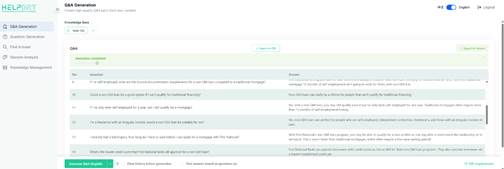
KnowForge Snapshot
34
Services and Operational Flow
We provide tailored AI contact center services to our enterprise users through our core product AI Assist, which includes specific functions such as agent assistance, QA assistance, supervisor assistance, and knowledge base assistance. Below is our operational flow chart that describes our flow of AI Assist services and operations for clients, with the entire process typically spanning from one to eight weeks. The customary implementation time-frame for a cloud-based platform takes one week, while private deployment requires four to eight weeks.
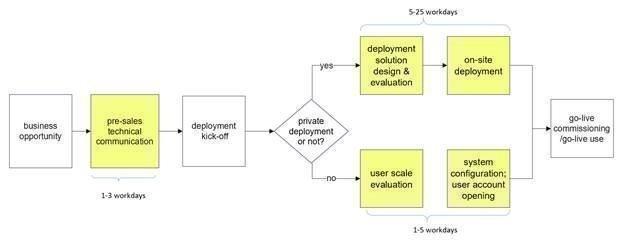
| ● | Pre-sales technical communication
The pre-sales technical communication includes discussion on product functionality, business impact, operational demonstrations, implementation feasibility assessment, and quotation proposals. |
| ● | Deployment kick-off – private deployment or cloud deployment
During this stage, we discuss implementation plans with customers. We design technical solutions for product implementation based on customer requirements; this could involve public cloud, hybrid cloud, or private deployment. Private deployment means AI Assist will be deployed locally in a customer’s contact center environment without using cloud servers. Cloud deployment means AI Assist will be deployed using cloud servers. |
35
| ● | Product Implementation
This stage follows project kick-off and before go-live commissioning/go-live use. If a customer requires private deployment of AI Assist, we will design a deployment solution and conduct evaluation procedures, followed by on-site deployment. This usually takes five to twenty-five workdays. If a customer does not require private deployment, we will conduct a user scale evaluation, followed by system configuration and user account opening. This usually takes one to five workdays. During the product implementation stage, we set up our products through “cold start”, a process consisting of initial import, configuration, and optimization of the knowledge base and the quality control library. |
| ● | Go-live commissioning/go-live use
This stage involves online testing and validation of AI Assist’s deployment by users. It also involves online training and tuning of the knowledge base after the cold start. |
AI+BPO
Launched in July 2024, our AI+BPO service offering is an AI-powered BPO service for customer contact, designed to maximize the effective utilization of our AI Assist product. For clients in need of customer engagement professionals, we offer our AI Assist product, coupled with customer contact agents. Using this model, we are able to provide our customers with a flexible solution that quickly demonstrates the efficacy of our AI software in actual customer-driven jobs/scenarios. In such outsourced business processes, our AI technology and digital platform enable real-time remote monitoring of the customer engagement professionals, compliance and quality checks of their work, and knowledge base construction to facilitate customer engagement, thereby ensuring and improving the quality of work of such outsourced professionals.
Revenue and Pricing Model
As of the date of this annual report, our primary source of revenue is generated by AI services derived from the sale of AI Assist software, which accounted for revenue of approximately $34.6 million, or 99.4% of total revenue for the fiscal year ended June 30, 2025. Our new AI+BPO service generated revenue of approximately $212,600 (0.6% of total revenue) for the same period.
AI Assist
AI Assist includes an array of software functions such as Agent Assistant, Supervisor Assistant, QA Assistant, and Knowledge Base Assistant. We primarily bill our clients using a subscription fee plus commission fee model. We bill our customers on a monthly basis for software packages chosen by customers, plus any commission fees based on task outcomes, typically negotiated to be at a rate of 7% to 15% of the Gross Service Fee (“GSF”), representing service income earned by agents who use AI Assist in delivering services. The base fee for calculating the average monthly GSF per seat is agreed upon in contracts. If the monthly GSF exceeds the agreed upon base fee, the actual service income will be used in the calculation. We usually grant our customers a credit term between 180 and 365 days. If customers demand customized development or have other special requests, we will enter into separate fee arrangements with customers, based on the type and volume of services required by such customers.
36
AI+BPO
In addition to AI Assist, we also provide AI+BPO service. For clients in need of customer engagement professionals, we offer our AI Assist product coupled with customer contact agents. Using this model, we are able to provide our customers with a flexible solution that quickly demonstrates the efficacy of our AI software in actual customer-driven jobs/scenarios. Our AI technology and digital platform enable real-time remote monitoring of the customer engagement professionals, compliance and quality checks of their work, and knowledge base construction to facilitate customer engagement, thereby ensuring and improving the quality of work of the customer contact agents.
For the fiscal year ended June 30, 2025, we had revenue of $34.86 million, and net income of $1.86 million. Among our revenue sources, the revenue generated from AI services provided under AI Assist contributed 100% for the fiscal year ended June 30, 2025. For the fiscal year ended June 30, 2024, we had revenue of $29.58 million, and net income of $7.37 million. Among our revenue sources, the revenue generated from AI services provided under AI Assist contributed 100% for the fiscal year ended June 30, 2024. For the fiscal year ended June 30, 2023, we had revenue of $12.73 million and net income of $4.81 million. Among our revenue sources, the revenue generated from AI services contributed 99.70% of our revenue for the fiscal year ended June 30, 2023, and the revenue generated from medical consulting service contributed 0.30% for the same period.
Data Privacy and Security
Helport’s AI products are deployed within the client’s exclusive IT environment and cloud infrastructure. User data, along with operational data from the contact center, is stored exclusively on the client’s servers and storage devices, and is accessible only by client’s staff. We do not access or store sensitive data beyond the client’s private environments. Certain data, such as voice stream data, requires transmission to the public cloud for voice recognition and text conversion. This data is strictly confined to the exchange between the client’s IT system and its public cloud, and we are not involved in the process. When our customer support staff operates on the client’s premises, they may engage with sensitive client data under the close supervision of client staff and, under such circumstances, support staff are required to strictly adhere to our security and privacy agreements with such clients.
Meanwhile, in order to ensure data security and compliance when clients use Helport AI products, we require all of our technology development and implementation service providers to possess high-level, client-recognized data security qualifications.
Major Supplier
To expedite the product development cycle and manage R&D costs, we rely on third-party R&D providers. Among them, we recognize Youfei Shuke as our supplier, for accounting purposes. While we recognize other third-party providers as R&D expenses, since their services have not yet reached the requirements to be classified as assets or costs supportive to generate revenue, they are not shown as suppliers in this section. We engage in collaborative development for AI training models and our products with Youfei Shuke, which also provides AI operation services to us.
37
For the AI operation services, Youfei Shuke entered into an AI Operation Service Agreement with us. The AI operation services include AI environment setup, knowledge base setup, and product enhancement. Youfei Shuke will provide AI operation service, ensure normal and stable operation of the system, and provide technical support, but it will not intervene in any transactions with users or assume any transaction responsibilities. The operation service fee is reconciled on a quarterly basis. Youfei Shuke and we have confidentiality obligations to each other. If either party breaches the agreement, the breaching party shall be liable for compensation and any related expenses, and the non-breaching party can immediately terminate the contract. The contract is valid for one year and will be automatically renewed for an additional year if either party fails to send a written notice of termination within 60 days before the expiration of the term, and the extension can be repeated indefinitely. The contract term was from the original term of January 1, 2025 to December 31, 2025.
In fiscal year ended June 30, 2025, for AI training service, Youfei Shuke entered into three AI training service agreements with us. We outsourced several development tasks to Youfei Shuke to train and develop small models applicable to different industries, improving the applicability and accuracy of AI technology. We provide business scenario requirements, while Youfei Shuke provides models, related development personnel, and underlying AI capabilities. We own intellectual property rights of the models developed. Both parties have confidentiality obligations. If either party breaches the agreement, the breaching party is liable for compensation and any related expenses, and the non-breaching party can immediately terminate the contract.
In fiscal year ended June 30, 2025, another research and development effort of the company focused on improving the fine-tuning capabilities of our large AI models, enabling them to adapt more rapidly to diverse application scenarios. Continuous feedback collection and iterative upgrades were integral parts of this development process. The development was outsourced to Youfei Shuke for ongoing updates and continuous development of products and systems. We provide business scenario requirements, while Youfei Shuke provides related development personnel, and underlying AI capabilities. We own intellectual property rights of the development. Both parties have confidentiality obligations. If either party breaches the agreement, the breaching party is liable for compensation and any related expenses, and the non-breaching party can immediately terminate the contract.
Because we do not have an operating entity or office in the PRC, and for ease and timely performance of rights and obligations, we have an Agreement of Authorization for Payment with Xinsheng, who will make payments on behalf of us to Youfei Shuke. See “ITEM 3. Key Information—D. Risk Factors—Risks Related to Helport Doing Business in the PRC—Each of our customers and suppliers has entered into an Authorization for Payment Agreement with our Singapore and U.S. operating entity and a third- party agent. Our financial condition and liquidity position may be subject to credit risks of the third-party agent.”
38
Below are the lists of our supplier for the fiscal years ended June 30, 2025, 2024, and 2023.
| ● | Fiscal year ended June 30, 2025 |
| Supplier | Purchase
Amount (USD); Percentage |
Major Contract Terms | ||
| Youfei Shuke | $31.017,078.80; 99.9% | AI Operation Service Agreement: Youfei Shuke provides AI operation service to us. The contract term was from January 1, 2025 to December 31, 2025, and was extended to December 31, 2026 by automatic renewal.
Software Asset Development Agreement:
Software assets that support the operation of revenue-generating products and services. We entered into five of such agreements with Youfei Shuke from July 2024 to June 2025. The contract terms are generally within one year and the agreements do not contain renewal provisions. | ||
Youfei Shuke |
AI Training Service Agreements:
We entered into three of such agreements with Youfei Shuke from July 2024 to June 2025. Youfei Shuke provided training, generation, updating, and data annotation services for our AI models applied to three various industries settings and scenarios. The contract terms are generally for one year from the effective date and require delivery within 6 months. The agreements do not contain renewal provisions. | |||
| Youfei Shuke | Information System Development Agreements
We entered into 21 of such agreements with Youfei Shuke from July 2024 to June 2025. Youfei Shuke was responsible for development, testing, and ultimately delivering a system product that would meet the contractual requirements. The contract terms are generally within one year and the agreements do not contain renewal provisions. |
39
| ● | Fiscal year ended June 30, 2024 |
| Supplier | Purchase
Amount (USD); Percentage |
Major Contract Terms | ||
| Youfei Shuke | $13,849,773; 100% | AI Operation Service Agreement:
Youfei Shuke provides AI operation service to us. The contract term was from March 5, 2023 to March 5, 2024, and was extended to March 5, 2025 by automatic renewal.
Seat Assistant Purchase Agreement:
Youfei Shuke and we collaborate on the development of AI Assist. The contract term is from January 4, 2022 to January 3, 2025, subject to automatic renewal if neither party raises objections upon expiration.
Hive System Purchase Agreement:
We outsource some development tasks of Helphub to Youfei Shuke. The contract term is from January 4, 2022 to January 3, 2025, subject to automatic renewal if neither party raises objections upon expiration. | ||
| Youfei Shuke | AI Training Service Agreements:
We entered into 13 of such agreements with Youfei Shuke from January 2024 to June 2024. Youfei Shuke provided training, generation, updating, and data annotation services for our AI models applied to 13 various industries settings and scenarios. The contract terms are generally for one year from the effective date and require delivery within 6 months. | |||
| Youfei Shuke | Information System Development Agreements
We entered into seven of such agreements with Youfei Shuke from January 2024 to June 2024. Youfei Shuke was responsible for requirements analysis, system design, development, testing, and ultimately delivering a system product that would meet the contractual requirements. |
40
| ● | Fiscal year ended June 30, 2023 |
| Supplier | Purchase
Amount (USD); Percentage |
Major Contract Terms | ||
| Youfei Shuke | $2,547,916; 100% | AI Operation Service Agreement:
Youfei Shuke provides AI operation service to us. The contract term was from March 6, 2022 to March 5, 2023, and is extended for one year to March 5, 2024, by automatic renewal.
Seat Assistant Purchase Agreement:
Youfei Shuke and we collaborate on the development of AI Assist. The contract term is from January 4, 2022 to January 3, 2025, subject to automatic renewal if neither party raises objections upon expiration.
Hive System Purchase Agreement:
We outsource some development tasks of Helphub to Youfei Shuke. The contract term is from January 4, 2022 to January 3, 2025, subject to automatic renewal if neither party raises objections upon expiration. |
The major factors that we evaluate when selecting suppliers are their industry experience, fee quotes, easiness of communication, and payment terms. We selected Youfei Shuke as our supplier by a comprehensive evaluation of products, services, and settlement. We maintain a long-term partnership with our supplier and rarely change it. See “ITEM 3. Key Information—D. Risk Factors—Risks Related to Our Business—Our business may rely on a primary supplier or a few customers that account for more than 10% of our total purchases. Any interruption in operations in such major clients or suppliers may have an adverse effect on our business, financial condition, and results of operations.”
41
Customers, Sales, and Marketing
As we develop our professional reputation, we believe our growth has been attributed to enterprise clients and their authorized BPO partners recommending that other enterprises and BPO companies collaborate with us because of our comprehensive tailored AI contact center services. We also maintain a sales and marketing team that actively seeks expansion of our AI contact center service client base.
Typically, we engage partnerships with enterprise clients and BPO clients via system information technology service agreements. These agreements are meant for enterprises and BPO companies aiming to enhance the automation capability and productivity of contact centers. The term of these agreements is 1 year, and if either party fails to give written notice of termination of these agreements to the other party within 60 days prior to the expiration of the term, the term of the agreements shall be automatically extended for 1 year, with no limit on the number of extensions. Because we do not have operating entity or office in the PRC and for the ease and timely performance of rights and obligations, we have a Delegated Payment Agreement with Xinsheng, which will collect payments on behalf of us from our customers. Upon the completion of the delegated collection of payment by Xinsheng, we will pay Xinsheng a service fee of 2% of the total payment amount.
During the fiscal years ended June 30, 2025, 2024, and 2023, we had 28, nine, and five customers, respectively. Our top five customers for the fiscal years ended June 30, 2025, 2024, and 2023 were all BPO companies.
For the fiscal year ended June 30, 2025, our top three customers, Baojiang, Pengbosheng, and Blue Legend represented approximately 27.5%, 25.8%, and 16.2% of our total revenue, respectively.
For the fiscal year ended June 30, 2024, our top two customers, Pengbosheng and Baojiang, represented approximately 37.5% and 26.9% of our total revenue, respectively.
For the fiscal year ended June 30, 2023, our top two customers, Pengbosheng and Baojiang, represented approximately 46.3% and 28.4% of our total revenue, respectively.
Competition
The AI contact center service industry in China and globally is both highly fragmented and intensely competitive. Companies with a robust combination of AI technologies and industry domain experience are likely to succeed in the long run. Competing in this space demands several core competencies: strong AI capabilities, contact center expertise, industry domain experience, mature business model and products.
As we serve enterprise clients and BPO clients from different sectors, we contend not only with generalist competitors but also with niche specialists who cater exclusively to specific sectors or industries. This multifaceted competition underscores the complexities inherent in the AI contact center industry in China and globally.
Our competitive position is strengthened by our tailored service approach. We believe that can effectively compete with our competitors with our services, coupled with seasoned teams that bring expertise across various sectors, giving us a distinctive edge. Furthermore, our expansive and deep-rooted business network with our enterprise users and BPO clients amplify our competitive advantage. We believe that the abovementioned factors combined give us a competitive edge in this highly fragmented industry.
42
Employees
We had 348, 52, and 23 employees as of June 30, 2025, 2024, and 2023, respectively. Specifically, we had two founders, 302 full-time employees, nine consultants, eight interns and 26 outsourced technology staff members as of June 30, 2025; five founders, 10 full-time employees, two consultants, 10 interns and 25 outsourced technology staff members as of June 30, 2024; and five founders, one full-time employee, three consultants, and 14 outsourced technology staff as of June 30, 2023. Helport manages and oversees the outsourced technology team, and is responsible for product planning, requirements, and the research and development of core algorithms. The following tables set forth the detailed number of our employees in the past three fiscal years, respectively:
| Function | Number of Employees as of June 30, 2025 | Number of Employees as of June 30, 2024 | Number of Employees as of June 30, 2023 | |||||||||
| Operation | 16 | 6 | 2 | |||||||||
| Management | 6 | 4 | 1 | |||||||||
| Research and Development* | 58 | 35 | 18 | |||||||||
| Sales and Marketing | 16 | 7 | 2 | |||||||||
| Deployment/BPO Support | 252 | |||||||||||
| Total | 348 | 52 | 23 | |||||||||
| * | This number includes our outsourced technology staff. |
Our full-time employees typically enter into standard employment contracts with us. As of the date of this annual report, we have 272 employees employed by Helport Singapore based in the Philippines, six employees employed by Helport Singapore based in Singapore, 15 employees employed by Helport Singapore based in the PRC, two employees employed by Helport AI Limited, and 27 employees employed by Helport AI, Inc primarily based in the U.S.
As provided under Singapore’s laws and regulations, employees working in Singapore and who are either Singapore citizens or Singapore permanent residents are, along with their employer, required to contribute to the Central Provident Fund (“CPF”). The CPF is a mandatory social security savings scheme funded by contributions from employers and employees in Singapore. As of the date of this annual report, Helport Singapore has paid all due CPF contributions in respect of its employees based in Singapore, except for the June 2025 contribution, which was paid on July 25, 2025, as required under Singaporean laws and regulations. Helport Singapore is not required to pay CPF contributions in respect of its employees based in the Philippines.
We believe that we maintain a good working relationship with our employees, and we have not experienced material labor disputes in the past. None of our employees are represented by labor unions.
Insurance
As of the date of this annual report, we have maintained director liability insurance since August 2, 2024, Helport Singapore has purchased employee health insurance for our full-time employees in Singapore, and Helport U.S. has purchased Business Owner Policy, which protects its business from risks such as property damage, liability claims, and business interruptions. Helport U.S. has also purchased workers’ compensation insurance, which covers work-related injuries or illnesses of employees.
We believe that we are covered by adequate insurance policies. As of the date of this annual report, we have not made any material insurance claims in relation to our business. Our management evaluates the adequacy of our insurance coverage from time to time and may purchase additional insurance policies as needed. However, there is no assurance that our insurance coverage will be adequate to cover all losses that may occur.
43
Property
As of the date of this annual report, we lease six offices which are located in Singapore, the Philippines, the U.S., Thailand, Indonesia, and Mexico, with an aggregate gross floor area of approximately 35,559 square feet. The areas of the leased premises are based on the figures specified in the corresponding lease agreements or estimated based on the actual usage area of shared office spaces. The following table shows notable information for the properties we lease as of the date of this annual report:
| Location | Area (Square Feet) |
Current Use | Term of Use | Annual Rent | ||||
| 9 Temasek Boulevard #07-00 Suntec Tower Two Singapore (038989) | 753 | Office | March 28, 2025 to April 15, 2026 |
SGD 68,670 | ||||
| 23rd Floor Office A and
Office B, IBM Plaza Building, Eastwood City Cyberpark, 188 E. Rodriguez Jr. Avenue, Bagumbayan, Quezon City, Philippines |
14,316 | Office | February 16, 2025 to October 15, 2030 |
Average PHP 5.93m | ||||
| 9171 Towne Centre Dr., Ste 335, San Diego, CA 92122, United States | 3,326 | Office | October 1, 2024 to September 30, 2029 | Average USD 142,000 | ||||
| 66 Tower, Level 24, Unit 2402-2404, 2556 Sukhumvit Rd, Bang Na Nuea, Bang Na, Bangkok 10260 | 5,253 | Office | September 1, 2025 until August 31, 2028 |
THB 3.81m | ||||
| Jl. Kyai Tapa No.1, RT.10/RW.10, Tomang, Kec. Grogol petamburan, Kota Jakarta Barat, Daerah Khusus Ibukota Jakarta 11440 | 2,051 | Office | August 1, 2025 to July 31, 2026 | IDR 171.45m | ||||
| Paseo de la Reforma 93, Colonia Tabacalera, Alcaldía Cuauhtémoc, Mexico City | 9,860
|
Office | October 10, 2025 until December 10, 2028 |
USD 234,000 |
We believe that the facilities that we currently lease are generally adequate to meet our needs for the foreseeable future.
R&D
Our R&D plan is to add and improve functionalities of our existing products.
In the fiscal years ended June 30, 2023, 2024, and 2025, we co-developed AI Assist and other products. We developed the following technologies that bring us competitive advantages in the industry:
| I. | Real-time QA technology, which solves the technical problem of large-scale concurrent real-time QA for more than 1000 seats, and realized the commercialization of real-time QA for large contact centers for the first time; |
| II. | List matching enhancement technology, which optimizes the list distribution mechanism and improves the conversion rate by 5%-10%; |
| III. | The technology knowhow that is not patented and kept secret from the public - the knowledge base and algorithmic model that improves agent performance; and |
| IV. | HyperX, a SaaS platform for businesses and professionals that transforms stored knowledge into intelligent services by using expert knowledge replication, communication style modeling, and automated agent deployment, to build high-quality private AI agents in three hours. |
44
In the fiscal year ended June 30, 2025, we developed and trained small models across various industry settings to enhance the applicability and accuracy of our AI technology. This involved collecting industry-specific data, performing preprocessing, and annotation tasks. We then tested and validated the small models through training, optimizing their performance and improving accuracy and efficiency.
In the fiscal year ended June 30, 2025, another research and development effort focused on improving the fine-tuning capabilities of our large AI models, enabling them to adapt more rapidly to diverse application scenarios. Continuous feedback collection and iterative upgrades were integral parts of this development process.
As of the date of this annual report, our R&D team consists of 58 members, among whom 36 are engaged in AI operations and 22 work in product development. The labor contracts of 21 employees in the R&D team have been executed with Youfei Shuke. Our R&D team is primarily responsible for developing new products and enhancing the functionalities of existing ones. Youfei Shuke provides technical research support on a project-by-project basis. We retain full intellectual property rights to any creations or inventions developed resulting from such agreements. Our R&D engineers possess extensive experience in operations research, AI, machine learning, and natural language processing, and their efforts have resulted in two patents currently under the application review process in Singapore related to various AI contact center technologies.
Our new technology development process usually begins with internal business planning, client requirements analysis, and initial research and design. Subsequently, we choose and collaborate with third-party R&D service providers on the development of specific technologies. Typically, Helport puts forward business and technical requirements, whereas the vendors are responsible for product development. Throughout the entire process, Helport actively participates in and leads the entire research and development efforts.
Our R&D department actively collaborates with our sales and marketing department, and the operation department to gather market intelligence for different segments, enhancing our understanding and response to market trends and changing consumer preferences.
Our recent research direction is the application of voice AI technology in contact center scenarios. This research project includes the following focuses:
| 1. | Speech recognition and conversion: This technology can convert customers’ voice information into text for subsequent processing and analysis. |
| 2. | Semantic understanding and analysis: Through the understanding and analysis of voice information, this technology can identify customers’ needs and intentions, and the types of services to be provided. |
| 3. | Speech synthesis and generation: This technology can convert text information into speech for automatic broadcasting, voice reminders, and other functions. |
| 4. | Emotional analysis and recognition: This technology utilizes natural language processing and machine learning methods to analyze features such as vocabulary, grammar, and intonation in text and speech. This enables the identification of customer emotional states, including happiness, anger, and sadness, and provides a more accurate understanding of customer emotions for contact centers. |
These are the Company’s core competitive field, and the Company has accumulation and resources in relevant contact center technology and scenarios.
In the fiscal years 2023, 2024, and 2025, our research and development costs were US$375,410, US$4,303,490, and US$6,316,962, respectively, accounting for 18.3%, 48.6%, and 38.6% of our total operating costs.
45
Intellectual Property
Patent Information
As of the date of this annual report, we have two pending patent applications in Singapore:
| Title | Patent Owner | Application Number | Application Date | Jurisdiction | ||||
| Method and System for Real Time Recommendation | Helport Singapore | 10202302918P | 10/23/2023 | Singapore | ||||
| A System for and Method of Constructing A Response Knowledge Base | Helport Singapore | 10202500892T | 04/02/2025 | Singapore |
These applications are being processed. Six patent applications disclosed in our annual report for the fiscal year ended June 30, 2024 have been withdrawn, and we are preparing to resubmit those applications in the U.S.
Domain Name
As of the date of this annual report, we have one registered domain name as follows:
| Domain Name | Date of Registration | Date of Expiration | Domain Holder | Jurisdiction | ||||
| Helport.ai | 8/31/2023 | August 31, 2025 | Helport | USA |
As of the date of this annual report, we have 35 staff employees that are responsible for research and development and developing our intellectual property.
We implement a set of comprehensive measures to protect our intellectual properties, in addition to making trademark and patent registration applications. Key measures include: (i) timely registration, filing, and application for ownership of our intellectual properties, (ii) actively tracking the registration and authorization status of intellectual properties and taking action in a timely manner if any potential conflicts with our intellectual properties are identified, and (iii) clearly stating all rights and obligations regarding the ownership and protection of intellectual properties in all employment contracts and commercial contracts we enter into.
As of the date of this annual report, we have not been subject to any material disputes or claims for infringement upon third parties’ trademarks, licenses, and other intellectual property rights.
Seasonality
Our business is not subject to obvious seasonal fluctuations.
Legal Proceedings
From time to time, we may become a party to various legal or administrative proceedings arising in the ordinary course of our business, including actions with respect to intellectual property infringement, violation of third-party licenses or other rights, breach of contract, and labor and employment claims. We are currently not a party to, and we are not aware of any threat of, any legal or administrative proceeding that, in the opinion of our management, is likely to have any material and adverse effect on our business, financial condition, cash flow, or results of operations.
46
C. Organizational Structure
Upon consummation of the Business Combination, Helport and Tristar became a wholly owned subsidiary of Helport AI. The following simplified diagram illustrates the ownership structure of Helport AI.
Unless otherwise noted, all entities are British Virgin Islands companies.
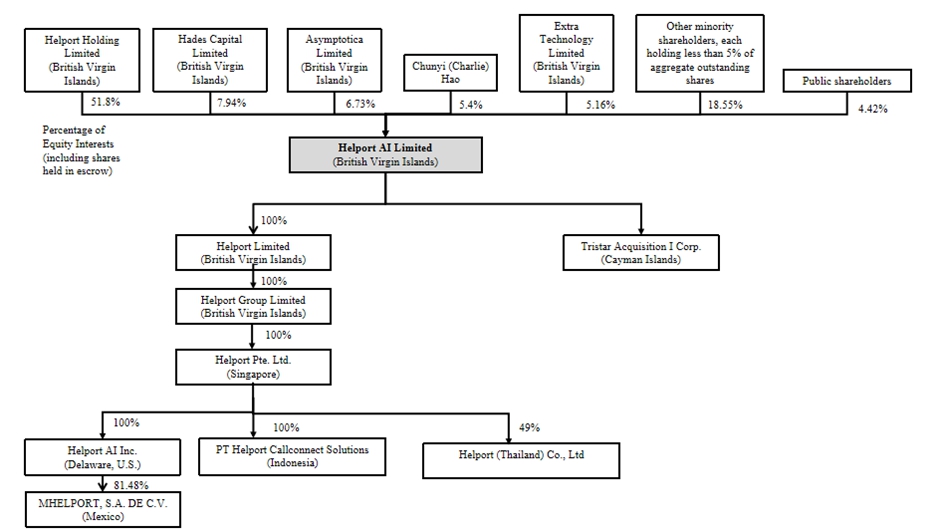
D. Property, Plants and Equipment
Helport leases the property for its dual principal executive offices, which are located at both 9 Temasek Boulevard #07-00 Suntec Tower Two, Singapore 038989, and 9171 Towne Centre Dr., Ste 335, San Diego, CA 92122, United States. In addition, Helport leases one office of 14,316 square feet in the Philippines, one office of 5,253 square feet in Thailand, one office of 2,051 square feet in Indonesia, and one office of 9,860 square feet in Mexico. Such properties are described herein in the section entitled “ITEM 4. Information of the Company — Business Overview” and are incorporated herein by reference.
ITEM 4A. UNRESOLVED STAFF COMMENTS
Not applicable.
47
ITEM 5. OPERATING AND FINANCIAL REVIEW AND PROSPECTS
We conduct business through Helport and its subsidiaries. You should read the following discussion and analysis of the financial condition and results of operations of Helport in conjunction with its consolidated financial statements and the related notes included elsewhere in this annual report. This discussion contains forward-looking statements that involve risks and uncertainties about our business and operations. The actual results of Helport and the timing of selected events may differ materially from those anticipated in these forward-looking statements as a result of various factors, including those we describe under “ITEM 3. Key Information—D. Risk Factors” and elsewhere in this annual report.
Overview
We are a global technology company serving enterprise clients with intelligent customer communication software and services. Our flagship software, AI Assist, is a real-time, AI-driven “co-pilot” providing intelligent guidance for customer contact professionals across industries such as banking, insurance, mortgage, and consumer financing. Our AI+BPO service model combines our AI software with our in-house customer contact agents, designed for rapid AI deployment and improved operational and economic efficiency for our clients.
For the fiscal years ended June 30, 2025, 2024, and 2023, we had revenue of US$34.86 million, US$29.58 million, and US$12.73 million, respectively, and net income of US$1.86 million, US$7.37 million, and US$4.81 million, respectively. Among our revenue sources, the revenue generated from AI services provided under AI Assist contributed 99.39%, 100.00%, and 99.70% for the fiscal years ended June 30, 2025, 2024, and 2023, respectively; the revenue generated from the medical consulting service contributed nil, nil, and 0.30%, respectively, for such fiscal years; and the revenue generated from AI+BPO service contributed 0.61%, nil, and nil, respectively, for such fiscal years.
We believe we have been able to distinguish ourselves in the AI integrated contact center business via our proprietary AI technologies, such as real-time communication assistance, real-time sales guidance, real-time quality assurance, knowledge base construction, knowledge base script generalization, real-time voice interaction, language simulation, and more. We utilize cloud computing infrastructure providers, AI technology service providers, and telecom operators to develop and operate our products. These infrastructure service providers offer IaaS and PaaS, upon which we build SaaS products such as AI Assist.
Quality is of utmost importance in the products and services we provide. We implement strict quality control in our R&D investment activities, and in our strategic collaboration with Youfei Shuke. Under the collaborative framework, Youfei Shuke provides operational support and maintenance in accordance with our business requirements to ensure the reliability and stability of software developed.
General Factors Affecting Our Results of Operations
The demand for our AI technology services serving enterprises’ customer contact centers is affected by various general factors, including (1) the macroeconomic conditions in China, our largest customer market, and the growth of the global AI technology markets; (2) customer acceptance and penetration rate of AI technologies application in various business scenarios; and (3) government policies and regulations on the development and application of AI technologies, as well as user data privacy and security. Changes in any of these general industry conditions could affect our business and results of operations.
Specific Factors Affecting Our Results of Operations
In addition to the general factors aforementioned, our business and results of operations are also affected by specific factors, including the following major factors:
Our ability to retain existing customers and consolidate our leader position in the AI contact center industry
The direct customers of Helport are BPO firms such as Pengbosheng and Baojiang, not banks or insurance companies. Banking, insurance, and Internet are the main industries in which AI Assist operate. Presently, through our BPO customers, our products are deployed with enterprises across those diverse industries, such as banking and insurance. We plan to grow our business by initiating sales to existing end users directly when they increase the size of their existing contact centers or decide to establish new contact centers, making sales by way of word-of-mouth referrals from existing users, participating in bidding, industry forums and seminars, and developing strategic cooperation to leverage partner relationships and brand influence. This strategy will allow us to sustain our engagement with existing BPO customers and enterprise users, and at the same time will enable us to enter new markets and foster partnerships with enterprise from banking, insurance and Internet sectors.
48
Our ability to expand in the BPO market and grow our customer base
We intend to work with small and medium-sized businesses, particularly those located in North America and Southeast Asia, to expand our customer base for our AI+BPO business line. We plan to concentrate on high-value verticals, such as insurance, mortgage, and consumer financing and develop industry-specific tools and expertise that will allow us to maintain a competitive advantage within these sectors. We expect to continue to grow our sales teams in these markets to drive new customer signings that translate into more seats/agents for our in-house AI+BPO operations.
Our ability to differentiate in products and services offerings with competitive technology
Competition in the AI technology service industry is intense and rapidly evolving. We believe technological advances are shaping higher customer expectations for intelligent integrated solutions and solution response speed. Our ability to continuously improve and optimize user experience will be an important contributor to our future revenue growth. We plan to continue focusing our research and development efforts on enhancing the product functions of our AI contact center solutions, including real-time communication assistance, real-time sales guidance, intelligent monitoring of agent conversations, and optimal agent behavior profiling. Meanwhile, we will also collect and leverage industry expertise and scenario-specific knowhow to constantly empower our professional knowledge base. We expect increasing R&D investment activities in the future with an aim to enhance our technological competitive strengths, so as to differentiate in products and services offerings.
Our ability to control costs and expenses and enhance operational efficiency
Our results of operations have been, and will continue to be, affected by our ability to control costs and expenses and enhance our operational efficiency. Cost-effectiveness is the key to our operational management and profitability. General and administrative expenses have historically represented a large portion of our total costs and expenses, consisting primarily of professional services fees paid to third parties for listing preparations. Research and development expenses, along with selling expenses, are becoming important components of our costs. As our business grows, we aim to further improve our operational efficiency by developing technologies and infrastructure across different business functions. We expect to achieve greater operating leverage and increase the productivity of our personnel, which would allow us to acquire customers and suppliers more cost-effectively and achieve higher operational efficiency.
Key Components of Results of Operations
Revenues
We generate revenues from (i) AI service; (ii) AI+BPO service; and (iii) medical consulting service. For the fiscal years ended June 30, 2025, 2024, and 2023, our revenues were US$34,856,807, US$29,575,625, and US$12,728,313, respectively. Since the commencement of AI service in April 2022, we have been dedicated to offering enterprise customers services including system functional modules, efficiency management service, custom development service and operation outsourcing services in the form of our integrated AI service tools, AI Assist. We further expanded our service portfolio in January 2025 with the launch of our AI+BPO service. We provided medical consulting service to customers occasionally during fiscal year 2023, which contributed a small percentage of our total revenue and was discontinued in January 2023.
Cost of revenues
Our cost of revenues primarily consists of (i) amortization of software; (ii) outsourced operation costs; (iii) server costs; and (iv) payroll costs. For the fiscal years ended June 30, 2025, 2024, and 2023, our cost of revenues were US$15,732,419, US$10,998,011, and US$4,882,792, respectively.
Selling expenses
Our selling expenses mainly consist of payroll expense, share-based compensation expense related to selling and marketing functions, marketing and promotion expense, etc. For the fiscal years ended June 30, 2025, 2024, and 2023, our selling expenses were US$1,152,197, US$97,984, and US$50,830, respectively. We expect our selling expenses will also continue to increase in absolute amount as we diversify, optimize and leverage our marketing channels to expand user community and explore more potential customers.
49
General and administrative expenses
Our general and administrative expenses mainly consist of withholding tax, professional service fees, share-based compensation expense related to general and administrative functions, payroll expense, insurance expense, rental expense, and other office miscellaneous fees. For the fiscal years ended June 30, 2025, 2024, and 2023, our general and administrative expenses were US$8,907,597, US$4,979,382, and US$1,625,887, respectively. We expect that our general and administrative expenses will continue to increase in absolute amount in the foreseeable future as we further grow our existing business lines. We also seek to optimize the cost structure of our company to control the relative level of general and administrative expenses as percentage of our revenues.
Research and development expenses
Our R&D expenses primarily consist of product development fees, AI training service fees, payroll expense, and technology service fees paid to external consultant. For the fiscal years ended June 30, 2025, 2024, and 2023, our research and development expenses were US$6,316,962, US$4,303,490, and US$375,410, respectively. We believe that our continued investment in research and development is critical to our growth and expect that our research and development expenses will continue to increase in absolute amount as we seek to upgrade our technologies to support our business growth.
Financial expenses, net
Our financial expenses, net primarily consist of interest expenses, net, bank service charges, and foreign exchange gain or loss.
Results of Operations
The following tables set forth a summary of our consolidated results of operations for the fiscal years ended June 30, 2025, 2024, and 2023, in absolute amount and as a percentage of our revenues. This information should be read together with our consolidated financial statements and related notes included elsewhere in this annual report. The results of operations in any period are not necessarily indicative of the results that may be expected for any future period.
| For the fiscal years ended June 30, | ||||||||||||||||||||||||
| 2025 | 2024 | FY2023 | ||||||||||||||||||||||
| US$ | % | US$ | % | US$ | % | |||||||||||||||||||
| Revenues | 34,856,807 | 100.00 | 29,575,625 | 100.00 | 12,728,313 | 100.00 | ||||||||||||||||||
| Cost of revenues | (15,732,419 | ) | (45.13 | ) | (10,998,011 | ) | (37.19 | ) | (4,882,792 | ) | (38.36 | ) | ||||||||||||
| Gross profit | 19,124,388 | 54.87 | 18,577,614 | 62.81 | 7,845,521 | 61.64 | ||||||||||||||||||
| Operating expenses: | ||||||||||||||||||||||||
| Selling expenses | (1,152,197 | ) | (3.31 | ) | (97,984 | ) | (0.33 | ) | (50,830 | ) | (0.40 | ) | ||||||||||||
| General and administrative expenses | (8,907,597 | ) | (25.55 | ) | (4,979,382 | ) | (16.84 | ) | (1,625,887 | ) | (12.77 | ) | ||||||||||||
| Research and development expenses | (6,316,962 | ) | (18.12 | ) | (4,303,490 | ) | (14.55 | ) | (375,410 | ) | (2.95 | ) | ||||||||||||
| Total operating expenses | (16,376,756 | ) | (46.98 | ) | (9,380,856 | ) | (31.72 | ) | (2,052,127 | ) | (16.12 | ) | ||||||||||||
| Operating income | 2,747,632 | 7.89 | 9,196,758 | 31.09 | 5,793,394 | 45.52 | ||||||||||||||||||
| Financial expenses, net | (112,311 | ) | (0.32 | ) | (226,713 | ) | (0.77 | ) | (7,936 | ) | (0.06 | ) | ||||||||||||
| Other income, net | (1,550 | ) | - | 1,007 | - | - | - | |||||||||||||||||
| Change in fair value of warrant liability | (237,055 | ) | (0.68 | ) | - | - | - | - | ||||||||||||||||
| Income before income tax expense | 2,396,716 | 6.89 | 8,971,052 | 30.32 | 5,785,458 | 45.46 | ||||||||||||||||||
| Income tax expense | (538,146 | ) | (1.54 | ) | (1,601,933 | ) | (5.42 | ) | (970,755 | ) | (7.63 | ) | ||||||||||||
| Net income | 1,858,570 | 5.35 | 7,369,119 | 24.90 | 4,814,703 | 37.83 | ||||||||||||||||||
50
Use of Non-GAAP Financial Measures
We consider adjusted net income, a non-GAAP financial measure, as a supplemental measure to review and assess our operating performance. We define adjusted net income for a specific period as net income in the same period excluding share-based compensation expenses and changes in fair value of warrant liabilities.
We present this non-GAAP financial measure because it is used by our management to evaluate our operating performance and formulate business plans. Accordingly, we believe that adjusted net income helps identify underlying trends in our business that could otherwise be distorted by the effect of certain expenses that are included in net income and certain expenses that are not expected to result in future cash payments or that are non-recurring in nature. We also believe that the use of the non-GAAP financial measure facilitates investors’ assessment of our operating performance, enhances the overall understanding of our past performance and future prospects and allows for greater visibility with respect to key metrics used by our management in its financial and operational decision making.
The non-GAAP financial measure should not be considered in isolation from or construed as an alternative to its most directly comparable financial measure prepared in accordance with GAAP. Investors are encouraged to review the historical non-GAAP financial measure in reconciliation to its most directly comparable GAAP financial measure. As the non-GAAP financial measure has material limitations as an analytical metric and may not be calculated in the same manner by all companies, such measure may not be comparable to other similarly titled measure used by other companies. In light of the foregoing limitations, you should not consider the non-GAAP financial measure as a substitute for, or superior to, its most directly comparable financial measure prepared in accordance with GAAP. We encourage investors and others to review our financial information in its entirety and not rely on a single financial measure.
The following table reconciles our adjusted net income for the periods indicated to the most directly comparable financial measure calculated and presented in accordance with U.S. GAAP, which is net income.
| For the fiscal years ended June 30, | ||||||||||||
| 2025 | 2024 | 2023 | ||||||||||
| US$ | US$ | US$ | ||||||||||
| Net income | 1,858,570 | 7,369,119 | 4,814,703 | |||||||||
| Add: | ||||||||||||
| Share-based compensation expenses | 584,150 | - | - | |||||||||
| Change in fair value of warrant liabilities | 237,055 | - | - | |||||||||
| Total | 2,679,775 | 7,369,119 | 4,814,703 | |||||||||
Comparison of Fiscal Years Ended June 30, 2025 and 2024
Revenues
Our revenues increased by approximately US$5.28 million, or 17.86%, from US$29.58 million for the fiscal year ended June 30, 2024 to US$34.86 million for the fiscal year ended June 30, 2025. The following table sets forth a breakdown of our revenues, each expressed in the absolute amount and as a percentage of our total revenues, for the periods indicated.
| For the fiscal years ended June 30, | Variance | |||||||||||||||||||||||
| 2025 | 2024 | Amount | Percentage | |||||||||||||||||||||
| US$ | % | US$ | % | US$ | % | |||||||||||||||||||
| Revenues: | ||||||||||||||||||||||||
| AI service | 34,644,203 | 99.39 | 29,575,625 | 100.00 | 5,068,578 | 17.14 | ||||||||||||||||||
| AI+BPO service | 212,604 | 0.61 | - | - | 212,604 | N/A | ||||||||||||||||||
| Total revenues | 34,856,807 | 100.00 | 29,575,625 | 100.00 | 5,281,182 | 17.86 | ||||||||||||||||||
| * | N/A represents non-applicable |
51
Revenues from AI service increased by approximately US$5.07 million, or 17.14%, from US$29.58 million for the fiscal year ended June 30, 2024 to US$34.64 million for the fiscal year ended June 30, 2025. Since January 2025, we have refined our settlement terms, in which the basis for settlement has been revised from subscribed seats to subscribed users, with a corresponding adjustment to the unit sales price. The revenue growth was primarily driven by the in-depth expansion of our core customer base: six key customers recorded positive growth in user numbers, with two top-tier customers achieving a growth rate exceeding 50%. The increase in average monthly subscribed users was driven by (i) our efforts in continuous optimization and development in our service offerings and software platform, (ii) our abilities to improve overall cost performance for customers in their business management process, and (iii) the growing demand for AI software in the professional technology services market. During the fiscal year ended June 30, 2025, we entered the U.S. market and secured several customers.
Since January 2025, we further expanded our service portfolio with the launch of our AI+BPO service and for the fiscal year ended June 30, 2025, revenue generated from AI+BPO service was US$212,604.
Cost of revenues
Our cost of revenues increased by approximately US$4.73 million, or 43.05%, from US$11.00 million for the fiscal year ended June 30, 2024 to US$15.73 million for the fiscal year ended June 30, 2025. The following table sets forth a breakdown of our cost of revenues by revenue streams, expressed as an absolute amount and as a percentage of the total cost of revenues, for the periods indicated.
| For the fiscal years ended June 30, | Variance | |||||||||||||||||||||||
| 2025 | 2024 | Amount | Percentage | |||||||||||||||||||||
| US$ | % | US$ | % | US$ | % | |||||||||||||||||||
| Cost of revenues: | ||||||||||||||||||||||||
| AI service | 15,544,983 | 98.81 | 10,998,011 | 100.00 | 4,546,972 | 41.34 | ||||||||||||||||||
| AI+BPO service | 187,436 | 1.19 | - | - | 187,436 | N/A | ||||||||||||||||||
| Total cost of revenues | 15,732,419 | 100.00 | 10,998,011 | 100.00 | 4,734,408 | 43.05 | ||||||||||||||||||
| * | N/A represents non-applicable |
Cost of revenues related to AI services increased by approximately US$4.55 million, or 41.34%, from US$11.00 million for the fiscal year ended June 30, 2024 to US$15.54 million for the fiscal year ended June 30, 2025, mainly due to the corresponding rise in outsourced operation costs as revenue increased. The growth rate of cost of revenue is proportionally higher than that of revenue, primarily driven by the increased amortization of software, a fixed cost, resulting from our higher investments in software to serve new markets and application scenarios. These investments enable us to enhance our product and service offerings with differentiated, competitive technology, particularly through the development of industry-specific application scenarios. These tailored solutions are essential for entering new sectors such as insurance, mortgage sales, and government services, as well as for localizing our platform to meet the regulatory and operational demands of new geographic regions like North America and Southeast Asia.
Cost of revenues related to AI+BPO services were US$187,436 and nil for the fiscal years ended June 30, 2025 and 2024, respectively.
52
Gross profit and margin
The following table sets forth a breakdown of our gross profit, margin by revenue streams, expressed as an absolute amount and as a percentage of the total gross profit for the periods indicated.
| For the fiscal years ended June 30, | ||||||||||||||||||||||||
| 2025 | 2024 | |||||||||||||||||||||||
| US$ | Margin | % | US$ | Margin | % | |||||||||||||||||||
| Gross profit and margin: | ||||||||||||||||||||||||
| AI service | 19,099,220 | 55.13 | 99.87 | 18,577,614 | 62.81 | 100.00 | ||||||||||||||||||
| AI+BPO service | 25,168 | 11.84 | 0.13 | - | - | - | ||||||||||||||||||
| Total | 19,124,388 | 54.87 | 100.00 | 18,577,614 | 62.81 | 100.00 | ||||||||||||||||||
We recorded a gross profit of US$19.12 million and US$18.58 million for the fiscal years ended June 30, 2025 and 2024, respectively. This reduction of gross profit margin from 62.81% to 54.87% is the result of the aforementioned elevated amortization costs from software and increased outsourcing of operation fees, which we believe are necessary for our future growth and profitability.
Operating expenses
Our operating expenses increased from US$9.38 million for the fiscal year ended June 30, 2024 to US$16.38 million for the fiscal year ended June 30, 2025, representing a year-over-year increase of 74.58%.
Selling expenses
The following table sets forth a breakdown of our selling expenses by categories, expressed as an absolute amount and as a percentage of the total selling expenses, for the periods indicated.
| For the fiscal years ended June 30, | Variance | |||||||||||||||||||||||
| 2025 | 2024 | Amount | Percentage | |||||||||||||||||||||
| US$ | % | US$ | % | US$ | % | |||||||||||||||||||
| Selling expenses: | ||||||||||||||||||||||||
| Payroll expense | 831,341 | 72.15 | 90,394 | 92.25 | 740,947 | 819.69 | ||||||||||||||||||
| Share-based compensation expense | 180,800 | 15.69 | - | - | 180,800 | N/A | ||||||||||||||||||
| Marketing expense | 80,218 | 6.96 | 7,590 | 7.75 | 72,628 | 956.89 | ||||||||||||||||||
| Other selling expense | 59,838 | 5.20 | - | - | 59,838 | N/A | ||||||||||||||||||
| Total selling expenses | 1,152,197 | 100.00 | 97,984 | 100.00 | 1,054,213 | 1,075.90 | ||||||||||||||||||
| * | N/A represents non-applicable |
Our selling expenses increased from US$97,984 for the fiscal year ended June 30, 2024 to US$1.15 million for the fiscal year ended June 30, 2025, which was mainly due to (i) an increase of payroll expenses of US$0.74 million, primarily driven by the establishment and ramp-up of dedicated sales and marketing teams in our U.S. subsidiary and Philippines office; and (ii) an increase of share-based compensation expense of US$0.18 million, resulting from share grants under the Company’s 2024 Equity Incentive Plan. The U.S. team expansion is part of our broader international growth strategy, aimed at strengthening our presence in North America, a key strategic market. As part of this effort, we expanded our U.S. office presence, increasing headcount to support go-to-market execution, client onboarding, business development, and marketing in the region. In February 2024, we established the U.S. team, and by June 2025, it had expanded to 27 staff, among whom 11 were engaged in selling and marketing activities.
53
General and administrative expenses
The following table sets forth a breakdown of our general and administrative expenses by categories, expressed as an absolute amount and as a percentage of the total general and administrative expenses, for the periods indicated.
| For the fiscal years ended June 30, | Variance | |||||||||||||||||||||||
| 2025 | 2024 | Amount | Percentage | |||||||||||||||||||||
| US$ | % | US$ | % | US$ | % | |||||||||||||||||||
| General and administrative expenses: | ||||||||||||||||||||||||
| Withholding tax | 3,462,049 | 38.87 | 2,957,562 | 59.40 | 504,487 | 17.06 | ||||||||||||||||||
| Professional service fees | 3,133,494 | 35.18 | 1,388,585 | 27.89 | 1,744,909 | 125.66 | ||||||||||||||||||
| Share-based compensation expense | 403,350 | 4.53 | - | - | 403,350 | N/A | ||||||||||||||||||
| Payroll expense | 789,279 | 8.86 | 255,394 | 5.13 | 533,885 | 209.04 | ||||||||||||||||||
| Insurance expense | 400,187 | 4.49 | 3,142 | 0.06 | 397,045 | 12,636.70 | ||||||||||||||||||
| Rental expense | 225,554 | 2.53 | 130,853 | 2.63 | 94,701 | 72.37 | ||||||||||||||||||
| Other office fees | 493,684 | 5.54 | 243,846 | 4.89 | 249,838 | 102.46 | ||||||||||||||||||
| Total general and administrative expenses | 8,907,597 | 100.00 | 4,979,382 | 100.00 | 3,928,215 | 78.89 | ||||||||||||||||||
| * | N/A represents non-applicable |
Our general and administrative expenses increased by 78.89% from US$4.98 million for the fiscal year ended June 30, 2024 to US$8.91 million for the fiscal year ended June 30, 2025, which was primarily attributable to (i) an increase of US$1.74 million in professional service fees, such as advisory fees, audit fees, and legal fees associated with the Closing of the Business Combination in August 2024, (ii) an increase of US$0.53 million in payroll expenses resulting from the expansion of the management team’s headcount, (iii) an increase of US$0.5 million in withholding tax incurred from 10% withholding tax on AI services provided to our customers in China, (iv) an increase of share-based compensation expense of US$0.40 million to award the core employee and executives as well as certain strategic external consultants, and (v) an increase of US$0.40 million in insurance expenses.
Research and development expenses
The following table sets forth a breakdown of our research and development expenses by categories, expressed as an absolute amount and as a percentage of the total research and development expenses, for the periods indicated.
| For the fiscal years ended June 30, | Variance | |||||||||||||||||||||||
| 2025 | 2024 | Amount | Percentage | |||||||||||||||||||||
| US$ | % | US$ | % | US$ | % | |||||||||||||||||||
| Research and development expenses | ||||||||||||||||||||||||
| Product development fees | 4,415,000 | 69.89 | 828,000 | 19.24 | 3,587,000 | 433.21 | ||||||||||||||||||
| Technology service consulting fees | 901,917 | 14.28 | 92,090 | 2.14 | 809,827 | 879.39 | ||||||||||||||||||
| AI training service fees | 807,700 | 12.79 | 3,383,400 | 78.62 | (2,575,700 | ) | (76.13 | ) | ||||||||||||||||
| Other expenses | 192,345 | 3.04 | - | - | 192,345 | N/A | ||||||||||||||||||
| Total research and development expenses | 6,316,962 | 100.00 | 4,303,490 | 100.00 | 2,013,472 | 46.79 | ||||||||||||||||||
| * | N/A represents non-applicable |
Our research and development expenses increased by US$2.01 million from US$4.30 million for the fiscal year ended June 30, 2024 to US$6.32 million for the fiscal year ended June 30, 2025. The increase was attributable to (i) an increase of US$3.59 million in product development fees, allowing us to better differentiate and diversify our product and service offerings with competitive technologies, (ii) an increase of US$0.81 million in technology service consulting fees for further improvement in our system development and platform optimization, and offset by a decrease of US$2.58 million in AI training service fees, as the AI model development during the fiscal year ended June 30, 2024 had already met short-term application scenarios, thereby reducing the related service fees.
54
Financial expenses, net
Our financial expenses, net decreased from US$0.23 million in financial expenses, net for the fiscal year ended June 30, 2024 to US$0.11 million for the fiscal year ended June 30, 2025, which was primarily attributable to a decrease of US$0.07 million in interest expenses accrued for convertible promissory notes, which were automatically converted into the Ordinary Shares of the Company on August 2, 2024, and a decrease of US$0.06 million in foreign exchange gain.
Income tax expense
As a result of our operating income position for the fiscal years ended June 30, 2025 and 2024, we incurred income tax expense of US$0.54 million and US$1.60 million for such fiscal years, respectively.
Net income
As a result of the foregoing, our net income decreased by US$5.51 million from US$7.37 million for the fiscal year ended June 30, 2024 to US$1.86 million for the year ended June 30, 2025.
Comparison of Fiscal Years Ended June 30, 2024 and 2023
Revenues
Our revenues increased by approximately US$16.85 million, or 132.36%, from US$12.73 million for the fiscal year ended June 30, 2023 to US$29.58 million for the fiscal year ended June 30, 2024. The following table sets forth a breakdown of our revenues, each expressed in the absolute amount and as a percentage of our total revenues, for the periods indicated.
| For the fiscal years ended June 30, | Variance | |||||||||||||||||||||||
| FY2024 | FY2023 | Amount | Percentage | |||||||||||||||||||||
| US$ | % | US$ | % | US$ | % | |||||||||||||||||||
| Revenues: | ||||||||||||||||||||||||
| AI service | 29,575,625 | 100.00 | 12,689,750 | 99.70 | 16,885,875 | 133.07 | ||||||||||||||||||
| Medical consulting service | - | - | 38,563 | 0.30 | (38,563 | ) | (100.00 | ) | ||||||||||||||||
| Total revenues | 29,575,625 | 100.00 | 12,728,313 | 100.00 | 16,847,312 | 132.36 | ||||||||||||||||||
Revenues from AI service increased by approximately US$16.89 million, or 133.07%, from US$12.69 million for the fiscal year ended June 30, 2023 to US$29.58 million for the fiscal year ended June 30, 2024. The significant increase was primarily attributable to the average monthly subscribed seats increased from 2,192 for the fiscal year ended June 30, 2023 to 5,475 for the fiscal year ended June 30, 2024, which was driven by (i) our efforts in continuous optimization and development in our service offerings and platform, (ii) our capabilities to increase overall cost performance for customers in their business management process, and (iii) the growing demands in professional technology services market.
55
Cost of revenues
Our cost of revenues increased by approximately US$6.12 million, or 125.24%, from US$4.88 million for the fiscal year ended June 30, 2023 to US$11.00 million for the fiscal year ended June 30, 2024. The following table sets forth a breakdown of our cost of revenues by revenue streams, expressed as an absolute amount and as a percentage of the total cost of revenues, for the periods indicated.
| For the fiscal years ended June 30, | Variance | |||||||||||||||||||||||
| FY2024 | FY2023 | Amount | Percentage | |||||||||||||||||||||
| US$ | % | US$ | % | US$ | % | |||||||||||||||||||
| Cost of revenues: | ||||||||||||||||||||||||
| AI service | 10,998,011 | 100.00 | 4,881,250 | 99.97 | 6,116,761 | 125.31 | ||||||||||||||||||
| Medical consulting service | - | - | 1,542 | 0.03 | (1,542 | ) | (100.00 | ) | ||||||||||||||||
| Total cost of revenues | 10,998,011 | 100.00 | 4,882,792 | 100.00 | 6,115,219 | 125.24 | ||||||||||||||||||
Cost of revenues related to AI service increased by approximately US$6.12 million, or 125.31%, from US$4.88 million for the fiscal year ended June 30, 2023 to US$11.00 million for the fiscal year ended June 30, 2024. The growth rate of cost of revenue is proportionally lower than that of revenue, primarily because we had relatively high percentage of fixed costs in our cost structure for the fiscal year ended June 30, 2024, which would present increased marginal revenue as revenue growth is mainly driven by the number of subscription accounts.
Cost of revenues related to medical consulting service were nil and US$1,542 for the fiscal year ended June 30, 2024 and 2023.
Gross profit and margin
The following table sets forth a breakdown of our gross profit, margin by revenue streams, expressed as an absolute amount and as a percentage of the total gross profit for the periods indicated.
| For the fiscal years ended June 30, | ||||||||||||||||||||||||
| 2024 | 2023 | |||||||||||||||||||||||
| US$ | Margin | % | US$ | Margin | % | |||||||||||||||||||
| Gross profit and margin: | ||||||||||||||||||||||||
| AI service | 18,577,614 | 62.81 | 100.00 | 7,808,500 | 61.53 | 99.53 | ||||||||||||||||||
| Medical consulting service | - | - | - | 37,021 | 96.00 | 0.47 | ||||||||||||||||||
| Total | 18,577,614 | 62.81 | 100.00 | 7,845,521 | 61.64 | 100.00 | ||||||||||||||||||
As a result of the foregoing, we recorded a gross profit of US$18.58 million and US$7.85 million for the fiscal years ended June 30, 2024 and 2023, respectively, representing gross profit margin of 62.81% and 61.64% for each corresponding periods, which indicates that as our sales increased, we were also able to optimize cost structure and achieve economic scale effect in the improvement of our gross profit margin performance.
56
Operating expenses
Our operating expenses increased from US$2.05 million for the fiscal year ended June 30, 2023 to US$9.38 million for the fiscal year ended June 30, 2024, representing a period-on-period increase of 331.81%, primarily due to the following:
Selling expenses
The following table sets forth a breakdown of our selling expenses by categories, expressed as an absolute amount and as a percentage of the total selling expenses, for the periods indicated.
| For the fiscal years ended June 30, | Variance | |||||||||||||||||||||||
| FY2024 | FY2023 | Amount | Percentage | |||||||||||||||||||||
| US$ | % | US$ | % | US$ | % | |||||||||||||||||||
| Selling expenses: | ||||||||||||||||||||||||
| Payroll expense | 90,394 | 92.25 | 50,830 | 100.00 | 39,564 | 77.84 | ||||||||||||||||||
| Marketing expense | 7,590 | 7.75 | - | - | 7,590 | N/A | ||||||||||||||||||
| Total selling expenses | 97,984 | 100.00 | 50,830 | 100.00 | 47,154 | 92.77 | ||||||||||||||||||
| * | N/A represents non-applicable |
Our selling expenses increased by 92.77% from US$50,830 for the fiscal year ended June 30, 2023 to US$97,984 for the fiscal year ended June 30, 2024, which was mainly due to the increase of payroll expenses since our marketing director for overseas business development was employed since January, 2023. Marketing expense incurred during the fiscal year ended June 30, 2024 was due to payment to third-party providers for public relation promotion on internet platforms for our brand and services.
General and administrative expenses
The following table sets forth a breakdown of our general and administrative expenses by categories, expressed as an absolute amount and as a percentage of the total general and administrative expenses, for the periods indicated.
| For the fiscal years ended June 30, | Variance | |||||||||||||||||||||||
| FY2024 | FY2023 | Amount | Percentage | |||||||||||||||||||||
| US$ | % | US$ | % | US$ | % | |||||||||||||||||||
| General and administrative expenses: | ||||||||||||||||||||||||
| Withholding tax | 2,957,562 | 59.40 | 1,268,975 | 78.05 | 1,688,587 | 133.07 | ||||||||||||||||||
| Professional service fees | 1,388,585 | 27.89 | 241,887 | 14.88 | 1,146,698 | 474.06 | ||||||||||||||||||
| Payroll and other office fees | 633,235 | 12.71 | 115,025 | 7.07 | 518,210 | 450.52 | ||||||||||||||||||
| Total general and administrative expenses | 4,979,382 | 100.00 | 1,625,887 | 100.00 | 3,353,495 | 206.26 | ||||||||||||||||||
Our general and administrative expenses increased by 206.26% from US$1.63 million for the fiscal year ended June 30, 2023 to US$4.98 million for the fiscal year ended June 30, 2024, which was primarily attributable to: (i) an increase of US$1.69 million in withholding tax incurred from our AI service provided to customers in the PRC subject to a 10% withholding tax rate, our overseas revenue from AI service provided in the PRC and elsewhere significantly increased from $12.69 million for the fiscal year ended June 30, 2023 to $29.58 million for the fiscal year ended June 30, 2024, primarily driven by the increase in average monthly subscribed seats per customer, and the average monthly revenue earned for each overseas customer increased from $0.23 million to $0.41 million; (ii) an increase of US$1.15 million in professional service fees such as advisory fees, audit fees and legal fees for overseas listing; (iii) an increase of US$0.52 million in payroll and other office fees.
57
Research and development expenses
The following table sets forth a breakdown of our research and development expenses by categories, expressed as an absolute amount and as a percentage of the total research and development expenses, for the periods indicated.
| For the fiscal years ended June 30, | Variance | |||||||||||||||||||||||
| FY2024 | FY2023 | Amount | Percentage | |||||||||||||||||||||
| US$ | % | US$ | % | US$ | % | |||||||||||||||||||
| Research and development expenses | ||||||||||||||||||||||||
| AI training service fees | 3,383,400 | 78.62 | - | - | 3,383,400 | N/A | ||||||||||||||||||
| Product development fees | 828,000 | 19.24 | - | - | 828,000 | N/A | ||||||||||||||||||
| Technology service consulting fees | 92,090 | 2.14 | 375,410 | 100.00 | (283,320 | ) | (75.47 | ) | ||||||||||||||||
| Total research and development expenses | 4,303,490 | 100.00 | 375,410 | 100.00 | 3,928,080 | 1,046.34 | ||||||||||||||||||
| * | N/A represents non-applicable |
Our research and development expenses increased by US$3.93 million from US$0.38 million for the fiscal year ended June 30, 2023 to US$4.30 million for the fiscal year ended June 30, 2024. The significant increase was attributable to the addition of US$3.38 million AI training service fees and US$0.83 million product development fees incurred during the fiscal year ended June 30, 2024 in order to enhance our core competence to differentiate and diversify in products and services offerings with competitive technology, especially related to the development of AI technology application scenarios.
Financial expenses, net
Our financial expenses, net increased from US$7,936 for the fiscal year ended June 30, 2023 and US$226,713 in financial expenses, net for the fiscal year ended June 30, 2024, which was primarily attributable to the increase in interest expenses accrued for convertible promissory notes and loan from a third party of US$0.16 million and the increase in foreign exchange loss of $0.05 million.
Income tax expense
As a result of our operating income position for the fiscal years ended June 30, 2024 and 2023, we incurred income tax expense of US$1.60 million and US$0.97 million for the fiscal years ended June 30, 2024 and 2023, respectively.
Net income
As a result of the foregoing, our net income increased by US$2.55 million, or 53.05%, from US$4.81 million for the fiscal year ended June 30, 2023 to US$7.37 million for the fiscal year ended June 30, 2024.
Liquidity and Capital Resources
In assessing our liquidity, we monitor and analyze our cash on-hand and our operating and capital expenditure commitments. To date, we have financed our working capital requirements mainly from cash flow from operations and third-party borrowings.
We had a cash balance of US$152,051 and US$2,581,086 as of June 30, 2025 and June 30, 2024, respectively. Our positive working capital was approximately US$4.68 million and US$10.63 million as of June 30, 2025 and June 30, 2024, respectively. We usually grant our customers a credit term between 180 days and 365 days in payment arrangements. Our days sales outstanding (“DSO”) was 234 days, 221 days and 244 days, for the fiscal years ended June 30, 2025, 2024, and 2023, respectively, which remained stable in the past three years.
58
On March 15, 2024, we entered into Line of Credit Agreements with two existing shareholders of Helport, Hades Capital Limited and Stony Holdings Limited (collectively, the “Helport Shareholders”), which provided us with unsecured lines of credit in the principal maximum amount of $4,000,000 and $2,000,000, respectively. The principal indebtedness under the Line of Credit Agreements will mature on the third anniversary of the date the Line of Credit Agreements were entered into, at an interest rate of 0% per annum. As of the date of this annual report, no amount is outstanding from such lines of credit. On April 26, 2024, we also entered into amended Lock-up Agreements with Helport Shareholders, which stipulated that if each Helport Shareholder provided a credit facility pursuant to each respective Line of Credit Agreement, any Lock-up Securities held by the applicable Helport Shareholder shall be subject to early release thereunder on the date that would be 12 months following the closing date of the Business Combination.
Our future capital requirements depend on many factors, including our growth rate, the continuing market acceptance of our offerings, the timing and extent of spending in research and development, our efforts to strengthen our services abilities, the expansion of our sales and marketing activities, and the expansion and penetration of our business into different geographies and markets. We may, however, need additional cash resources in the future if we experience changes in business conditions or other developments, or if we find and wish to pursue opportunities for investment, acquisition, capital expenditure, or similar actions. If we determine that our cash requirements exceed the amount of cash and cash equivalents we have on hand at the time, we may seek to issue equity or debt securities or obtain credit facilities. The issuance and sale of additional equity would result in further dilution to our shareholders. The incurrence of indebtedness would result in increased fixed obligations and could result in operating covenants that would restrict our operations. Our obligation to bear credit risk for certain financing transactions we facilitate may also strain our operating cash flow.
Cash Flows
The following table sets forth a summary of our cash flows for the periods presented:
| For the fiscal years ended June 30, | ||||||||||||
| 2025 | 2024 | 2023 | ||||||||||
| US$ | US$ | US$ | ||||||||||
| Net cash provided by/(used in) operating activities | 9,067,013 | 5,033,630 | (454,121 | ) | ||||||||
| Net cash used in investing activities | (14,661,372 | ) | (7,410,933 | ) | - | |||||||
| Net cash provided by financing activities | 3,171,098 | 4,770,128 | 590,502 | |||||||||
| Effects of exchange rate changes on cash | (5,774 | ) | 45,860 | (2,380 | ) | |||||||
| Net change in cash | (2,429,035 | ) | 2,438,685 | 134,001 | ||||||||
| Cash at the beginning of the year | 2,581,086 | 142,401 | 8,400 | |||||||||
| Cash at the end of the year | 152,051 | 2,581,086 | 142,401 | |||||||||
Operating activities
For the fiscal year ended June 30, 2025, our net cash provided by operating activities was US$9.07 million, which was primarily attributable to net income of US$1.86 million, as mainly adjusted for (1) non-cash items including (i) amortization of intangible assets of US$4.40 million, (ii) recognition of deferred income tax liabilities of US$0.55 million, (iii) share-based compensation of US$0.58 million, and (iv) the changes in fair value of warrant liabilities of US$0.24 million; (2) changes in working capital that positively affected the cash flow from operating activities, primarily including an increase of US$3.19 million in accounts payable for outsourced operation service costs due to the revenue growth in AI service; partially offset by (3) changes in working capital that negatively affected the cash flow from operating activities, primarily including an increase of US$2.15 million in accounts receivable, in line with the revenue growth, and a decrease of US$1.40 million in income tax payable.
59
For the fiscal year ended June 30, 2024, our net cash provided by operating activities was US$5.03 million, which was primarily attributable to net income of US$7.37 million, as adjusted for (1) non-cash item including amortization of intangible assets of US$2.35 million; (2) changes in working capital that positively affected the cash flow from operating activities, primarily including an increase of US$3.70 million in accrued expenses and other liabilities mainly due to the increased loan from a third party, an increase of US$1.60 million in income tax payable; partially offset by (3) changes in working capital that negatively affected the cash flow from operating activities, primarily including an increase of US$6.81 million in accounts receivable in line with the revenue growth, due to the increased monthly subscribed seats, a decrease of US$3.16 million in accounts payable, due to timely payment to our supplier.
For the fiscal year ended June 30, 2023, our net cash used in operating activities was US$0.45 million, which was primarily attributable to net income of US$4.82 million, as adjusted for (1) non-cash items including amortization of intangible assets of US$2.33 million, (2) changes in working capital that negatively affected the cash flow from operating activities, primarily including an increase of US$12.08 million in accounts receivable mainly due to the increased aging balance which was later collected in September, 2023; partially offset by (3) changes in working capital that positively affected the cash flow from operating activities, primarily including an increase of US$2.55 million in accounts payable for software development and outsourced operation service fees due to the fast revenue growth in AI service; an increase of US$0.95 million in accrued expenses and other payables mainly due to the increase of other tax payable and professional service fees as a result of business development; an increase of US$0.97 million in income tax payable; and US$0.01 million in amounts due to related parties.
Investing activities
For the fiscal year ended June 30, 2025, our net cash used in investing activities was US$14.66 million, which was mainly attributable to the settlement of the purchase of intangible assets of US$14.65 million.
For the fiscal year ended June 30, 2024, our net cash used in investing activities was US$7.41 million, which was attributable to the settlement of the purchase of intangible assets.
For the fiscal years ended June 30, 2023, we did not have cash flow in investing activities.
Financing activities
For the fiscal year ended June 30, 2025, our net cash provided by financing activities was US$3.17 million, which was primarily attributable to proceeds from equity investments of US$2.6 million and cash inflow from reverse recapitalization of US$1.14 million; partly offset by repayment of loans from related parties of US$0.47 million, payment of deferred offering costs of US$0.21 million, repayment of sponsor loans of US$0.20 million, and repayment of a loan from a third party of US$0.20 million.
For the fiscal year ended June 30, 2024, our net cash provided by financing activities was US$4.77 million, which was primarily attributable to proceeds from convertible promissory notes of US$4.89 million and a loan from a third party of US$0.98 million; offset by payment for listing costs of US$0.82 million and repayment of a loan from a third party of US$0.63 million.
For the fiscal year ended June 30, 2023, our net cash provided by activities was US$0.59 million, which was primarily attributable to loans from related parties of US$0.57 million and a loan from a third party of US$0.07 million; offset by repayment of loans from related parties of US$0.05 million.
60
Contingencies
From time to time, we may become involved in litigation relating to claims arising in the ordinary course of the business. There are no claims or actions pending or threatened against us that, if adversely determined, would in our judgment have a material adverse effect on us.
Capital Expenditures
Our capital expenditures are incurred primarily in connection with the purchase or external development costs of intangible assets. Our capital expenditures were US$14.65 million for the addition of intangible assets during the fiscal year ended June 30, 2025.
In September 2023, we settled the payment of US$7.00 million to Youfei Shuke for the acquisition of intangible assets which were purchased in April 2022. Other than the aforementioned cash flow, our capital expenditures were US$0.41 million for the addition of intangible assets during the fiscal year ended June 30, 2024.
For the fiscal year ended June 30, 2023, we did not incur any capital expenditures since we have been given a credit period for the purchase of intangible assets.
We expect our capital expenditures will increase in the foreseeable future as we expand our business, and that our level of capital expenditures will be significantly affected by user demand for our products and services. The fact that we have a limited operating history means we have limited historical data on the demand for our products and services. As a result, our future capital requirements may be uncertain and actual capital requirements may be different from those we currently anticipate. To the extent the proceeds of securities we have issued and cash flows from our business activities are insufficient to fund future capital requirements, we may need to seek equity or debt financing. We will continue to make capital expenditures to support the expected growth of our business.
Contractual Obligations
The following table sets forth our contractual obligations as of June 30, 2025:
| Payment due to schedule | ||||||||||||||||
| Less than one year | One to three years | Above three years | Total | |||||||||||||
| US$ | US$ | US$ | US$ | |||||||||||||
| Short-term office rental fees | 51,503 | - | - | 51,503 | ||||||||||||
| Long-term office rental fees | 45,431 | 126,766 | 155,830 | 328,027 | ||||||||||||
| Lease liabilities | 183,992 | 390,859 | 319,955 | 894,806 | ||||||||||||
Other than those shown above, we did not have any significant capital and other commitments, long-term obligations or guarantees as of June 30, 2025.
61
Off-Balance Sheet Arrangements
We have not entered into any off-balance sheet financial guarantees or other off-balance sheet commitments to guarantee the payment obligations of any third parties. We have not entered into any derivative contracts that are indexed to our shares and classified as shareholders’ equity or that are not reflected in our consolidated financial statements. Furthermore, we do not have any retained or contingent interest in assets transferred to an unconsolidated entity that serves as credit, liquidity or market risk support to such entity. We do not have any variable interest in any unconsolidated entity that provides financing, liquidity, market risk or credit support to us, or engages in leasing, hedging or product development services with us.
Holding Company Structure
Helport AI is the holding company of Helport and its subsidiaries. Helport AI has no material operations of its own and conducts a substantial majority of its operations through its indirect operating subsidiary in Singapore. As a result, Helport AI’s ability to pay dividends depends largely upon dividends paid by its Singapore subsidiary. If our existing Singapore subsidiary or any newly formed ones incur debt on their own behalf in the future, the instruments governing their debt may restrict their ability to pay dividends to us.
Critical Accounting Policies, Judgments and Estimates
We prepare our consolidated financial statements in accordance with U.S. GAAP, which requires us to make judgments, estimates and assumptions. To the extent that there are material differences between these estimates and actual results, our financial condition or results of operations would be affected. We base our estimates and assumptions on our own historical data and other assumptions that we believe are reasonable after taking account of our circumstances and expectations for the future based on available information. We evaluate these estimates and assumptions on an ongoing basis.
Our expectations regarding the future are based on available information and assumptions that we believe to be reasonable and accurate, which together form our basis for making judgments about matters that are not readily apparent from other sources. Since the use of estimates is an integral component of the financial reporting process, our actual results could differ from those estimates. Some of our accounting policies require a higher degree of judgment than others in their application.
The critical accounting policies, judgments and estimates that we believe to have the most significant impacts on our consolidated financial statements are described below, which should be read in conjunction with our consolidated financial statements and accompanying notes and other disclosures included in this annual report. When reviewing our financial statements, you should consider:
| ● | our selection of critical accounting policies; | |
| ● | the judgments and other uncertainties affecting the application of such policies; | |
| ● | the sensitivity of reported results to changes in conditions and assumptions. |
62
When reading our consolidated financial statements, you should consider our selection of critical accounting policies, the judgment and other uncertainties affecting the application of such policies and the sensitivity of reported results to changes in conditions and assumptions. Our critical accounting policies and practices include (1) revenue recognition, (2) credit losses and (3) income taxes. See Note 2—Summary of Significant Accounting Policies to our consolidated financial statements for the disclosure of these accounting policies.
We consider an accounting estimate to be critical if: (i) the accounting estimate requires us to make assumptions about matters that were highly uncertain at the time the accounting estimate was made, and (ii) changes in the estimate that are reasonably likely to occur from period to period or use of different estimates that we reasonably could have used in the current period, would have a material impact on our financial condition or results of operations. We consider our critical accounting estimates mainly include (1) credit losses and (2) estimated useful lives of intangible assets and impairment of long-lived assets.
Credit losses
Our accounts receivable, amounts due from a related party and other receivables which included prepaid expenses and other current assets line item in the balance sheet are within the scope of ASC Topic 326. We use an aging schedule method in combination with current situation adjustment, to determine the loss rate of receivable balances and evaluate the expected credit losses on an individual basis. When establishing the loss rate, we make the assessment based on various factors, including aging of receivable balances, historical experience, credit-worthiness of debtor, current economic conditions, reasonable and supportable forecasts of future economic, and other factors that may affect our ability to collect form the debtors. We also apply current situation adjustment to provide specific provisions for allowance when facts and circumstances indicate that the receivable is unlikely to be collected. Expected credit losses are indicated in general and administrative expenses in the consolidated statements of operations and comprehensive loss. After all attempts to collect a receivable have failed, the receivable is written off against the allowance.
Estimated useful lives of intangible assets and impairment of long-lived assets
Intangible assets with finite useful lives are carried at cost less accumulated amortization and any recorded impairment. Estimated useful lives by intangible asset classes are as follows:
| Category | Estimated useful lives | |
| Software | 3 years |
63
We estimated the useful lives of software to be 3 years in consideration of comparative industry data and technology iteration factor.
The estimated useful lives of intangible assets with finite lives are reassessed if circumstances occur that indicate the original estimated useful lives may have changed.
We review for the impairment of long-lived assets whenever events or changes in circumstances indicate that the carrying amount of an asset may not be recoverable. We measure the carrying amount of the asset against the estimated undiscounted future cash flows associated with it. Should the sum of the expected future net cash flows be less than the carrying value of the asset being evaluated, an impairment loss would be recognized for the amount by which the carrying value of the asset exceeds its fair value. The evaluation of asset impairment requires us to make assumptions about future cash flows over the life of the asset being evaluated. These assumptions require significant judgment and actual results may differ from assumed and estimated amounts.
Taxations
British Virgin Islands (“BVI”)
The Company and its subsidiary, Helport BVI, are incorporated in the British Virgin Islands. Under the current laws of the British Virgin Islands, Helport Limited is not subject to tax on income or capital gains. Additionally, upon payments of dividends by the Company to its shareholders, no BVI withholding tax will be imposed.
Singapore
Helport Singapore is incorporated in Singapore and is subject to Singapore Profits Tax on the taxable income as reported in its statutory financial statements adjusted in accordance with relevant Singapore tax laws. The applicable tax rate is 17% in Singapore, with 75% of the first $7,862 (SGD 10,000) taxable income and 50% of the next $149,383 (SGD 190,000) taxable income are exempted from income tax.
United States
Helport U.S. is incorporated in the United States is subject to state income tax and federal income tax depending upon taxable income levels. It did not have taxable income and no income tax expense was provided for the fiscal years ended June 30, 2025, 2024, and 2023.
Indonesia
PT Helport Callconnect Solutions incorporated in Indonesia during the fiscal year of 2025, is governed by the income tax law of Indonesia and is subject to a Corporate Income Tax (“CIT”) rate of 22% on their taxable income generated from operations in Indonesia, for the fiscal year ended June 30, 2025.
Quantitative and Qualitative Disclosure about Market Risks
Interest rate risk
We are exposed to interest rate risk on our interest-bearing assets and liabilities. As part of our asset and liability risk management, we review and take appropriate steps to manage our interest rate exposures on our interest-bearing assets and liabilities. We have not been exposed to material risks due to changes in market interest rates, and not used any derivative financial instruments to manage the interest risk exposure during the fiscal years ended June 30, 2025, 2024, and 2023.
Inflation risk
Inflationary factors, such as increases in personnel and overhead costs, could impair our operating results. Although we do not believe that inflation has had a material impact on our financial position or results of operations to date, a high rate of inflation in the future may have an adverse effect on our ability to maintain current levels of gross margin and operating expenses as a percentage of sales revenue if the revenues do not increase with such increased costs.
64
Credit risk
Credit risk is controlled by the application of credit approvals, limits, and monitoring procedures. We manage credit risk through in-house research and analysis of the Singapore economy and the underlying obligors and transaction structures. We identify credit risk collectively based on industry, geography, and customer type. In measuring the credit risk of our sales to our customers, we mainly reflect the “probability of default” by the customer on its contractual obligations and consider the current financial position of the customer and the current and likely future exposures to the customer.
Liquidity risk
We are also exposed to liquidity risk, which is risk that we will be unable to provide sufficient capital resources and liquidity to meet our commitments and business needs. Liquidity risk is controlled by the application of financial position analysis and monitoring procedures. When necessary, we will turn to other financial institutions and related parties to obtain short-term funding to cover any liquidity shortage.
Foreign exchange risk
Our reporting currency is the United States dollar. Our subsidiaries incorporated in Singapore and the United States also use the US$ as functional currencies, and the branches or subsidiaries incorporated in the Philippines and Indonesia use the respective local currencies as functional currencies, including the Philippine peso and the Indonesian Rupiah. We are exposed to foreign exchange risk in respect of our operating activities when purchase of services in Singapore or other areas is using transaction currency other than USD.
ITEM 6. DIRECTORS, SENIOR MANAGEMENT AND EMPLOYEES
A. Directors and Executive Officers
The following table sets forth information regarding our directors and executive officers as of the date of this annual report. The business address our directors and executive officers is 9 Temasek Boulevard #07-00, Suntec Tower Two, Singapore 038989.
| Name | Age | Position | ||
| Executive Officers | ||||
| Guanghai Li | 56 | Chief Executive Officer, Executive Director and Chairman | ||
| Di Shen | 55 | Interim Chief Financial Officer and Executive Director | ||
| Non-Executive Directors | ||||
| Xiaoma (Sherman) Lu | 58 | Independent Non-Executive Director | ||
| Geoffrey Bonnycastle | 52 | Independent Non-Executive Director | ||
| Xinyue (Jasmine) Geffner | 52 | Independent Non-Executive Director |
Executive Officers
Mr. Guanghai Li. Mr. Li has served as the Chief Executive Officer and chairman of the board of Helport AI since August 2024. Mr. Li has served as the Chief Executive Officer of Helport since September 2023. Mr. Li has also served as the Chief Strategy Officer of ENN Natural Gas Ltd. from September 2021 to August 2023, where he was responsible for the developing and overseeing of the company’s strategic direction and ensuring its alignment with the company’s long-term goals. From September 2020 to August 2021, Mr. Li served as the Chief Strategy Officer of ENN Group, the principal business of which was the development of hardware, software and applications. From July 2012 to August 2020, Mr. Li served as the Managing Director of Accenture plc, where he was responsible for driving client engagements and building sustainable client relationships, as well as leading project teams to deliver high-quality consulting services. Mr. Li received his dual-major bachelor’s degree in Economics and Thermal Engineering in 1991 and his master’s degree in Thermal Engineering in 1994, both from Tsinghua University. In 2000, Mr. Li received his master’s degree in Technology and Policy from the Massachusetts Institute of Technology.
65
Ms. Di Shen. Ms. Di Shen has experience in accounting. She has been the secretary of the Company since July 2023. From June 2020 to June 2023, Ms. Shen served as a senior product director at Beijing Sincere Digits Co., Ltd. Ms. Shen obtained a master’s degree in accountancy from George Washington University in 2012, and a bachelor’s degree in economics from Xiamen University in 2009.
Non-Executive Directors
Mr. Xiaoma (Sherman) Lu. Mr. Lu has served as an independent director of Helport AI since August 2024. Mr. Lu is a founding partner and has been a managing director of East Stone Capital Limited, a private equity firm focusing on emerging industries, since October 2017. From September 2023 to August 2024 when the Business Combination was consummated, Mr. Xiaoma (Sherman) Lu served as the Chief Executive Officer of Tristar Acquisition I Corp. From January 2017 to November 2017, Mr. Lu served as the executive vice president of Kangde Investment Group, a Chinese company engaging in new energy and financial services and capital investment. From May 2015 to December 2016, Mr. Lu served as the chief executive officer of Wanda Investment Company and vice president of Wanda Financial Group, the investment and financial arms of Wanda Group, a Chinese multinational conglomerate in the real estate, hospitality, retailing, entertainment and heath care industries, responsible for business expansion, capital investment, and cross board merger and acquisition in commercial real estate and entertainment business. From November 2012 to May 2015, Mr. Lu served as the executive vice president of Shenzhen Stock Exchange, one of the two primary stock exchanges in China, overseeing public company governance, product development and international businesses. Mr. Lu was a full-time non-executive board director at China Construction Bank from August 2010 to November 2012. Mr. Lu has also served in various positions and in different functions at State Street Corporation (NYSE: STT) from May 2005 to August 2010, a financial services and bank holding company headquartered in Boston with operations worldwide. Currently, Mr. Lu serves as independent director on the boards of Forgame Holdings Limited (0484.HK), a China-based gaming, trading and development company, Sailing Henan Investment, a private investment company, and Bank of China International (China) Co, Limited (601696.SH), an affiliate of Bank of China, which offers investment banking and securities brokerage services in China. From June 2017 to August 2022, Mr. Lu served as an independent director on the board of Yango Group Co., Ltd. (000671.SZ), a China-based company principally engaged in real estate development. Mr. Lu received his bachelor’s and master’s degree in thermal engineering from Tsinghua University in Beijing, China and an MBA degree from Boston College.
Mr. Geoffrey Bonnycastle . Mr. Bonnycastle has experience in corporate management. He is the founder and has been the president at Alius Corporation since 1998. He obtained a master’s degree in political science from University of Toronto in 1989, and a bachelor’s degree in East Asian studies in 1985 from University of Toronto.
Ms. Xinyue (Jasmine) Geffner. Ms. Geffner has served as an independent director of Helport AI since August 2024. Ms. Geffner has more than 20 years of experience in management, financing, fund raising and mergers and acquisitions. Ms. Geffner is currently an executive director and chief executive officer of Hang Sang (Siu Po) International Holding Company Limited (HKSE: 3626) since May 2025. She is also the managing director and responsible officer of Hong Kong-based Austen Capital International Limited, a Securities and Futures Commission licensed corporation specializing in investment advisory and asset management. Ms. Geffner was previously an independent director of NWTN Inc. (Nasdaq: NWTN) from November 2022 to December 2024, Tristar Acquisition I Corp. (NYSE: TRIS) from August 2023 to August 2024, and China Finance Online Co. Limited (Nasdaq: JRJC) from May to November 2021, respectively. She had served as chief financial officer of various listed companies, including (i) Dorsett Hospitality International Services Limited (part of Far East Consortium International Limited (HKSE: 035), from February 2019 to March 2025; (ii) GreenTree Hospitality Group Limited (NYSE: GHG), from October 2017 to December 2018; and (iii) Carnival Group International Holdings Limited (HKSE: 0996, delisted on December 7, 2023), from August 2014 to March 2016. She served as the vice president in charge of corporate finance and development in Asia Pacific with LeEco from October 2016 to August 2017. Apart from the aforementioned work experiences, Ms. Geffner also has experiences working in regional and international banks such as ANZ Hong Kong, HSBC, and Crédit Agricole. Ms. Geffner received a bachelor’s degree in international marketing and finance from Baruch College at the City University of New York in February 1994 and an MBA degree from the Stern School of Business at New York University in September 1997. She is a Certified Public Accountant of the American Institute of Certified Public Accountants and the Hong Kong Institute of Certified Public Accountants, and a Chartered Financial Analyst.
B. Compensation
For the fiscal year ended June 30, 2025, we paid an aggregate of $323,548 as compensation to our executive officers and directors. None of our non-employee directors have any service contracts with us that provide for benefits upon termination of directorship. We have not set aside or accrued any amount to provide pension, retirement, or other similar benefits to our directors and executive officers.
Helport AI intends to develop an executive compensation program that is consistent with existing compensation policies and philosophies of Nasdaq-listed peer companies, which are designed to align the interest of executive officers with those of its stakeholders, while enabling Helport AI to attract, motivate and retain individuals who contribute to the long-term success of Helport AI. The initial determinations with respect to director and executive compensation after the Business Combination have not been determined by the compensation committee of the Helport AI Board.
66
2024 Equity Incentive Plan
Under Helport AI’s 2024 Equity Incentive Plan, which we refer to herein as the “Incentive Plan,” a number of our Ordinary Shares equal to 15% of the aggregate number of our Ordinary Shares issued and outstanding immediately after the Closing, or 5,569,945 our Ordinary Shares, have been authorized for issuance pursuant to awards under the Incentive Plan.
The Incentive Plan provides for an automatic evergreen increase feature, whereby the number of Shares available for issuance under this Plan will be increased automatically on the first day of each fiscal year beginning with the 2024 Fiscal Year and continuing until (and including) the 2033 fiscal year, in an amount equal to the lesser of (i) one point five (1.5%) of the aggregate number of Ordinary Shares issued and outstanding on the last day of the immediately preceding Fiscal Year and (ii) a number of Ordinary Shares determined by the Incentive Plan administrator.
Types of Awards. The Incentive Plan permits the awards of share options, share appreciation rights, dividend equivalent rights, restricted shares, restricted share units, and other rights or benefits under the Incentive Plan.
Authorized Shares. The Incentive Plan provides for the issuance of up to fifteen percent (15%) of the aggregate number of Ordinary Shares issued and outstanding immediately after the Closing, or 5,569,945 our Ordinary Shares, subject to adjustment upon changes in capitalization of Helport AI and the automatic evergreen annual increase described above. Any Ordinary Shares covered by an award (or portion of an award) which are forfeited, canceled, or expire (whether voluntarily or involuntarily) shall be deemed not to have been issued for purposes of determining the maximum aggregate number of Ordinary Shares which may be issued under the Incentive Plan. Ordinary Shares that actually have been issued under the Incentive Plan pursuant to an award shall not be returned to the Incentive Plan and shall not become available for future issuance under the Incentive Plan, except that if unvested Ordinary Shares are forfeited or repurchased by Helport AI, such Ordinary Shares shall become available for future grant under the Incentive Plan. To the extent not prohibited by the applicable law and the listing requirements of the applicable stock exchange or national market system on which the Ordinary Shares are traded, any Ordinary Shares covered by an award which are surrendered (i) in payment of the award exercise or purchase price or (ii) in satisfaction of tax withholding obligations incident to the exercise of an award shall be deemed not to have been issued for purposes of determining the maximum number of Ordinary Shares which may be issued pursuant to all awards under the Incentive Plan, unless otherwise determined by the administrator. During the term of the Incentive Plan, Helport AI will at all times reserve and keep available a sufficient number of Ordinary Shares available for issue to satisfy the requirements of the Incentive Plan.
Plan Administration. The Incentive Plan shall be administrated by the Helport AI Board or any committee authorized by the Helport AI Board and formed in accordance with applicable stock exchange rules, unless otherwise determined by the Helport AI Board.
Eligibility. Helport AI may grant awards to its employees, directors, and consultants. An employee, director, or consultant who has been granted an award may, if he or she is otherwise eligible, be granted additional awards.
Designation of Award. Each award under the Incentive Plan is designated in an award agreement, which is a written agreement evidencing the grant of an award executed by Helport AI and the grantee, including any amendments thereto.
Conditions of Award. The administrator of the Incentive Plan shall determine the provisions, terms, and conditions of each award including, but not limited to, the award vesting schedule, repurchase provisions, rights of first refusal, forfeiture provisions, and form of payment upon settlement of the award.
Transferability of Award. Subject to the applicable laws, awards shall be transferable (i) by will and by the laws of descent and distribution and (ii) during the lifetime of the grantee, only to the extent and in the manner approved by the Administrator. Notwithstanding the foregoing, the grantee may designate one or more beneficiaries in the event of the grantee’s death.
Exercise of Award. Any award granted under the Incentive Plan is exercisable at such times and under such conditions as determined by the administrator under the terms of the Incentive Plan and specified in the award agreement. An award is deemed to be exercised when exercise notice has been given to Helport AI in accordance with the terms of the award by the person entitled to exercise the award and full payment for the shares with respect to which the award is exercised.
67
Amendment, Suspension or Termination of the Incentive Plan. The Helport AI Board may amend, suspend, or terminate the Incentive Plan; provided, however, that no such amendment, suspension, or termination shall be made without the approval of the Helport AI’s shareholders to the extent such approval is required by applicable laws or if such amendment would change any of the provisions of the section of the Incentive Plan on the amendment, suspension or termination of the Incentive Plan.
Employment Agreements with Executive Officers
Helport AI has entered into written employment agreements with each of its executive officers. Pursuant to employment agreements, we agreed to employ each of our executive officers for an initial term of one (1) year. Upon expiration of the one (1)-year term, the employment shall be automatically extended for successive 1-year terms unless either party gives the other party hereto a one (1)-month prior written notice to terminate the employment prior to the expiration of the then current term. We may terminate the employment for cause, at any time, without notice or remuneration, for certain acts of the executive officer, including but not limited to the commitments of any serious or persistent breach or non-observance of the terms and conditions of the employment, conviction of a criminal offense, willful disobedience of a lawful and reasonable order, fraud or dishonesty, receipt of bribery, or severe neglect of his or her duties. An executive officer may terminate his or her employment at any time with a one month’s prior written notice. Each executive officer has agreed to hold, both during and after the employment agreement expires, in strict confidence and not to use or disclose to any person, corporation or other entity without written consent, any confidential information.
C. Board Practices
Risk Oversight
The Helport AI Board is responsible for overseeing Helport AI’s risk management process. The Helport AI Board focuses on Helport AI’s general risk management strategy, the most significant risks facing Helport AI, and oversight of the implementation of risk mitigation strategies by the management of Helport AI. Helport AI’s audit committee is also responsible for discussing Helport AI’s policies with respect to risk assessment and risk management.
The Helport AI Board appreciates the evolving nature of its business and industry and is actively involved with monitoring new threats and risks as they emerge.
Committees of the Board of Directors
Helport AI has established a separately standing audit committee, nomination committee and compensation committee. The Helport AI Board has adopted a charter for each of these committees. Helport AI intends to comply with future Nasdaq requirements to the extent they will be applicable to Helport AI.
Audit Committee
Helport AI’s audit committee is composed of Xinyue (Jasmine) Geffner, Xiaoma (Sherman) Lu, and Geoffrey Bonnycastle. Helport AI’s Board has determined that all such directors meet the independence requirements under the rules of the Nasdaq and under Rule 10A-3 of the Exchange Act. Each member of the audit committee is financially literate, in accordance with Nasdaq audit committee requirements, and possesses prior experience sitting in auditing committees of publicly listed companies. In arriving at this determination, the Helport AI Board examined each audit committee member’s scope of experience and the nature of their prior and/or current employment.
68
Nomination Committee
Helport AI’s nomination committee is composed of Xinyue (Jasmine) Geffner, Xiaoma (Sherman) Lu, and Guanghai Li, with Guanghai Li serving as the chairperson. The nomination committee is responsible for the assessment of the performance of the board, considering and making recommendations to the board with respect to the nominations or elections of directors, and other governance issues.
Compensation Committee
Helport AI’s compensation committee is composed of Xiaoma (Sherman) Lu, Xinyue (Jasmine) Geffner, and Geoffrey Bonnycastle, with Xiaoma (Sherman) Lu serving as the chairperson. The compensation committee is responsible for reviewing and making recommendations to the Helport AI Board regarding its compensation policies for its officers and all forms of compensation. The compensation committee also administers Helport AI’s equity-based and incentive compensation plans and make recommendations to the Helport AI Board about amendments to such plans and the adoption of any new employee incentive compensation plans.
Code of Ethics
Helport AI adopted a Code of Ethics that applies to all of its employees, officers, and directors. This includes Helport AI’s principal executive officer, principal financial officer, and principal accounting officer or controller, or persons performing similar functions. We intend to disclose on our website any future amendments of the Code of Ethics or waivers that exempt any principal executive officer, principal financial officer, principal accounting officer or controller, persons performing similar functions, or our directors from provisions in the Code of Ethics.
Shareholder Communication with the Board of Directors
Shareholders and other interested parties may communicate with the board of directors, including non-management directors, by sending a letter to us at Helport AI Limited, 9 Temasek Boulevard #07-00, Suntec Tower Two, Singapore 038989, attention Mr. Guanghai Li, Chief Executive Officer, for submission to the board of directors or committee or to any specific director to whom the correspondence is directed. Shareholders communicating through this means should include with the correspondence evidence, such as documentation from a brokerage firm, that the sender is a current record or beneficial shareholder of Helport AI. All communications received as set forth above will be opened by the Corporate Secretary or his or her designee for the sole purpose of determining whether the contents contain a message to one or more of our directors. Any contents that are not advertising materials, promotions of a product or service, patently offensive materials or matters deemed, using reasonable judgment, inappropriate for the board of directors will be forwarded promptly to the chairman of the board of directors, the appropriate committee or the specific director, as applicable.
D. Employees
As of June 30, 2025, Helport had 348 employees, consisting of two founders, 302 full-time employees, nine consultants, eight interns and 26 outsourced technology staff members.
E. Share Ownership
Ownership of Helport AI’s shares by its executive officers and directors upon consummation of the Business Combination is set forth in ITEM 7.A of this annual report.
69
ITEM 7. MAJOR SHAREHOLDERS AND RELATED PARTY TRANSACTIONS
A. Major Shareholders
The following table sets forth information regarding the beneficial ownership of our Ordinary Shares as of the date of this annual report by:
| ● | each person known by us to be the beneficial owner of more than 5% of our outstanding shares; |
| ● | each of our officers and directors; and |
| ● | all our officers and directors as a group. |
The calculations in the table below are based on 37,430,968 Ordinary Shares issued and outstanding as of the date of this annual report.
| Name and Address of Beneficial Owner* | Number
of Ordinary Shares | %
of Ordinary Shares | ||||||
| Directors and Executive Officers Post-Business Combination: | ||||||||
| Guanghai Li | - | - | ||||||
| Di Shen | - | - | ||||||
| Xiaoma (Sherman) Lu | - | - | ||||||
| Geoffrey Bonnycastle | - | - | ||||||
| Xinyue (Jasmine) Geffner | - | - | ||||||
| All directors and executive officers as a group | 0 | 0 | % | |||||
| Five Percent Holders: | ||||||||
| Helport Holdings Limited(1) | 19,388,669 | 51.80 | % | |||||
| Hades Capital Limited(2) | 2,971,003 | 7.94 | % | |||||
| Asymptotica Limited(3) | 2,520,515 | 6.73 | % | |||||
| Extra Technology Limited(4) | 1,932,758 | 5.40 | % | |||||
| Chunyi (Charlie) Hao(5) | 2,738,000 | 7.07 | % | |||||
| * | Unless otherwise noted, the business address of each of the following entities or individuals is 9 Temasek Boulevard #07-00, Suntec Tower Two, Singapore 038989. |
| (1) | Represents 19,388,669 Ordinary Shares held by Helport Holdings Limited, a British Virgin Islands company wholly owned by Helport Z Limited, a British Virgin Islands company and controlled by the Silver Ocean Trust, of which Fan Yu is the settlor with the power to direct the trustee with respect to the exercise of any voting and other rights attached to the shares held by Helport Holdings Limited in Helport AI. |
| (2) | Represents 2,971,003 Ordinary Shares held by Hades Capital Limited, a British Virgin Islands company wholly owned by Ying Chen, who has voting and dispositive control over the securities owned by Hades Capital Limited. |
| (3) | Represents 2,520,515 Ordinary Shares held by Asymptotica Limited, a British Virgin Islands company wholly owned by Shuangchi He, who has voting and dispositive control over the securities owned by Asymptotica Limited. |
| (4) | Represents 1,932,758 Ordinary Shares held by Extra Technology Limited, a British Virgin Islands company wholly owned by Cong Shi, who has voting and dispositive control over the securities owned by Extra Technology Limited. |
| (5) | Represents 2,738,000 Ordinary Shares beneficially owned by Chunyi (Charlie) Hao. The shares beneficially owned include: (i) 715,125 Ordinary Shares held by Navy Sail International Limited, a British Virgin Islands company wholly owned by Mr. Hao, who has voting and dispositive control over the securities owned by Navy Sail International Limited; and (ii) 2,022,875 Ordinary Shares held directly by Mr. Hao. The business addresses of Navy Sail International Limited and Chunyi (Charlie) Hao is 2 Burlington Woods Drive, Suite 100, Burlington, MA 01803. |
70
B. Related Party Transactions
Employment Agreements and Indemnification Agreements
See “ITEM 6. Directors, Senior Management and Employees—B. Compensation—Employment Agreements with Executive Officers.”
Share Incentive Plans
See “ITEM 6. Directors, Senior Management and Employees—B. Compensation—2024 Equity Incentive Plan.”
Helport Related Party Transactions
The table below sets forth the major related parties and their relationships with Helport as of June 30, 2025, 2024, and 2023:
| No. | Related Parties | Relationship | ||
| 1 | Ufintek Group Pte. Ltd. | Wang Yizhou, Financial Director of Helport Singapore, serves as the Executive Director of Ufintek Group Pte. Ltd. | ||
| 2 | Stony Holdings Limited | Shareholder of Helport AI Limited | ||
| 3 | Ms. Fan Yu | Chairman of the Board of Directors of Helport Limited | ||
| 4 | Ms. Yizhou Wang | Financial Director of Helport Singapore | ||
| 5 | Helport (Thailand) Co., Ltd | Equity investments with 49% shareholding | ||
| 6 | Ms. Michelle Zhang | Spouse of key management | ||
| 7 | Mr. Chunyi Hao | Shareholder of Helport AI Limited |
| (a) | Helport entered into the following transactions with related parties: |
| For the fiscal years ended June 30, | ||||||||||||
| 2025 | 2024 | 2023 | ||||||||||
| Nature | ||||||||||||
| Loan to a related party | ||||||||||||
| Helport (Thailand) Co., Ltd | $ | 10,372 | $ | - | $ | - | ||||||
| Loan from related parties | - | - | ||||||||||
| Stony Holdings Limited | $ | - | $ | 84,991 | $ | - | ||||||
| Ufintek Group Pte. Ltd. | $ | - | $ | - | $ | 561,703 | ||||||
| Yu Fan | $ | - | $ | 269,986 | $ | 7,356 | ||||||
| Michelle Zhang | $ | 545,576 | $ | - | $ | - | ||||||
| Advance payment from a related party | ||||||||||||
| Wang Yizhou | $ | - | $ | - | $ | 1,524 | ||||||
| Reimbursement for advance payment from a related party | ||||||||||||
| Wang Yizhou | $ | - | $ | 1,524 | $ | - | ||||||
| Yu Fan | $ | 160,025 | $ | - | $ | - | ||||||
| Service fees paid to a related party | ||||||||||||
| Wang Yizhou | $ | - | $ | - | $ | 751 | ||||||
| Loans repayment to related parties | ||||||||||||
| Ufintek Group Pte. Ltd. | $ | 74,261 | $ | 3,638 | $ | - | ||||||
| Yu Fan | $ | 109,961 | $ | - | $ | 45,102 | ||||||
| Michelle Zhang | $ | 199,582 | $ | - | $ | - | ||||||
| Stony Holdings Limited | $ | 84,991 | $ | - | $ | - | ||||||
71
| (b) | Helport had the following balances with related parties: |
| As of June 30, | ||||||||
| 2025 | 2024 | |||||||
| Amount due to related parties: | ||||||||
| Chunyi Hao (1) | $ | 1,300,000 | $ | - | ||||
| Michelle Zhang (2) | 764,447 | - | ||||||
| Ufintek Group Pte. Ltd. (3) | 558,213 | 604,084 | ||||||
| Yu Fan (3) | 6,715 | 276,701 | ||||||
| Helport (Thailand) Co., Ltd (4) | 30,181 | - | ||||||
| Stony Holdings Limited (5) | - | 84,991 | ||||||
| Total | $ | 2,659,556 | $ | 965,776 | ||||
| (1) | As of the Closing Date, US$1,500,000 remained outstanding under the Tristar promissory notes held by Mr. Chunyi Hao. In connection with the closing of the Business Combination, Tristar, the Company, and Mr. Chunyi Hao, entered into a letter agreement, pursuant to which the Tristar promissory notes were forgiven by Mr. Chunyi Hao in exchange for the issuance of new promissory notes issued by the Company in the aggregate principal amount of $1,500,000 (the “New Promissory Notes”). The New Promissory Notes are unsecured and shall be due and payable on August 2, 2025. The New Promissory Notes do not bear any interest pursuant to the terms of the related contract. As of the date of this annual report, the Group was engaged in negotiations with Mr. Chunyi Hao to work out an arrangement for overdue payments. As of June 30, 2025, the outstanding aggregate principal of the New Promissory Notes was $1,300,000. |
| (2) | The balance represents the amount outstanding from the interest-bearing loan provided by the related party, with an annual interest rate of 5.5%. |
| (3) | The balance represents the advance funds received from related parties for daily operational purposes. |
| (4) | The balance represents the capital contribution that the Company is obligated to pay to related parties. |
| (5) | On March 15, 2024, the Group entered into Line of Credit Agreements with two existing shareholders, Hades Capital Limited and Stony Holdings Limited (collectively, “Helport Shareholders”), which provide the Group with unsecured lines of credit in the principal maximum amount of $4,000,000 and $2,000,000, respectively. The principal indebtedness under the Line of Credit Agreements will mature on the third anniversary of the date the Line of Credit Agreements were entered into, at an interest rate of 0% per annum. As of June 30, 2024, an aggregate of $84,991 was drawn from such lines of credit. As of June 30, 2025, the Group had fully settled the outstanding balance. |
| As of June 30, | ||||||||||||
| 2025 | 2024 | 2023 | ||||||||||
| Amount due from a related party: | ||||||||||||
| Michelle Zhang (1) | $ | 10,372 | $ | - | $ | |||||||
| Total | $ | 10,372 | $ | - | $ | - | ||||||
| (1) | The balance represents the advance funds paid on behalf of the related party for its daily operational purposes. |
C. Interests of Experts and Counsel
Not applicable.
72
ITEM 8. FINANCIAL INFORMATION
A. Consolidated Statements and Other Financial Information
We have appended consolidated financial statements filed as part of this annual report. See “ITEM 18. Financial Statements.”
Legal Proceedings
We are currently not a party to any material legal proceeding. From time to time, however, we may be subject to various claims and legal actions arising in the ordinary course of business.
Dividend Policy
The holders of Ordinary Shares are entitled to such dividends as may be declared by our board of directors, provided always that they are satisfied, on reasonable grounds, that, immediately after the distribution, the value of Helport AI’s assets will exceed its liabilities and PuCo will be able to pay its debts as they fall due.
B. Significant Changes
Except as disclosed elsewhere in this annual report, we have not experienced any significant changes since the date of our audited consolidated financial statements included in this annual report.
ITEM 9. THE OFFER AND LISTING
A. Offer and Listing Details.
Our Ordinary Shares and warrants are listed on the Nasdaq Capital Market under the symbols “HPAI” and “HPAIW,” respectively. Holders of our Ordinary Shares and warrants should obtain current market quotations for their securities.
B. Plan of Distribution
Not applicable.
C. Markets
Our Ordinary Shares and warrants are listed on the Nasdaq Capital Market under the symbols “HPAI” and “HPAIW,” respectively.
D. Selling Shareholders
Not applicable.
E. Dilution
Not applicable.
F. Expenses of the Issue
Not applicable.
73
ITEM 10. ADDITIONAL INFORMATION
A. Share Capital
We are authorized to issue a maximum of 500,000,000 shares of a single class each with a par value of US$0.0001. As of the date of this annual report, there were 37,430,968 Ordinary Shares of outstanding. There were also 18,844,987 warrants outstanding, each to purchase one Ordinary Share at a price of $11.50 per share.
Certain of our shareholders are subject to lock-up as described in the section entitled “ITEM 4. Information on the Company —A. History and Development of the Company—Business Combination with Tristar—Related Agreements—Lock-Up Agreements.”
B. Memorandum and Articles of Association
We incorporate by reference into this annual report the description of our amended and restated memorandum and articles of association, Exhibits 3.1 and 3.2, and the description of differences in corporate laws contained in our registration statement on Form F-4 (File No. 333-276940), as amended, initially filed with the SEC on February 7, 2024.
C. Material Contracts
We have not entered into any material contracts other than in the ordinary course of business and other than those described in “ITEM 4. Information on the Company” or elsewhere in this annual report.
D. Exchange Controls
Under the laws of the British Virgin Islands, there are currently no restrictions on the export or import of capital, including foreign exchange controls or restrictions that affect the remittance of dividends, interest or other payments to non-resident holders of our Ordinary Shares.
E. Taxation
Material U.S. Federal Income Tax Considerations
The following is a general discussion of certain material U.S. federal income tax consequences of owning and disposing of our Ordinary Shares Warrants. This discussion applies only to our Ordinary Shares and Warrants held as capital assets for U.S. federal income tax purposes (generally, property held for investment) and does not discuss all aspects of U.S. federal income taxation that might be relevant to holders in light of their particular circumstances or status, including alternative minimum tax and Medicare contribution tax consequences, or holders who are subject to special rules, including:
| ● | brokers, dealers and other investors that do not own our Ordinary Shares or warrants as capital assets; | |
| ● | traders in securities that elect to use a mark-to-market method of accounting for their securities holdings; | |
| ● | tax-exempt organizations, qualified retirement plans, individual retirement accounts or other tax deferred accounts; | |
| ● | banks or other financial institutions, underwriters, insurance companies, real estate investment trusts or regulated investment companies; | |
| ● | U.S. expatriates or former long-term residents of the United States; |
74
| ● | persons that own (directly, indirectly, or by attribution) 5% or more (by vote or value) of our Ordinary Shares; | |
| ● | partnerships or other pass-through entities for U.S. federal income tax purposes, or beneficial owners of partnerships or other pass-through entities; | |
| ● | persons holding our Ordinary Shares or warrants as part of a straddle, hedging or conversion transaction, constructive sale, or other arrangement involving more than one position; | |
| ● | persons required to accelerate the recognition of any item of gross income with respect to our Ordinary Shares or our Warrants as a result of such income being recognized on an applicable financial statement; | |
| ● | persons whose functional currency is not the U.S. dollar; | |
| ● | persons that received our Ordinary Shares or our Warrants as compensation for services; or | |
| ● | controlled foreign corporations or passive foreign investment companies. |
This discussion is based on the Code, its legislative history, existing and proposed Treasury regulations promulgated under the Code (the “Treasury Regulations”), published rulings by the IRS and court decisions, all as of the date hereof. These laws are subject to change, possibly on a retroactive basis. This discussion is necessarily general and does not address all aspects of U.S. federal income taxation, including the effect of the U.S. federal alternative minimum tax, or U.S. federal estate and gift tax, or any state, local or non-U.S. tax laws to a holder of our Ordinary Shares or our Warrants. We have not and do not intend to seek any rulings from the IRS regarding the Business Combination. There is no assurance that the IRS will not take positions concerning the tax consequences of the Business Combination that are different from those discussed below, or that any such different positions would not be sustained by a court.
ALL HOLDERS OF HELPORT AI ORDINARY SHARES AND HELPORT AI WARRANTS SHOULD CONSULT WITH THEIR TAX ADVISORS REGARDING THE TAX CONSEQUENCES OF THE BUSINESS COMBINATION AND CONSIDERATIONS RELATING TO THE OWNERSHIP AND DISPOSITION OF HELPORT AI ORDINARY SHARES AND HELPORT AI WARRANTS, INCLUDING THE EFFECTS OF U.S. FEDERAL, STATE, AND LOCAL AND NON-U.S. TAX LAWS.
Ownership and Disposition of Our Ordinary Shares and Our Warrants by U.S. Holders
Distributions on Our Ordinary Shares
This section is subject to further discussion under “— Passive Foreign Investment Company Consequences” below.
Distributions paid by Helport AI out of current or accumulated earnings and profits (as determined for U.S. federal income tax purposes) generally will be taxable to a U.S. holder as dividend income. Distributions in excess of current and accumulated earnings and profits will be treated as a non-taxable return of capital to the extent of the U.S. holder’s basis in our Ordinary Shares and thereafter as capital gain. However, Helport AI does not intend to maintain calculations of its earnings and profits in accordance with U.S. federal income tax accounting principles. U.S. holders should therefore assume that any distribution by Helport AI with respect to its shares will be treated as ordinary dividend income. Such dividends will not be eligible for the dividends-received deduction allowed to U.S. corporations with respect to dividends received from other U.S. corporations. U.S. holders should consult their own tax advisers with respect to the appropriate U.S. federal income tax treatment of any distribution received from Helport AI.
75
Dividends received by non-corporate U.S. holders (including individuals) from a “qualified foreign corporation” may be eligible for reduced rates of taxation, provided that certain holding period requirements and other conditions are satisfied. For these purposes, a non-U.S. corporation will be treated as a qualified foreign corporation if our Ordinary Shares are readily tradable on an established securities market in the United States. There can be no assurance that our Ordinary Shares will be considered “readily tradable” on an established securities market in future years. Non-corporate U.S. holders that do not meet a minimum holding period requirement during which they are not protected from the risk of loss or that elect to treat the dividend income as “investment income” pursuant to Section 163(d)(4) of the Code (dealing with the deduction for investment interest expense) will not be eligible for the reduced rates of taxation regardless of Helport AI’s status as a qualified foreign corporation. In addition, the rate reduction will not apply to dividends if the recipient of a dividend is obligated to make related payments with respect to the positions in substantially similar or related property. This disallowance applies even if the minimum holding period has been met. Helport AI will not constitute a qualified foreign corporation for purposes of these rules if it is a PFIC for the taxable year in which it pays a dividend or for the preceding taxable year. See discussion below under “— Passive Foreign Investment Company Rules.” U.S. holders should consult their tax advisors regarding the availability of the lower rate for dividends paid with respect to our Ordinary Shares.
Subject to certain exceptions, dividends on our Ordinary Shares will generally constitute foreign source income for foreign tax credit limitation purposes. If such dividends are qualified dividend income (as discussed above), the amount of the dividend taken into account for purposes of calculating the foreign tax credit limitation will be limited to the gross amount of the dividend, multiplied by a fraction, the numerator of which is the reduced rate applicable to qualified dividend income and the denominator of which is the highest rate of tax normally applicable to dividends. The limitation on foreign taxes eligible for credit is calculated separately with respect to specific classes of income. For this purpose, dividends distributed by Helport AI with respect to our Ordinary Shares generally will constitute “passive category income” but could, in the case of certain U.S. holders, constitute “general category income.”
Sale, Exchange, Redemption or Other Taxable Disposition of Our Ordinary Shares and Our Warrants
This section is subject to further discussion under “— Passive Foreign Investment Company Rules,” below.
A U.S. holder generally would recognize gain or loss on any sale, exchange, redemption or other taxable disposition of our Ordinary Shares or our Warrants in an amount equal to the difference between (i) the amount realized on the disposition and (ii) such U.S. holder’s adjusted tax basis in such our Ordinary Shares or such our Warrants, as applicable. Any gain or loss recognized by a U.S. holder on a taxable disposition of our Ordinary Shares or our Warrants generally will be capital gain or loss. A non-corporate U.S. holder, including an individual, who has held our Ordinary Shares or our Warrants for more than one year generally will be eligible for reduced tax rates for such long-term capital gains. The deductibility of capital losses is subject to limitations. Any such gain or loss recognized generally will be treated as U.S. source gain or loss. In the event any non-U.S. tax (including withholding tax) is imposed upon such sale or other disposition, a U.S. holder’s ability to claim a foreign tax credit for such non-U.S. tax is subject to various limitations and restrictions. U.S. holders should consult their tax advisors regarding the ability to claim a foreign tax credit.
Exercise or Lapse of a Helport AI Warrant
A U.S. holder generally will not recognize gain or loss upon the acquisition of a Helport AI Ordinary Share on the exercise of a Helport AI Warrant for cash. A U.S. holder’s initial tax basis in its Ordinary Shares received upon exercise of the Helport AI Warrant generally would be an amount equal to the sum of the U.S. holder’s tax basis in the Purchaser Warrant exchanged therefor and the exercise price. The U.S. holder’s holding period for a Helport AI Ordinary Share received upon exercise of the Helport AI Warrant will begin on the date following the date of exercise (or possibly the date of exercise) of the Helport AI Warrant and will not include the period during which the U.S. holder held the Helport AI Warrant. If a Helport AI Warrant is allowed to lapse unexercised, a U.S. holder generally will recognize a capital loss equal to such holder’s tax basis in the Helport AI Warrant.
The tax consequences of a cashless exercise of a Helport AI Warrant are not clear under current tax law. Subject to the PFIC rules discussed under “— Passive Foreign Investment Company Rules” below, a cashless exercise may be tax-deferred, either because the exercise is not a gain realization event or because the exercise is treated as a recapitalization for U.S. federal income tax purposes. In either situation, a U.S. holder’s basis in our Ordinary Shares received would equal the holder’s basis in our Warrants exercised therefor. If the cashless exercise were treated as not being a gain realization event, a U.S. holder’s holding period in our Ordinary Shares would be treated as commencing on the date following the date of exercise (or possibly the date of exercise) of our Warrants. If the cashless exercise were treated as a recapitalization, the holding period of our Ordinary Shares would include the holding period of our Warrants exercised therefor.
76
It is also possible that a cashless exercise of a Helport AI Warrant could be treated in part as a taxable exchange in which gain or loss would be recognized in the manner set forth under “— Sale, Exchange, Redemption or Other Taxable Disposition of our Ordinary Shares and our Warrants.” In such event, a U.S. holder could be deemed to have surrendered warrants having an aggregate fair market value equal to the exercise price for the total number of warrants to be exercised. Subject to the discussion below under “— Passive Foreign Investment Company Rules”, the U.S. holder would recognize capital gain or loss with respect to our Warrants deemed surrendered in an amount generally equal to the difference between (i) the fair market value of our Ordinary Shares that would have been received in a regular exercise of our Warrants deemed surrendered, net of the aggregate exercise price of such our Warrants and (ii) the U.S. holder’s tax basis in such our Warrants. In this case, a U.S. holder’s aggregate tax basis in our Ordinary Shares received would equal the sum of (i) such U.S. holder’s tax basis in our Warrants deemed exercised and (ii) the aggregate exercise price of such our Warrants. A U.S. holder’s holding period for our Ordinary Shares received in such case generally would commence on the date following the date of exercise (or possibly the date of exercise) of our Warrants and will not include the period during which the U.S. holder held our Warrants.
Due to the absence of authority on the U.S. federal income tax treatment of a cashless exercise of warrants, including when a U.S. holder’s holding period would commence with respect to the Helport AI Ordinary Share received, there can be no assurance regarding which, if any, of the alternative tax consequences and holding periods described above would be adopted by the IRS or a court of law. Accordingly, U.S. holders should consult their tax advisors regarding the tax consequences of a cashless exercise of our Warrants.
Possible Effect of the Change in the Helport AI Warrant Conversion Ratio
In some circumstances, the conversion ratio of our Warrants is subject to adjustment. For U.S. federal income tax purposes, U.S. holders of our Warrants will be treated as having received a constructive distribution, resulting in ordinary income to the extent of the Helport AI’s current or accumulated earnings and profits if certain adjustments in the conversion ratio occur (particularly an adjustment to reflect a taxable dividend to holders of our Ordinary Shares) to increase the proportionate interest of a U.S. holder of a Helport AI Warrant in the fully diluted our Ordinary Shares, whether or not the U.S. holder ever exercises the Helport AI Warrant. Generally, a U.S. holder’s tax basis in a Helport AI Warrant will be increased by the amount of any such constructive distribution. The rules with respect to such adjustments are complex and U.S. holders should consult their own tax advisers regarding the applicability of such rules.
Passive Foreign Investment Company Rules
Generally. The treatment of U.S. holders of our Ordinary Shares could be materially different from that described above if Helport AI is treated as a PFIC for U.S. federal income tax purposes. A PFIC is any non-U.S. corporation with respect to which either: (i) 75% or more of the gross income for a taxable year constitutes passive income for purposes of the PFIC rules (the “PFIC income test”), or (ii) more than 50% of such foreign corporation’s assets in any taxable year (generally based on the quarterly average of the value of its assets during such year) is attributable to assets, including cash, that produce passive income or are held for the production of passive income (the “PFIC asset test”). Passive income generally includes dividends, interest, certain royalties and rents, annuities, net gains from the sale or exchange of property producing such income and net foreign currency gains. The determination of whether a foreign corporation is a PFIC is based upon the composition of such foreign corporation’s income and assets (including, among others, its proportionate share of the income and assets of any other corporation in which it owns, directly or indirectly, 25% (by value) of the stock), and the nature of such non-U.S. corporation’s activities. A separate determination must be made after the close of each taxable year as to whether a non-U.S. corporation was a PFIC for that year. Once a non-U.S. corporation qualifies as a PFIC it is, with respect to a shareholder during the time it qualifies as a PFIC, always treated as a PFIC with respect to such shareholder, regardless of whether it satisfied either of the qualification tests in subsequent years (unless the U.S. holder makes a deemed sale election with respect to our Ordinary Shares once Helport AI ceases to satisfy either of the qualification tests).
77
We believe that it is likely that Helport AI will meet the PFIC income test for our current taxable year. However, pursuant to a start-up exception, a corporation will not be a PFIC for the first taxable year the corporation has gross income (the “start-up year”), if (1) no predecessor of the corporation was a PFIC; (2) the corporation satisfies the IRS that it will not be a PFIC for either of the two taxable years following the start-up year; and (3) the corporation is not in fact a PFIC for either of those years. The applicability of the start-up exception to us will not be known until after the close of our current taxable year. Based on the projected composition of Helport AI’s assets, including unbooked goodwill as valued based on the projected market value of Helport AI’s equity, Helport AI is not expected to be meet the PFIC asset test for its taxable year that includes the date of the Business Combination or in the foreseeable future. However, Helport AI’s possible status as a PFIC must be determined annually after the close of each taxable year, and therefore may be subject to change. This determination will depend on the composition of Helport AI’s income and assets, and the fair market value of its assets from time to time, including its unbooked goodwill, which may be determined by reference to Helport AI’s share price (which could fluctuate significantly). In addition, Helport AI’s possible status as a PFIC will also depend on the application of complex statutory and regulatory rules that are subject to potentially varying or changing interpretations. Because Helport AI has valued its goodwill based on the projected market value of its equity, a decrease in the price of its shares may also result in Helport AI becoming a PFIC. The composition of Helport AI’s assets will also be affected by Helport AI’s holding of significant cash balances. The application of the PFIC rules is subject to uncertainty in several respects and, therefore, no assurances can be provided that the IRS will not assert that Helport AI is a PFIC for the taxable year that includes the date of the Business Combination or in a future year.
If Helport AI is or becomes a PFIC during any year in which a U.S. holder holds our Ordinary Shares, there are three separate taxation regimes that could apply to such U.S. holder under the PFIC rules, which are the (i) excess distribution regime (which is the default regime), (ii) QEF regime, and (iii) mark-to-market regime. A U.S. holder who holds (actually or constructively) stock in a non-U.S. corporation during any year in which such corporation qualifies as a PFIC is subject to U.S. federal income taxation under one of these three regimes. The effect of the PFIC rules on a U.S. holder will depend upon which of these regimes applies to such U.S. holder. However, dividends paid by a PFIC are generally not eligible for the lower rates of taxation applicable to qualified dividend income (“QDI”) under any of the foregoing regimes.
Excess Distribution Regime. If you do not make a QEF election or a mark-to-market election, as described below, you will be subject to the default “excess distribution regime” under the PFIC rules with respect to (i) any gain realized on a sale or other disposition (including a pledge) of your our Ordinary Shares, and (ii) any “excess distribution” you receive on your our Ordinary Shares (generally, any distributions in excess of 125% of the average of the annual distributions on our Ordinary Shares during the preceding three years or your holding period, whichever is shorter). Generally, under this excess distribution regime:
| (a) | the gain or excess distribution will be allocated ratably over the period during which you held your our Ordinary Shares; |
| (b) | the amount allocated to the current taxable year and any taxable year prior to the first taxable year in which Helport AI is a PFIC, will be taxed as ordinary income; and | |
| (c) | the amount allocated to each of the other taxable years will be subject to the highest tax rate in effect for that taxable year and the interest charge generally applicable to underpayments of tax will be imposed on the resulting tax attributable to each such year. |
The tax liability for amounts allocated to years prior to the year of disposition or excess distribution will be payable generally without regard to offsets from deductions, losses and expenses. In addition, gains (but not losses) realized on the sale of your our Ordinary Shares cannot be treated as capital gains, even if you hold the shares as capital assets. Further, no portion of any distribution will be treated as QDI.
QEF Regime. If Helport AI is a PFIC, a U.S. holder of our Ordinary Shares (but not our Warrants) may avoid taxation under the excess distribution rules described above by making a QEF election. However, a U.S. holder may make a QEF election with respect to our Ordinary Shares only if Helport AI provides U.S. holders on an annual basis with certain financial information specified under applicable U.S. Treasury Regulations. Because Helport AI currently does not intend to provide U.S. holders with such information on an annual basis, U.S. holders generally would not be able to make a QEF election with respect to our Ordinary Shares.
78
Mark-to-Market Regime. Alternatively, a U.S. holder of our Ordinary Shares (but not our Warrants) may also avoid taxation under the excess distribution rules by making a mark-to-market election. The mark-to-market election is available only for “marketable stock,” which is stock that is regularly traded on a qualified exchange or other market, as defined in applicable U.S. Treasury Regulations. The Ordinary Shares, which are listed on Nasdaq, qualify as marketable stock for purposes of the PFIC rules, but there can be no assurance that they will be “regularly traded” for purposes of these rules. If a U.S. holder makes a valid mark-to-market election with respect to our Ordinary Shares, such U.S. holder will include as ordinary income each year, the excess, if any, of the fair market value of our Ordinary Shares at the end of the taxable year of the U.S. holders adjusted basis in our Ordinary Shares. Such U.S. holder will also be allowed to take an ordinary loss in respect of the excess, if any, of such holder’s adjusted basis in our Ordinary Shares over the fair market value of such our Ordinary Shares at the end of the taxable year (but only to the extent of the net amount of previously included income as a result of the mark-to-market election). The U.S. holder’s basis in our Ordinary Shares will be adjusted to reflect any such income or loss amounts. Any gain that is recognized on the sale or other taxable disposition of our Ordinary Shares would be ordinary income and any loss would be an ordinary loss to the extent of the net amount of previously included income as a result of the mark-to-market election and, thereafter, a capital loss. A mark-to-market election cannot be made for any lower-tier PFICs. U.S. holders should consult their tax advisers regarding the application of the PFIC rules to their indirect ownership of shares in any lower-tier PFICs.
PFIC Reporting Requirements. A U.S. holder who owns, or who is treated as owning, PFIC stock during any taxable year in which Helport AI is classified as a PFIC may be required to file IRS Form 8621. U.S. holders of our Ordinary Shares should consult their tax advisors regarding the requirement to file IRS Form 8621 and the potential application of the PFIC regime.
Additional Reporting Requirements
Certain U.S. holders holding specified foreign financial assets with an aggregate value in excess of an applicable dollar threshold are required to report information to the IRS relating to our Ordinary Shares, subject to certain exceptions (including an exception for our Ordinary Shares held in an account maintained with a U.S. financial institution), by attaching a complete IRS Form 8938, Statement of Specified Foreign Financial Assets, with their tax return, for each year in which they hold our Ordinary Shares. U.S. holders should consult their tax advisors regarding the effect, if any, of these rules on the ownership and disposition of our Ordinary Shares.
F. Dividends and Paying Agents
We have no current plans to pay dividends. We do not currently have a paying agent.
G. Statement by Experts
Not applicable.
H. Documents on Display
We are subject to certain of the informational filing requirements of the Exchange Act. Since we are a “foreign private issuer,” we are exempt from the rules and regulations under the Exchange Act prescribing the furnishing and content of proxy statements, and our officers, directors and principal shareholders are exempt from the reporting and “short-swing” profit recovery provisions contained in Section 16 of the Exchange Act, with respect to their purchase and sale of our shares. In addition, we are not required to file reports and financial statements with the Securities and Exchange Commission as frequently or as promptly as U.S. companies whose securities are registered under the Exchange Act. However, we are required to file with the Securities and Exchange Commission an Annual Report on Form 20-F containing financial statements audited by an independent accounting firm. We also furnish to the Securities and Exchange Commission, on Form 6-K, unaudited financial information after each of our first three fiscal quarters. The Securities and Exchange Commission also maintains a website at http://www.sec.gov that contains reports and other information that we file with or furnish electronically with the Securities and Exchange Commission.
79
I. Subsidiary Information
For a listing of our subsidiaries, see “ITEM 4. Information on the Company—A. History and Development of the Company.”
J. Annual Report to Security Holders
No applicable.
ITEM 11. QUANTITATIVE AND QUALITATIVE DISCLOSURES ABOUT MARKET RISK
The information set forth in the section entitled “ITEM 5. Operating and Financial Review and Prospects— Quantitative and Qualitative Disclosure about Market Risk.”
ITEM 12. DESCRIPTION OF SECURITIES OTHER THAN EQUITY SECURITIES
A. Debt Securities
Not applicable.
B. Warrants and Rights
Following the consummation of the Business Combination, we have assumed all outstanding Tristar warrants and converted such into corresponding warrants to purchase Ordinary Shares (the “Warrants”). Each such Warrant entitles the holder thereof to purchase one (1) Ordinary Share at a price of $11.50 per whole share, subject to adjustment. The Warrants may be exercised only for a whole number of Ordinary Shares. There are 18,844,987 Warrants outstanding as of the date of this annual report. For details of the Warrants, please refer to Exhibit 2.2 to this annual report.
C. Other Securities
Not applicable.
D. American Depositary Shares
Not applicable.
80
Part II
ITEM 13. DEFAULTS, DIVIDEND ARREARAGES AND DELINQUENCIES
None.
ITEM 14. MATERIAL MODIFICATIONS TO THE RIGHTS OF SECURITY HOLDERS AND USE OF PROCEEDS
See “ITEM 10. Additional Information” for a description of the rights of securities holders, which remain unchanged.
ITEM 15. CONTROLS AND PROCEDURES
Disclosure Controls and Procedures
Our management, with the participation of our chief executive officer and chief financial officer, has performed an evaluation of the effectiveness of our disclosure controls and procedures (as defined in Rule 13a-15(e) under the Exchange Act) as of the end of the period covered by this annual report, as required by Rule 13a-15(b) under the Exchange Act.
Based upon this evaluation, our management has concluded that, as of June 30, 2025, our disclosure controls and procedures were effective in ensuring that the information required to be disclosed by us in the reports that we file or submit under the Exchange Act was recorded, processed, summarized and reported, within the time periods specified in the SEC’s rules and forms, and that the information required to be disclosed by us in the reports that we file or submit under the Exchange Act is accumulated and communicated to our management, including our executive officers and directors, to allow timely decisions regarding required disclosure.
Management’s Annual Report on Internal Control over Financial Reporting
Our management is responsible for establishing and maintaining adequate internal control over financial reporting, as such term is defined in Exchange Act Rule 13a-15(f). Our internal control over financial reporting is a process designed to provide reasonable assurance regarding the reliability of financial reporting and the preparation of financial statements for external purposes in accordance with U.S. GAAP. Under the supervision and with the participation of our management, including our chief executive officer and chief financial officer, we conducted an assessment of the effectiveness of our internal control over financial reporting as of June 30, 2025. The assessment was based on criteria established in the framework Internal Control—Integrated Framework (2013), issued by the Committee of Sponsoring Organizations of the Treadway Commission. Based on this assessment, management concluded that our internal control over financial reporting was effective as of June 30, 2025.
Attestation Report of the Registered Public Accounting Firm
This annual report on Form 20-F does not include an attestation report of our registered public accounting firm regarding internal control over financial reporting. Management’s report was not subject to attestation by our registered public accounting firm pursuant to rules of the SEC where domestic and foreign registrants that are non-accelerated filers, which we are, and “emerging growth companies,” which we also are, are not required to provide the auditor attestation report.
Changes in Internal Control over Financial Reporting
Other than as described above, there were no changes in our internal controls over financial reporting that occurred during the period covered by this annual report on Form 20-F that have materially affected, or are reasonably likely to materially affect, our internal control over financial reporting.
ITEM 16. [RESERVED]
ITEM 16A. AUDIT COMMITTEE FINANCIAL EXPERT
Ms. Xinyue (Jasmine) Geffner qualifies as an “audit committee financial expert” as defined in ITEM 16A of Form 20-F. Mr. Xiaoma (Sherman) Lu, Mr. Geoffrey Bonnycastle, and Ms. Xinyue (Jasmine) Geffner satisfy the “independence” requirements of Section 5605(a)(2) of the NASDAQ Listing Rules as well as the independence requirements of Rule 10A-3 under the Exchange Act.
81
ITEM 16B. CODE OF ETHICS
Our board of directors has adopted a code of business conduct and ethics, which is applicable to all of our directors, officers, and employees. Our code of business conduct and ethics is publicly available on our website.
ITEM 16C. PRINCIPAL ACCOUNTANT FEES AND SERVICES
The following table sets forth the aggregate fees by categories specified below in connection with certain professional services rendered and billed by Enrome LLP, our independent registered public accounting firm for the periods indicated.
| For the fiscal years ended June 30, | 2025 | 2024 | ||||||
| in USD | ||||||||
| Audit fees (1) | $ | 334,940 | $ | 238,000 | ||||
| Audit-related fees (2) | - | - | ||||||
| Tax fees (3) | 5,000 | 8,720 | ||||||
| All other fees | - | - | ||||||
| Total | $ | 339,940 | $ | 238,720 | ||||
| (1) | Audit fees include the aggregate fees billed for each of the fiscal years for professional services rendered by our independent registered public accounting firm for the audit of our annual financial statements or for the audits of our financial statements and review of the interim financial statements. |
| (2) | Audit related fees include the aggregate fees billed for related services by our principal accountant that are reasonably related to the performance of the audit or review of our financial statements and are not reported under audit fees. |
| (3) | Tax fees represent the aggregated fees billed for professional services rendered by our independent registered public accounting firm for tax compliance, tax advice, and tax planning. |
ITEM 16D. EXEMPTIONS FROM THE LISTING STANDARDS FOR AUDIT COMMITTEES
Not applicable.
ITEM 16E. PURCHASES OF EQUITY SECURITIES BY THE ISSUER AND AFFILIATED PURCHASERS
None.
ITEM 16F. CHANGE IN REGISTRANT’S CERTIFYING ACCOUNTANT
None.
ITEM 16G. CORPORATE GOVERNANCE
As a BVI company listed on the Nasdaq Capital Market, we are subject to the Nasdaq corporate governance listing standards. Nasdaq rules, however, permit a foreign private issuer like us to follow the corporate governance practices of its home country. Certain corporate governance practices in the BVI, which is our home country, may differ significantly from the Nasdaq corporate governance listing standards.
Nasdaq Listing Rule 5605(e)(1) generally provides that director nominees of companies listed on Nasdaq must either be selected, or recommended for the board of directors’ selection, either by:
| (A) | independent directors constituting a majority of the board’s independent directors in a vote in which only independent directors participate, or |
| (B) | a nominations committee comprised solely of independent directors. |
In addition, Nasdaq Listing Rule 5620 generally provides that companies listed on Nasdaq are required to hold an annual meeting of shareholders no later than one year after the end of its fiscal year-end.
Notwithstanding these general requirements, Nasdaq Listing Rule 5615(a)(3)(A) permits foreign private issuers to follow their home country practice rather than these requirements.
As of the date of this annual report, the Company has elected to follow certain home country practices in lieu of these requirements. The director nominees of the Company are selected by a nominations committee comprised of two independent directors and one executive director. In addition, the Company has elected to not hold an annual meeting of shareholders for the fiscal year ending June 30, 2026. As advised by the Company’s BVI counsel, Ogier, such practices are not prohibited by:
| (a) | the terms of the Company’s Amended and Restated Memorandum and Articles of Association; or |
| (b) | the laws of the BVI as they apply to the Company. |
Other than those described above, there are no significant differences between our corporate governance practices and those followed by U.S. domestic companies under Nasdaq Capital Market corporate governance listing standards.
82
ITEM 16H. MINE SAFETY DISCLOSURE
Not applicable.
ITEM 16I. DISCLOSURE REGARDING FOREIGN JURISDICTIONS THAT PREVENT INSPECTIONS
Not applicable.
ITEM 16J. INSIDER TRADING POLICIES
Our
board of directors has
ITEM 16K. CYBERSECURITY
1.
We
have fully integrated
Once a security incident is identified, the reporting process includes the following steps:
When a network security threat or incident is detected, initial analysis is conducted to confirm its authenticity, scope of impact, and potential risks, such as data breaches and system downtime.
The detected incidents are then categorized, such as malware, infection, data breach, and any other intrusion, and any such incident is then prioritized based on the impact range, severity of the attack, and urgency, to ensure that serious events are prioritized for handling and reporting. Incidents are usually reported up the chain of command via email or phone. Major security incidents are reported directly to management.
After management has received the reports, dedicated personnel will be assigned to follow up on the investigation and disposal process of the incident. Such personnel will be responsible for ensuring that the incident is effectively controlled and resolved. The management will also receive regular updates on the progress and adjust the cybersecurity strategy based on the development of the incident.
2.
We actively collaborate with professional third-party experts to enhance our cybersecurity defenses. These third-party experts provide us with independent cybersecurity assessments, penetration testing, and other services, helping us identify potential security vulnerabilities and threats. Their expert advice and recommendations are critical to the development and implementation of our cybersecurity strategy.
3.
We have established stringent processes for managing and overseeing third-party service providers. When selecting service providers, our management conduct rigorous reviews of their cybersecurity capabilities, including their security policies, control measures, and incident response plans. During the course of our collaboration, we continuously monitor their cybersecurity performance and require them to provide regular security audit reports for our management. If any potential security risks are identified, we are prepared to take immediate action, including working with the service provider to resolve the issue or terminating the partnership if necessary.
Cybersecurity incidents could have a significant impact on our business. However, due to our cybersecurity risk assessment, identification, and management processes, as well as our rigorous oversight of third-party service providers, we have not experienced any cybersecurity incidents that have materially affected our business strategy, operational results, or financial condition, as of the date of this annual report. Nevertheless, we remain highly vigilant and will continue to strengthen our cybersecurity defenses to address potential cybersecurity threats. We believe that through our ongoing efforts and continuous improvement, we can ensure the Company’s cybersecurity and protect the interests of our customers, employees, and shareholders.
83
Part III
ITEM 17. FINANCIAL STATEMENTS
We have elected to provide financial statements pursuant to ITEM 18.
ITEM 18. FINANCIAL STATEMENTS
The consolidated financial statements of Helport AI Limited and its subsidiaries are included at the end of this annual report.
ITEM 19. EXHIBITS
EXHIBIT INDEX
84
| * | Filed with this annual report on Form 20-F |
| ** | Furnished with this annual report on Form 20-F |
85
SIGNATURES
The registrant hereby certifies that it meets all of the requirements for filing on Form 20-F and that it has duly caused and authorized the undersigned to sign this annual report on its behalf.
| Helport AI Limited | ||
| By: | /s/ Guanghai Li | |
| Guanghai Li | ||
| Executive Chairwoman and Executive Director | ||
| (Principal Executive Officer) | ||
| Date: November 17, 2025 | ||
86
HELPORT AI LIMITED
INDEX TO CONSOLIDATED FINANCIAL STATEMENTS
TABLE OF CONTENTS
F-1
REPORT OF INDEPENDENT REGISTERED PUBLIC ACCOUNTING FIRM
To the Shareholders and Board of Directors of
Helport AI Limited
Opinion on the Financial Statements
We have audited the accompanying consolidated balance sheets of Helport AI Limited (the “Company”) and its subsidiaries (the “Group”) as of June 30, 2025 and 2024, the related consolidated statements of operations and comprehensive income, changes in shareholders’ equity and cash flows for each of the fiscal years ended June 30, 2025, 2024 and 2023 and the related notes (collectively referred to as the “consolidated financial statements”). In our opinion, the consolidated financial statements present fairly, in all material respects, the financial position of the Group as of June 30, 2025 and 2024, and the results of its operations and its cash flows for each of the fiscal years ended June 30, 2025, 2024 and 2023, in conformity with accounting principles generally accepted in the United States of America (“U.S. GAAP”).
Basis for Opinion
These consolidated financial statements are the responsibility of the Group’s management. Our responsibility is to express an opinion on the Group’s consolidated financial statements based on our audits. We are a public accounting firm registered with the Public Company Accounting Oversight Board (United States) (“PCAOB”) and are required to be independent with respect to the Group in accordance with the U.S. federal securities laws and the applicable rules and regulations of the Securities and Exchange Commission and the PCAOB.
We conducted our audits in accordance with the standards of the PCAOB and in accordance with auditing standards generally accepted in the United States of America. Those standards require that we plan and perform the audits to obtain reasonable assurance about whether the consolidated financial statements are free of material misstatement, whether due to error or fraud. The Group is not required to have, nor were we engaged to perform, an audit of its internal control over financial reporting. As part of our audits we are required to obtain an understanding of internal control over financial reporting but not for the purpose of expressing an opinion on the effectiveness of the Group’s internal control over financial reporting. Accordingly, we express no such opinion.
Our audits included performing procedures to assess the risks of material misstatement of the consolidated financial statements, whether due to error or fraud, and performing procedures that respond to those risks. Such procedures included examining, on a test basis, evidence regarding the amounts and disclosures in the consolidated financial statements. Our audits also included evaluating the accounting principles used and significant estimates made by management, as well as evaluating the overall presentation of the consolidated financial statements. We believe that our audits provide a reasonable basis for our opinion.
/s/
We have served as the Company’s auditor since 2023.
November 17, 2025
F-2
HELPORT AI LIMITED
CONSOLIDATED BALANCE SHEETS
(Amounts in U.S. dollars (“US$”), except share data)
| As of June 30, | ||||||||
| 2025 | 2024 | |||||||
| Cash | $ | $ | ||||||
| Accounts receivable | ||||||||
| Deferred offering costs | ||||||||
| Amount due from a related party | ||||||||
| Prepaid expenses and other receivables | ||||||||
| Total current assets | ||||||||
| Long-term investment | ||||||||
| Intangible assets, net | ||||||||
| Right-of-use assets, net | ||||||||
| Total non-current assets | ||||||||
| Total assets | $ | $ | ||||||
| Accounts payable | $ | $ | ||||||
| Income tax payable | ||||||||
| Amount due to related parties | ||||||||
| Convertible promissory notes | ||||||||
| Warrant liabilities | ||||||||
| Loans due to third parties | ||||||||
| Accrued expenses and other liabilities | ||||||||
| Lease liabilities | ||||||||
| Deferred tax liabilities | ||||||||
| Total current liabilities | ||||||||
| Lease liabilities | ||||||||
| Total non-current liability | ||||||||
| Total liabilities | ||||||||
| Commitments and contingencies | ||||||||
| Ordinary shares (US$ | ||||||||
| Additional paid-in capital* | ||||||||
| Accumulated other comprehensive loss | ( | ) | ||||||
| Retained earnings | ||||||||
| Shareholders’ equity | ||||||||
| Total liabilities and shareholders’ equity | $ | $ | ||||||
| * | Par value of Ordinary Shares, additional paid-in capital, and share data have been retroactively restated to give effect to the reverse recapitalization that is discussed in Note 1. |
The accompanying notes are an integral part of these consolidated financial statements.
F-3
HELPORT AI LIMITED
CONSOLIDATED STATEMENTS OF OPERATIONS AND COMPREHENSIVE INCOME
(Amounts in U.S. dollars (“US$”), except share data)
| For the fiscal year ended June 30, | ||||||||||||
| 2025 | 2024 | 2023 | ||||||||||
| Revenues | $ | $ | $ | |||||||||
| Cost of revenues | ( | ) | ( | ) | ( | ) | ||||||
| Gross profit | ||||||||||||
| Selling expenses | ( | ) | ( | ) | ( | ) | ||||||
| General and administrative expenses | ( | ) | ( | ) | ( | ) | ||||||
| Research and development expenses | ( | ) | ( | ) | ( | ) | ||||||
| Total operating expenses | ( | ) | ( | ) | ( | ) | ||||||
| Income from operation | ||||||||||||
| Financial expenses, net | ( | ) | ( | ) | ( | ) | ||||||
| Other (loss)/income, net | ( | ) | ||||||||||
| Change in fair value of warrant liabilities | ( | ) | ||||||||||
| Income before income tax expenses | ||||||||||||
| Income tax expenses | ( | ) | ( | ) | ( | ) | ||||||
| Net income | $ | $ | $ | |||||||||
| Other comprehensive income, net of tax: | ||||||||||||
| Net change in foreign currency translation adjustment | ( | ) | ||||||||||
| Total comprehensive income | $ | $ | $ | |||||||||
| Earnings per ordinary share | ||||||||||||
| Basic | ||||||||||||
| Diluted | ||||||||||||
| Weighted average number of ordinary shares outstanding* | ||||||||||||
| Basic | ||||||||||||
| Diluted | ||||||||||||
| * |
The accompanying notes are an integral part of these consolidated financial statements.
F-4
HELPORT AI LIMITED
CONSOLIDATED STATEMENTS OF CHANGES IN SHAREHOLDERS’ EQUITY
(Amounts in U.S. dollars (“US$”), except share data)
| Ordinary Shares | Additional
paid-in | Retained | Accumulated
comprehensive | Total shareholders’ | ||||||||||||||||||||
| Shares* | Amount* | capital* | earnings | loss | equity | |||||||||||||||||||
| US$ | US$ | US$ | US$ | US$ | ||||||||||||||||||||
| Balance as of June 30, 2022 | ||||||||||||||||||||||||
| Net income | - | |||||||||||||||||||||||
| Balance as of June 30, 2023 | ||||||||||||||||||||||||
| Net income | - | |||||||||||||||||||||||
| Balance as of June 30, 2024 | ||||||||||||||||||||||||
| Reverse recapitalization | ( | ) | ( | ) | ||||||||||||||||||||
| Equity financing through Private Placement | ||||||||||||||||||||||||
| Conversion from Convertible Promissory Notes | ||||||||||||||||||||||||
| Offering costs in the Business Combination | - | ( | ) | ( | ) | |||||||||||||||||||
| Share-based compensation | ||||||||||||||||||||||||
| Net income | - | |||||||||||||||||||||||
| Foreign currency translation adjustment | - | ( | ) | ( | ) | |||||||||||||||||||
| Balance as of June 30, 2025 | ( | ) | ||||||||||||||||||||||
| * |
The accompanying notes are an integral part of these consolidated financial statements.
F-5
HELPORT AI LIMITED
CONSOLIDATED STATEMENTS OF CASH FLOWS
(Amounts in U.S. dollars (“US$”), except share data)
| For the fiscal year ended June 30, | ||||||||||||
| 2025 | 2024 | 2023 | ||||||||||
| CASH FLOWS FROM OPERATING ACTIVITIES: | ||||||||||||
| Net income | $ | $ | $ | |||||||||
| Adjustments to reconcile net income to net cash provided by operating activities: | ||||||||||||
| Amortization of intangible assets | ||||||||||||
| Amortization of right-of-use assets | ||||||||||||
| Share-based compensation | ||||||||||||
| Investment loss | ||||||||||||
| Interest expenses on loans from related parties | ||||||||||||
| Deferred income tax | ||||||||||||
| Change in fair value of warrant liabilities | ||||||||||||
| Changes in operating assets and liabilities: | ||||||||||||
| Accounts receivable | ( | ) | ( | ) | ( | ) | ||||||
| Prepaid expenses and other receivables | ( | ) | ||||||||||
| Accounts payable | ( | ) | ||||||||||
| Amount due to related parties | ( | ) | ||||||||||
| Accrued expenses and other liabilities | ||||||||||||
| Income tax payable | ( | ) | ||||||||||
| Lease liabilities | ( | ) | ||||||||||
| Net cash provided by/(used in) operating activities | ( | ) | ||||||||||
| CASH FLOWS FROM INVESTING ACTIVITIES | ||||||||||||
| Purchase of intangible assets | ( | ) | ( | ) | ||||||||
| Loans to related parties | ( | ) | ||||||||||
| Net cash used in investing activities | ( | ) | ( | ) | ||||||||
| CASH FLOWS FROM FINANCING ACTIVITIES | ||||||||||||
| Payment for listing costs | ( | ) | ( | ) | ||||||||
| Loan from a third party | ||||||||||||
| Repayment of loan from a third party | ( | ) | ( | ) | ||||||||
| Loans from related parties | ||||||||||||
| Repayment of loans from related parties | ( | ) | ( | ) | ( | ) | ||||||
| Proceeds from convertible promissory notes | ||||||||||||
| Cash inflow from reverse recapitalization | ||||||||||||
| Proceeds from PIPE investments | ||||||||||||
| Repayment of sponsor loans | ( | ) | ||||||||||
| Net cash provided by financing activities | ||||||||||||
| Effect of exchange rate changes | ( | ) | ( | ) | ||||||||
| Net change in cash | ( | ) | ||||||||||
| Cash at the beginning of the year | ||||||||||||
| Cash at the end of the year | $ | $ | ||||||||||
| SUPPLEMENTAL DISCLOSURE OF CASH FLOW INFORMATION: | ||||||||||||
| Cash paid for interest | $ | $ | $ | |||||||||
| Cash paid for income tax expenses | $ | $ | $ | |||||||||
| SUPPLEMENTAL SCHEDULE OF NON-CASH ITEM | ||||||||||||
| Lease liabilities arising from obtaining right-of-use assets | $ | $ | $ | |||||||||
| Net assets acquired from Reverse recapitalization | ||||||||||||
| Financing funds received by a third party on behalf of the Group | ||||||||||||
| Conversion from Convertible Promissory Notes | ||||||||||||
| Offering costs recognized as additional paid-in capital | ||||||||||||
| Issuance of New Promissory Notes to replace the Tristar’s original Sponsor Loans | ||||||||||||
The accompanying notes are an integral part of these consolidated financial statements.
F-6
| 1. | Organization and Principal Activities |
Helport AI Limited (the “Company” or “HPAI”) was incorporated under the laws of the British Virgin Islands (“BVI”) on October 3, 2023. The Company was formed to facilitate the merger between Tristar Acquisition I Corp. (“Tristar”), a special purpose acquisition company with its securities traded on the New York Stock Exchange (under the symbol “TRIS”), and Helport Limited, a British Virgin Island exempted company (“Helport”) pursuant to the Business Combination Agreement (as defined below) dated December 18, 2023, and the public listing of Helport.
On December 18, 2023, Helport entered into a Business Combination Agreement (as amended, the “Business Combination Agreement”) with Tristar, HPAI, Merger I Limited, a British Virgin Islands business company and a wholly-owned subsidiary of HPAI (the “First Merger Sub”), Merger II Limited, an exempted company incorporated with limited liability in the Cayman Islands and a wholly-owned subsidiary of HPAI (the “Second Merger Sub”), Navy Sail International Limited, a British Virgin islands company, as the purchaser representative, and Extra Technology Limited, a British Virgin Islands business company, as the seller representative.
Pursuant to the Business Combination Agreement, the mergers contemplated by the Business Combination Agreement (the “Business Combination,” or the “Transaction,” and the consummation of such mergers, the “Closing”) were carried out in two steps:
| (i) | First Merger: The First Merger Sub merged with and into Helport (the “First Merger”), with Helport surviving the First Merger as a wholly-owned subsidiary of HPAI, and the outstanding securities of Helport being converted into the right to receive securities of HPAI. | |
| (ii) | Second Merger: Following the First Merger, the Second Merger Sub merged with and into Tristar (the “Second Merger”), with Tristar surviving the Second Merger as a wholly-owned subsidiary of HPAI, and the outstanding securities of Tristar being converted into the right to receive securities of HPAI. |
The Business Combination was consummated on August 2, 2024 (the “Closing Date”), and the Company’s securities started trading on the Nasdaq under the ticker symbol “HPAI” on August 5, 2024. The Company, through its wholly-owned subsidiaries (collectively, the “Group”), are primarily engaged in the development of software and applications and mainly provide software-as-a-service (“SaaS”) platform and artificial intelligent (“AI”) tools to customers in the contact center industry.
As of June 30, 2025, the Company’s subsidiaries are as follows:
| Name: | Date of incorporation | Place of incorporation | Percentage of direct or indirect ownership | Principal activities | ||||||||
| Helport Limited (“Helport”) | % | |||||||||||
| Helport Group Limited (“Helport BVI”) | % | |||||||||||
| Helport Pte. Ltd. (“Helport Singapore”) | % | |||||||||||
| Helport AI Inc. (“Helport US”) | % | |||||||||||
| PT Helport Callconnect Solutions (“Helport Indonesia”) | % | |||||||||||
| Tristar Acquisition I Corp. (“Tristar”) | % | |||||||||||
F-7
| 1. | Organization and Principal Activities (Continued) |
Reverse Recapitalization
Following the consummation of the Transaction, with Helport and Tristar as wholly-owned subsidiaries of the Company, and the outstanding shares of Helport and Tristar being converted into the right to receive ordinary shares of the Company, the combined company retained its name as “Helport AI Limited.” No goodwill or intangible assets were recorded following the consummation of the Transaction.
Helport is determined to be the accounting acquirer, given that it effectively controlled the combined entity after the Transaction. The Transaction is not determined as a business combination for the purpose of accounting because Tristar was not a business. The Transaction is accounted for as a reverse recapitalization, which is equivalent to the issuance of shares by Helport for the net monetary assets of the Company, accompanied by a recapitalization, based on the following factors:
| ● | Helport’s former shareholders hold a majority ownership interest in the Company; | |
| ● | Helport’s former shareholders have the right to nominate, appoint, and remove the majority of the members on the board of directors of the Company; | |
| ● | Helport’s existing senior management team comprise senior management of the Company; | |
| ● | Helport is the larger entity in terms of substantive operations and employee base; and | |
| ● | Helport’s operations comprise the ongoing operations of the Company. |
Under
this method of accounting, Helport is determined as the accounting acquirer and the historical financial statements of Helport became
the Company’s historical financial statements, with retrospective adjustments to give effect to the reverse recapitalization. All
of the ordinary shares of Helport that were issued and outstanding immediately prior to the Transaction were cancelled and converted
into an aggregate of
The
par value of ordinary shares changed from $
The
consolidated statements of changes in shareholders’ equity for the fiscal years ended June 30, 2024 and 2023 were also
adjusted retrospectively to reflect these changes. The weighted average number of ordinary shares outstanding used in computing net
loss per ordinary share - basic and diluted was adjusted retrospectively from
The net income per ordinary share before and after the retrospective adjustments of comparative historical period are as follows:
| For the fiscal years ended June 30, | ||||||||||||||||
| 2024 | 2023 | |||||||||||||||
| Net income per ordinary share | Before Adjustment | After Adjustment | Before Adjustment | After Adjustment | ||||||||||||
| —Basic and diluted | $ | $ | $ | $ | ||||||||||||
2023 Reorganization
The Group’s history began in September 2020 with the establishment of Helport Singapore, a limited liability company established in Singapore by Ms. Fan Yu (known as the “Founding Shareholder”). Prior to the Business Combination, Helport undertook an equity restructuring in order to re-domicile its business from Singapore to the British Virgin Islands (the “2023 Reorganization”), which was executed in the following steps:
| (1) | In June 2023, Helport Limited was incorporated in the British Virgin Islands to be the holding company of the Group. On November 14, 2023, Helport established Helport Group Limited in the British Virgin Islands, a wholly owned subsidiary to be the intermediate holding company. | |
| (2) | Effective on December 22, 2023, Helport Limited, through Helport BVI, acquired |
The main purpose of the 2023 Reorganization was to establish a BVI holding company for the existing business in preparation for an overseas business combination. Immediately before and after the 2023 Reorganization as described above, Helport’s business continued to be carried out by its operating subsidiaries without change in control.
F-8
| 2. | Summary of Significant Accounting Policies |
| ( |
The consolidated financial statements are prepared in accordance with accounting principles generally accepted in the United States of America (“U.S. GAAP”). Significant accounting policies followed by the Group in the preparation of the accompanying consolidated financial statements are summarized below.
| (b) | Principle of consolidation |
The
consolidated financial statements presented herein represent the financial statements of Helport AI Limited and its subsidiaries after
the Business Combination which was consummated on August 2, 2024. All intercompany transactions and balances among the Company and its
subsidiaries have been eliminated upon consolidation. A subsidiary is an entity in which (i) the Company directly or indirectly controls
more than
| (c) | Use of estimates |
The preparation of the consolidated financial statements in accordance with U.S. GAAP requires management to make estimates and assumptions that affect the reported amounts of assets and liabilities, related disclosures of contingent assets and liabilities at the balance sheet date, and the reported revenues and expenses during the reported periods in the consolidated financial statements and accompanying notes. Significant accounting estimates include, but not limited to allowance for credit losses, useful lives and impairment of long-lived assets, and fair value measurement of warrant liabilities. Changes in facts and circumstances may result in revised estimates. The effects of material revisions in estimates, if any, will be reflected in the CFS prospectively from the date of change in estimates. Actual results could differ from those estimates, and as such, differences may be material to the consolidated financial statements.
| (d) | Foreign currency translation |
The Group’s reporting currency is United States dollars (“US$” or “$”). The Group’s subsidiaries incorporated in Singapore and the United States also use US$ as their functional currencies, and the branches or subsidiaries incorporated in the Philippines and Indonesia use their respective local currencies as their functional currencies, including the Philippine Peso (“PHP”) and the Indonesian Rupiah (“IDR”). The determination of the respective functional currency is based on the criteria of ASC Topic 830, Foreign Currency Matters.
Transactions denominated in currencies other than the functional currency are translated into the functional currency at the exchange rates quoted by authoritative banks prevailing at the dates of the transactions. Exchange gains and losses resulting from those foreign currency transactions denominated in a currency other than the functional currency are recorded as foreign currency exchange gain or loss included in “Financial expenses, net” in the consolidated financial statements of operations and comprehensive income.
The
Group entities with functional currencies other than the US$, translate their operating results and financial position into US$, the
Group’s reporting currency. Assets and liabilities in foreign currencies are translated into US$ using the applicable exchange
rates at the balance sheet date. Equity accounts other than earnings generated in current period are translated into US$ at the appropriate
historical rates. Revenues, expenses, gains and losses are translated into US$ using the periodic average exchange rates.
| June 30, 2025 | June 30, 2024 | June 30, 2023 | ||||||||||||||||||||||
| Year-end spot rate | Average rate | Year-end spot rate | Average rate | Year-end spot rate | Average rate | |||||||||||||||||||
| US$ against PHP | ||||||||||||||||||||||||
| US$ against IDR | ||||||||||||||||||||||||
| * |
F-9
| 2. | Summary of Significant Accounting Policies (Continued) |
| (e) | Deferred offering costs |
The
Group complies with the requirement of the Accounting Standards Codification (“ASC”) 340-10-S99-1 and SEC Staff
Accounting Bulletin (“SAB”) Topic 5A — “Expenses of Offering.” Deferred offering costs consist
of legal, advisory, listing and printing fees and other costs incurred through the balance sheet date that are directly related to the
Business Combination transaction with Tristar for overseas listing. Deferred offering costs would be charged against shareholders’
equity upon the consummation of the Business Combination. As of June 30, 2024, the Group capitalized deferred offering costs of $
| (f) | Cash |
Cash consists of cash at bank which is highly
liquid investments with original maturities less than three months, which are unrestricted as to withdrawal or use. Cash consists
of cash in bank only. As of June 30, 2025 and 2024, cash balances were $
| (g) | Credit losses |
On July 1, 2023, the Group adopted Accounting Standards Update (“ASU”) 2016-13 “Financial Instruments — Credit Losses” (Topic 326). Measurement of Credit Losses on Financial Instruments,” by using an aging schedule method in combination with current situation adjustment, which replaces the previous incurred loss impairment model. The expected credit loss impairment model requires the entity to recognize its estimate of expected credit losses for affected financial assets using an allowance for credit losses and requires consideration of a broader range of reasonable and supportable information to inform credit loss estimates. The adoption of ASU 2016-13 did not have a material impact on the Group’s financial statements.
The Group’s accounts receivable and other receivables included in the line item of prepaid expenses and other current assets in the balance sheet, are within the scope of ASC Topic 326. The Group uses an aging schedule method in combination with current situation adjustment to determine the loss rate of receivable balances and evaluate the expected credit losses on an individual basis. When establishing the loss rate, the Group makes the assessment based on various factors, including aging of receivable balances, historical experience, credit-worthiness of debtor, current economic conditions, reasonable and supportable forecasts of future economic, and other factors that may affect the Group’s ability to collect form the debtors. The Group also applies current situation adjustment to provide specific provisions for allowance when facts and circumstances indicate that the receivable is unlikely to be collected.
Expected credit losses are indicated in general and administrative expenses in the consolidated statements of operations and comprehensive income. After all attempts to collect a receivable have failed, the receivable is written off against the allowance.
Accounts receivable are stated at the original amount less an allowance for credit losses. The Group reviews the accounts receivable on a periodic basis and makes general and specific allowances when there is doubt as to the collectability of individual balances. The Group considers factors in assessing the collectability of its receivables, such as historical bad debts, changes in customers’ payment patterns, credit-worthiness and financial conditions of the customers, current economic trends and other specific circumstances related to the accounts. An allowance for credit losses is recorded in the period in which a loss is determined to be probable. Accounts receivable balances are written off after all collection efforts have been exhausted. No allowance for credit losses was recorded for the fiscal years ended June 30, 2025, 2024 and 2023.
| (h) | Long-term investment |
Long-term investments are the Group’s equity investments in privately held companies accounted for equity method.
Equity investments are comprised of investments in privately held companies. The Group uses the equity method to account for an equity investment over which it has the ability to exert significant influence but does not otherwise have control. The Group records equity method investments at the cost of acquisition, plus the Group’s share in undistributed earnings and losses since acquisition. For equity investments over which the Group does not have significant influence or control, the cost method of accounting is used.
The Group assesses its equity investment and loans to equity investees for impairment on a periodic basis by considering factors including, but not limited to, current economic and market conditions, the operating performance of the investees including current earnings trends, the technological feasibility of the investee’s products and technologies, the general market conditions in the investee’s industry or geographic area, factors related to the investee’s ability to remain in business, such as the investee’s liquidity, debt ratios, cash burt rate, and other company-specific information including recent financing rounds. If it has been determined that the equity investment is less than its related fair value and that is decline is other-than-temporary, the carrying value of the investment and loan to equity investee is adjusted downward to reflect these declines in value.
F-10
| 2. | Summary of Significant Accounting Policies (Continued) |
| (i) | Intangible assets, net |
Intangible assets with finite useful lives are carried at cost less accumulated amortization and any recorded impairment. Estimated useful lives by intangible asset classes are as follows:
| Category | Estimated useful lives | |||
| Software |
The estimated useful lives of intangible assets with finite lives are reassessed if circumstances occur that indicate the original estimated useful lives may have changed.
| (j) | Impairment of long-lived assets |
The Group reviews for the impairment of long-lived assets whenever events or changes in circumstances indicate that the carrying amount of an asset may not be recoverable. The Group measures the carrying amount of the asset against the estimated undiscounted future cash flows associated with it. Should the sum of the expected future net cash flows be less than the carrying value of the asset being evaluated, an impairment loss would be recognized for the amount by which the carrying value of the asset exceeds its fair value. The evaluation of asset impairment requires the Group to make assumptions about future cash flows over the life of the asset being evaluated. These assumptions require significant judgment and actual results may differ from assumed and estimated amounts. The Group did not record any impairment charge for the fiscal years ended June 30, 2025, 2024, and 2023.
| (k) | Warrants |
The Group evaluated its public warrants (“Public Warrants”) and private warrants (“Private Placement Warrants”, together with the Public Warrants, the “Warrants”), in accordance with Financial Accounting Standards Board (“FASB”) ASC Topic 815-40, “Derivatives and Hedging - Contracts in Entity’s Own Equity” (“ASC 815-40”), and concluded that a provision in the Warrant Agreement, dated October 13, 2021, by and between Tristar and Continental Stock Transfer & Trust Company (the “Warrant Agreement”), related to certain tender or exchange offers precludes the Warrants from being accounted for as components of equity. As the Warrants meet the definition of a derivative as contemplated in ASC 815-40, the Warrants are recorded as derivative liabilities on the accompanying balance sheets and measured at fair value at inception (on the date of Tristar’s initial public offering) and at each reporting date in accordance with FASB ASC Topic 820, “Fair Value Measurement” (“ASC 820”), with changes in fair value recognized in the statement of operations in the period of change.
The Private Placement Warrants were initially measured at fair value using a modified Black-Scholes Option Pricing Model. As the transfer of Private Placement Warrants to anyone who is not a permitted transferee would result in the Private Placement Warrants having substantially the same terms as the Public Warrants, the Group determines that the fair value of each Private Placement Warrant is equivalent to that of each Public Warrant. The fair value of the Public and Private Placement Warrants as of June 30, 2025 is based on observable listed prices. The Private Placement Warrants have the same value as the Public Warrants since they are also subject to the make-whole provisions, per the warrant agreement. For the fiscal year ended June 30, 2025, the Group recognized changes of fair value of the warrant liabilities of $237,055.
F-11
| 2. | Summary of Significant Accounting Policies (Continued) |
| (l) | Fair value measurement |
Accounting guidance defines fair value as the price that would be received from selling an asset or paid to transfer a liability in an orderly transaction between market participants at the measurement date. When determining the fair value measurements for assets and liabilities required or permitted to be recorded at fair value, the Group considers the principal or most advantageous market in which it would transact and it considers assumptions that market participants would use when pricing the asset or liability.
Accounting guidance establishes a fair value hierarchy that requires an entity to maximize the use of observable inputs and minimize the use of unobservable inputs when measuring fair value. A financial instrument’s categorization within the fair value hierarchy is based upon the lowest level of input that is significant to the fair value measurement.
The three levels of the fair value hierarchy under ASC 820 are as follows:
| ● | Level 1—Observable inputs that reflect quoted prices (unadjusted) for identical assets or liabilities in active markets. | |
| ● | Level 2—Include other inputs that are directly or indirectly observable in the marketplace. | |
| ● | Level 3—Unobservable inputs which are supported by little or no market activity. |
Accounting guidance also describes three main approaches to measuring the fair value of assets and liabilities: (1) market approach; (2) income approach, and (3) cost approach. The market approach uses prices and other relevant information generated from market transactions involving identical or comparable assets or liabilities. The income approach uses valuation techniques to convert future amounts to a single present value amount. The measurement is based on the value indicated by current market expectations about those future amounts. The cost approach is based on the amount that would currently be required to replace an asset.
Financial assets and liabilities of the Group primarily consist of cash, accounts receivable, prepaid expenses and other receivables, accounts payable, amounts due to related parties, accrued expenses and other current liabilities and warrant liabilities. As of June 30, 2025 and 2024, the carrying amounts of other financial instruments approximated to their fair values due to the short-term maturity of these instruments. The warrant liabilities were measured at fair value using unobservable inputs and were categorized in Level 3 of the fair value hierarchy.
The Group’s non-financial assets, such as software and equipment, would be measured at fair value only if they were determined to be impaired.
The following table details the fair value measurements of liabilities that were measured at fair value on a recurring basis based on the following three-tiered fair value hierarchy per ASC 820, Fair Value Measurement, as of June 30, 2025 and August 2, 2024.
| Fair Value Measurement | ||||||||||||||||
| Level 1 | Level 2 | Level 3 | Total fair value | |||||||||||||
| Warrant liabilities: | ||||||||||||||||
| As of August 2, 2024 | $ | $ | $ | $ | ||||||||||||
| As of June 30, 2025 | $ | $ | $ | $ | ||||||||||||
The fair value of the Public Warrants is considered
a Level 1 valuation and is determined by their public trading price. The fair value of the Private Warrants is considered a Level 3 valuation
and is determined using the Black-Scholes valuation model. As of June 30, 2025, the total fair value of the Public Warrants and Private
Warrant was $
| Warrants | ||||
| Fair value as of August 2, 2024 | $ | |||
| Change in fair value | ||||
| Fair value as of June 30, 2025 | $ | |||
The significant unobservable inputs used in the measurement of fair value of Warrants as of June 30, 2025 are as follows:
| As of June 30, 2025 | ||||
| Expected term (in years) | ||||
| Volatility | % | |||
| Risk-free interest rate | % | |||
| Dividend yield | ||||
F-12
| 2. | Summary of Significant Accounting Policies (Continued) |
| (m) | Accounts and other payables |
Accounts and other payables represent liabilities for goods and services provided to the Group prior to the end of the financial year which are unpaid. They are classified as current liabilities if payment is due within one year or less (or in the normal operating cycle of the business if longer). Otherwise, they are presented as non-current liabilities. Accounts and other payables are initially recognized as fair value, and subsequently carried at amortized cost using the effective interest method.
| (n) | Related party |
A
related party may be any of the following: a) an affiliate, which is a party that directly or indirectly controls, is controlled by,
or is under common control with another party; b) a principle owner, owner of record or known beneficial owner of more than
| (o) | Revenue recognition |
On July 1, 2020, the Group adopted ASC606 using the modified retrospective approach.
The Group recognizes revenue under ASC 606, Revenue from Contracts with Customers. The core principle of the new revenue standard is that a company should recognize revenue to depict the transfer of promised goods or services to customers in an amount that reflects the consideration to which the Group expects to be entitled in exchange for those goods or services. The following five steps are applied to achieve that core principle:
Step 1: Identify the contract with the customer
Step 2: Identify the performance obligations in the contract
Step 3: Determine the transaction price
Step 4: Allocate the transaction price to the performance obligations in the contract
Step 5: Recognize revenue when the company satisfies a performance obligation
These criteria as they relate to each of the following major revenue generating activities are described below.
Revenues are presented net of value added taxes (“VAT”).
| For the fiscal years ended June 30, | ||||||||||||
| 2025 | 2024 | 2023 | ||||||||||
| AI services | $ | $ | $ | |||||||||
| AI+ Business Process Outsourcing (“AI+BPO”) services | ||||||||||||
| Total revenues | $ | $ | $ | |||||||||
AI services
The
Group enters into System Information Technology Service Agreements with customers, to provide a series of services in the form of integrated
AI service tools, AI Assist, which includes system functional modules, efficiency management services, custom development services, and
operation outsourcing services. The Group identifies one performance obligation in the licensed usage of AI Assist because a series of
services are delivered through the ultimate integrated functions within AI Assist, and cannot be separated from each other. The service
consideration is reconciled on a monthly basis, which is calculated based on the monthly average subscribed seats. The Group usually
grants the customers a credit term between
F-13
| 2. | Summary of Significant Accounting Policies (Continued) |
Certain contracts with promises to provide additional customization or request may include multiple performance obligations when the promises are separately identifiable with one another and are indicated with standalone selling price. For such arrangements, the Group allocates transaction price to each performance obligation based on its relative standalone selling price. The Group generally determines the standalone selling prices based on the prices charged to customers. Revenue from such additional customization or request is recognized at a point in time when the service deliverables are completed and achieve the requirements of the customers.
AI+BPO services
The Group enters into service agreements with customers to provide AI+BPO services where it manages specified business processes—such as inbound customer support, outbound debt collection, and outbound customer engagement/sales—by deploying trained personnel supported by the Group’s AI tools under client guidance. Such contract usually involves one performance obligation, where the Group commits to providing designated number of personnels and technological support to perform the business processes or operations as required by customers. Service fees are structured under either a per-agent monthly model or performance-based pricing tied to measurable outcomes. The Group typically collects monthly instalment from customer over contract period in AI+BPO services. Revenues from AI+BPO services are recognized over the contract term based on the amount in revenue statement, which is reconciled with and confirmed by the customers on a monthly basis.
Principal versus agent considerations
The Group has entered into contracts with a third-party service provider for outsourced operation, in which the third-party service provider is obliged to conduct certain technical supporting activities, including IT environment maintenance, software module optimization, industrial database update, servers setting, etc. The Group has evaluated the terms with the third-party service provider and considers itself a principal and recognizes revenue on a gross basis in services as it controls the services through the following key considerations:
| ● | The Group owns its brand and intellectual property, directs the third-party service provider to conduct a series of outsourced operation activities on its behalf, and reserves the right to accept or reject any customer contracts without involvement of the third-party service provider. The Group assumes primary responsibility for controlling the quality of service deliverables. | |
| ● | The Group has discretion in setting the price. The third-party service provider is only entitled to the fixed outsourced operation fees settled monthly for their performance obligation and do not participate in profit sharing for the revenue from services. |
Contract balance
When the obligation in a service contract has been performed, the Group presents the contract in the consolidated balance sheet as a contract asset or a contract liability, depending on the relationship between the Group’s performance and the customer’s payment. A contract asset is the Group’s right to consideration in exchange for goods and services that the Group has transferred to a customer. The Group did not have any contract assets as of June 30, 2025 and 2024.
The contract liability represents the billings or cash received for services in advance of revenue recognition and is recognized as revenue when all of the Group’s revenue recognition criteria are met. The Group did not have any contract liabilities as of June 30, 2025 and 2024.
| (p) | Cost of revenues |
Cost of revenues primarily consists of amortization of purchased software, payment to a third-party service provider for outsourced operation, and server costs.
| (q) | Selling expenses |
Selling expenses mainly consist of payroll expenses, share-based compensation expenses, marketing and promotion expenses, and other miscellaneous expenses.
| (r) | General and administrative expenses |
General and administrative expenses mainly consist of withholding tax, professional service fees, payroll expenses, insurance expenses, share-based compensation expenses, and other office miscellaneous fees.
| (s) | Research and development expenses |
Research and development expenses primarily consist of payroll expenses, AI training service fees, and product development fees.
F-14
| 2. | Summary of Significant Accounting Policies (Continued) |
| (t) | Leases |
The Group enters into lease agreements to lease office spaces. On July 1, 2024, the Group adopted ASU No. 2016-02 (Topic 842) “Leases” using the optional transition method. Results and disclosure requirements for reporting periods beginning after July 1, 2024 are presented under Topic 842, while the Group had not commenced any leases subject to Topic 842 until October 2024. Under Topic 842, lessees are required to recognize assets and liabilities on the balance sheet for most leases. At inception of a contract, the Group assesses whether a contract is, or contains, a lease. A contract is or contains a lease if it conveys the right to control the use of an identified asset for a period of time in exchange of a consideration. To assess whether a contract is or contains a lease, the Group assesses whether the contract involves the use of an identified asset, whether it has the right to obtain substantially all the economic benefits from the use of the asset and whether it has the right to control the use of the asset.
The Group accounts for short-term leases with terms less than 12 months in accordance with ASC 842-20-25-2 to recognize the lease payments in profit or loss on a straight-line basis over the lease term and variable lease payments in the period in which the obligation for those payments is incurred. The adoption of the standard did not have a significant impact on the Group’s consolidated financial statements.
Right-of-use (“ROU”) assets represent the Group’s rights to use underlying assets for the lease term and lease liabilities represent the Group’s obligation to make lease payments arising from the lease. Operating lease ROU assets and lease liabilities are recognized at commencement date. Lease expense for lease payments is recognized on a straight-line basis over the lease term.
Operating lease ROU assets
The right-of-use assets are initially measured at cost, which comprise the initial amounts of the lease liabilities adjusted for any lease payments made at or before the commencement date, plus any initial direct costs incurred and less any lease incentive received. The Group will evaluate the carrying value of ROU assets if there are indicators of impairment and review the recoverability of the related asset group. If the carrying value of the asset group is determined not to be recoverable and is in excess of the estimated fair value, the Group will record an impairment loss in other expenses in the consolidated statements of operations. For the fiscal years ended June 30, 2025, 2024, and 2023, the Group did not recognize impairment loss on its operating lease ROU assets.
Operating lease liabilities
Lease liabilities are initially measured at the present value of the outstanding lease payments at the commencement date, discounted using the discount rate for the leases. As most of the Group’s leases do not provide an implicit rate, the Group uses its incremental borrowing rate based on the information available on lease commencement date in determining the present value of lease payments. The Group’s lease terms may include options to extend or terminate the lease when it is reasonably certain that the Group will exercise that option.
Lease liabilities are measured at amortized cost using the effective interest rate method. They are re-measured when there is a change in future lease payments, if there is a change in the estimate of the amount expected to be payable under a residual value guarantee, or if there is any change in the Group assessment of option purchases, contract extensions or termination options.
| (u) | Share-based compensation |
The Group applies ASC 718, Compensation—Stock Compensation (“ASC 718”), to account for all of its share-based payments. In accordance with ASC 718, the Group determines whether an award should be classified and accounted for as a liability award or equity award. All the Group’s grants of share-based awards were classified as equity awards and are recognized in the financial statements based on their grant date fair values.
The Group has elected to recognize compensation expense using the straight-line method for all awards granted with graded vesting over the requisite service period. For awards with performance conditions, the Group would recognize compensation cost if and when it concludes that it is probable that the performance condition will be achieved. The Group has also elected to account for forfeitures as they occur. Previously recognized compensation cost for the awards is reversed in the period that the award is forfeited.
F-15
| 2. | Summary of Significant Accounting Policies (Continued) |
| (v) | Income taxes |
The Group accounts for income taxes under ASC 740. Deferred tax assets and liabilities are recognized for the future tax consequences attributable to differences between the financial statements carrying amounts of existing assets and liabilities and their respective tax bases.
Deferred tax assets and liabilities are measured using enacted tax rates expected to apply to taxable income in the years in which those temporary differences are expected to be recovered or settled. The effect on deferred tax assets and liabilities of a change in tax rates is recognized in income in the period including the enactment date. Valuation allowances are established, when necessary, to reduce deferred tax assets to the amount expected to be realized. Current income taxes are provided for in accordance with the laws of the relevant taxing authorities.
The provisions of ASC 740-10-25, “Accounting for Uncertainty in Income Taxes,” prescribe a more-likely-than-not threshold for financial statements recognition and measurement of a tax position taken (or expected to be taken) in a tax return. This interpretation also provides guidance on the recognition of income tax assets and liabilities, classification of current and deferred income tax assets and liabilities, accounting for interest and penalties associated with tax positions, and related disclosures.
Penalties and interest incurred related to underpayment of income tax are classified as income tax expense in the period incurred. The Group did not accrue any liability, interest or penalties related to uncertain tax positions in its provision for income taxes line of its statements of income for the fiscal years ended June 30, 2025, 2024 and 2023.
The
Group does not expect that its assessment regarding unrecognized tax positions will materially change over the next
| (w) | Commitments and contingencies |
In the normal course of business, the Group is subject to commitments and contingencies, including operating lease commitments, legal proceedings and claims arising out of its business that relate to a wide range of matters, such as government investigations and tax matters. The Group recognizes a liability for such contingency if it determines it is probable that a loss has occurred and a reasonable estimate of the loss can be made. The Group may consider many factors in making these assessments on liability for contingencies, including historical and the specific facts and circumstances of each matter.
| (x) | Earnings per share |
The Group computes earnings per share (“EPS”) in accordance with ASC 260, “Earnings per Share” (“ASC 260”). ASC 260 requires companies with complex capital structures to present basic and diluted EPS. Basic EPS are computed by dividing income available to ordinary shareholders of the Group by the weighted average ordinary shares outstanding during the period. Diluted EPS takes into account the potential dilution that could occur if securities or other contracts to issue ordinary shares were exercised and converted into ordinary shares. For the fiscal years ended June 30, 2025, 2024, and 2023, there was no dilution impact.
| (y) | Segment reporting |
ASC 280, Segment Reporting, establishes standards for companies to report in their financial statements information about operating segments, products, services, geographic areas, and major customers. Based on the criteria established by ASC 280, the Group’s chief operating decision maker (“CODM”) has been identified as the Chief Executive Officer.
CODM regularly reviews entity-wide operating results and reviews consolidated revenues and net income when making decisions about allocating resources and assessing performance of the segment, and hence, the Group has only one single principal reportable segment, i.e. AI services, which is considered as the primary revenue source of the Group.
The primary measure of segment revenue and profitability for the Group’s operating segment is considered to be consolidated revenue and net income. Significant segment expenses reviewed by the CODM on a regular basis included within net income include cost of sales, selling and marketing expenses, general and administrative expenses, and research and development expenses, which are separately presented on the Group’s consolidated statements of operations and comprehensive income. Other segment items within net income include financial expenses, net, other income or loss, net, and income tax expense. CODM uses segment profit or loss to monitor budget versus actual results, and also in competitive analysis by benchmarking to the Group’s competitors at the same development stage.
The Group does not distinguish between markets or segments for the purpose of internal reporting. As the Group’s long-lived assets are all located in Singapore, and the Group’s revenues are substantially derived from PRC customers, no geographical segment information is presented. The CODM does not review any information regarding total assets on a reportable segment basis.
For operating results of segment provided to and reviewed by CODM, please refer to the consolidated statements of operations and comprehensive income.
F-16
| 2. | Summary of Significant Accounting Policies (Continued) |
| (z) | Recent accounting pronouncements |
The Group expects to be an emerging growth company (“EGC”) as defined by the Jumpstart Our Business Startups Act (“JOBS Act”). The JOBS Act provides that an EGC can take advantage of extended transition periods for complying with new or revised accounting standards. This allows an EGC to delay adoption of certain accounting standards until those standards would otherwise apply to private companies. The Group elected to take advantage of the extended transition periods. However, this election will not apply should the Group cease to be classified as an EGC.
Recently issued accounting pronouncements adopted
In March 2023, the FASB issued ASU No. 2023-01, “Leases (Topic 842): Common Control Arrangements”, which amends certain provisions of ASC 842 that apply to arrangements between related parties under common control. In addition, the ASU amends the accounting for leasehold improvements in common-control arrangements for all entities. ASU 2023-01 is effective for fiscal years beginning after December 15, 2023, including interim periods within those fiscal years. Early adoption is permitted in any annual or interim period as of the beginning of the related fiscal year. The Group has adopted ASU 2023-01 from July 1, 2024. The Group evaluates that the impact of adoption of this ASU is immaterial to consolidated financial statements.
In November 2023, the FASB issued ASU 2023-07, Segment Reporting (Topic 280): Improvements to Reportable Segment Disclosures to improve reportable segment disclosure requirements, primarily through enhanced disclosures about significant segment expenses. ASU 2023-07 is effective for fiscal years beginning after December 15, 2023, and interim periods within fiscal years beginning after December 15, 2024. Early adoption is permitted. The Group has adopted ASU 2023-07 for the fiscal year of 2025 since July 1, 2024. The Group evaluates that the impact of adoption of this ASU and has amended disclosure to segment reporting for single reportable segment in the consolidated financial statements.
Recently issued accounting pronouncements issued but not yet adopted
In December 2023, the FASB issued ASU 2023-09, Improvement to Income Tax Disclosure. This standard requires more transparency about income tax information through improvements to income tax disclosures primarily related to the rate reconciliation and income taxes paid information. This standard also includes certain other amendments to improve the effectiveness of income tax disclosures. ASU 2023-09 is effective for public business entities, for annual periods beginning after December 15, 2024. For entities other than public business entities, the amendments are effective for annual periods beginning after December 15, 2025. Early adoption is also permitted, and entities may apply the amendments in this update prospectively or retrospectively to all prior periods presented in the financial statements. The Group is in the process of evaluating the impact of adopting this new guidance on its consolidated financial statements.
On November 4, 2024, the FASB has released ASU 2024-03, Income Statement — Reporting Comprehensive Income — Expense Disaggregation Disclosures. The purpose of this update is to improve the disclosures about a public business entity’s expenses and address requests from investors for more detailed information about the types of expenses (including purchases of inventory, employee compensation, depreciation, amortization, and depletion) in commonly presented expense captions (such as cost of sales, selling expenses, general and administrative expenses, and research and development expenses). ASU 2024-04 is effective for all public business entities, for annual reporting periods beginning after December 15, 2026, and interim reporting periods within annual reporting periods beginning after December 15, 2027. Any entity qualified as public business (“PBEs”) entity shall apply ASU 2024-04 prospectively to financial statements issued for current period and all comparative periods. PBEs shall apply the amendments in this update either (1) prospectively to financial statements issued for reporting periods after the effective date or (2) retrospectively to any or all prior periods presented in the financial statements. Early adoption is permitted. The Group is in the process of evaluating the impact of adopting this new guidance on its consolidated financial statements.
F-17
| 2. | Summary of Significant Accounting Policies (Continued) |
In May 2025, the FASB issued ASU 2025-03, “Business Combinations (Topic 805) and Consolidation (Topic 810): Determining the Accounting Acquirer in the Acquisition of a Variable Interest Entity,” which requires an entity involved in an acquisition transaction effected primarily by exchanging equity interests when the legal acquiree is a VIE that meets the definition of a business to consider specific factors to determine the accounting acquirer and removes the requirement that the primary beneficiary always is the acquirer for certain transactions. Under the amendments, acquisition transactions in which the legal acquiree is a VIE will, in more instances, result in the same accounting outcomes as economically similar transactions in which the legal acquiree is a voting interest entity. The amendments do not change the accounting for a transaction determined to be a reverse acquisition or a transaction in which the legal acquirer is not a business and is determined to be the accounting acquiree. The new guidance is required to be applied prospectively to any acquisition transaction that occurs after the initial application date. This guidance is effective for the Company for the year ending March 31, 2028. Early adoption is permitted. The Group is evaluating the impact of the adoption of this guidance.
In July 2025, the FASB issued ASU 2025-05, “Financial Instruments — Credit Losses (Topic 326): Measurement of Credit Losses for Accounts Receivable and Contract Assets,” which provides guidance for entities that apply the practical expedient and accounting policy election, if applicable, when estimating expected credit losses on current accounts receivable and/or current contract assets arising from transactions under Topic 606, including those assets acquired in a business combination accounted for under Topic 805. The amendments will be effective for annual reporting periods beginning after December 15, 2025, and interim reporting periods within those annual reporting periods. Early adoption is permitted. The Group is currently evaluating the impact of the adoption of this guidance.
In September 2025, the FASB issued ASU 2025-06, Intangibles -Goodwill and Other - Internal-Use Software (Subtopic 350-40): Targeted Improvements to the Accounting for Internal-Use Software (“ASU 2025-06”). The amendments modernize the recognition and disclosure framework for internal-use software costs, removing the previous “development stage” model and introducing a more judgment-based approach. ASU 2025-06 is effective for annual reporting periods beginning after December 15, 2027 and for interim reporting periods beginning in that fiscal year. The Group is currently evaluating the impact that this update will have on the consolidated financial statements.
In September 2025, the FASB issued ASU 2025-07, Derivatives and Hedging (“Topic 815”) and Revenue from Contracts with Customers (“Topic 606”): Derivatives Scope Refinements and Scope Clarification for Share-Based Noncash Consideration from a Customer in a Revenue Contract (“ASU 2025-07”). ASU 2025-07, expands an existing scope exception under Topic 815 to exclude non-exchange-traded contracts where the underlying is based on the operations or activities specific to one of the contract parties. The Group is currently evaluating the impact that this update will have on the consolidated financial statements.
In November 2025, the FASB issued ASU 2025-08, Financial Instruments—Credit Losses (“Topic 326”): Purchased Loans (“ASU 2025-08”). The amendments expand the population of acquired loans subject to the gross-up approach, treating non-credit-deteriorated loans (excluding credit cards) as “seasoned” if purchased at least 90 days after origination or acquired in a business combination. ASU 2025-08 is effective for annual reporting periods beginning after December 15, 2026 and interim reporting periods within those annual reporting periods. Early adoption is permitted. The Group is currently evaluating the impact that this update will have on the consolidated financial statements.
Recently issued ASUs by the FASB, except for the ones mentioned above, are not expected to have a significant impact on the Group’s consolidated results of operations or financial position. Other accounting standards that have been issued or proposed by FASB that do not require adoption until a future date are not expected to have a material impact on the consolidated financial statements upon adoption. The Group does not discuss recent pronouncements that are not anticipated to have an impact on or are unrelated to its consolidated financial condition, results of operations, cash flows, or disclosures.
| 3. | Accounts Receivable |
Accounts receivable consists of the following:
| As of June 30, | ||||||||
| 2025 | 2024 | |||||||
| Accounts receivable | $ | $ | ||||||
| Accounts receivable | $ | $ | ||||||
As of the date of issuance of the consolidated financial statements,
the Group has collected $
| 4. | Prepaid Expenses and Other Receivables |
Prepaid expenses and other receivables consist of the following:
| As of June 30, | ||||||||
| 2025 | 2024 | |||||||
| Deposits | $ | $ | ||||||
| Prepaid operation expenses | ||||||||
| Others | ||||||||
| Prepaid expenses and other receivables | $ | $ | ||||||
F-18
| 5. | Long-term investment |
| As of June 30, | ||||||||
| 2025 | 2024 | |||||||
| Investments accounted for using the equity method: | ||||||||
| Helport (Thailand) Co., Ltd (1) | $ | $ | ||||||
| Total | $ | $ | ||||||
| (1) |
| 6. | Intangible Assets, Net |
Intangible assets, net, consists of the following:
| As of June 30, | ||||||||
| 2025 | 2024 | |||||||
| Software | $ | $ | ||||||
| Accumulated amortization | ( | ) | ( | ) | ||||
| Intangible assets, net | $ | $ | ||||||
Amortization
expense was $
| 7. | Loans due to third parties |
| As of June 30, | ||||||||
| 2025 | 2024 | |||||||
| New Promissory Notes (1) | $ | $ | ||||||
| Loans due to third parties | $ | $ | ||||||
| (1) |
| 8. | Accrued Expenses and Other Liabilities |
Accrued expenses and other liabilities consist of the following:
| As of June 30, | ||||||||
| 2025 | 2024 | |||||||
| Payables to third parties | $ | $ | ||||||
| VAT payable (1) | ||||||||
| Interest payable | ||||||||
| Payroll payable | ||||||||
| Others | ||||||||
| Accrued expenses and other liabilities | $ | $ | ||||||
| (1) |
F-19
| 9. | Leases |
The Group leases office space under multiple non-cancelable operating lease agreements, which will expire between August 2028 to October 2030.
A summary of supplemental information related to the operating lease as of June 30, 2025 is as follows:
| As of June 30, | ||||||||
| 2025 | 2024 | |||||||
| Operating right-of-use assets | $ | $ | ||||||
| Amortization of right-of-use assets | ( | ) | ||||||
| Right-of-use assets, net | $ | $ | ||||||
| Operating lease liabilities, current portion | $ | $ | ||||||
| Operating lease liabilities, non-current portion | ||||||||
| Total operating lease liabilities | $ | $ | ||||||
| Weighted average remaining lease term | ||||||||
| Weighted average discount rate* | % | |||||||
| * |
A summary of lease cost recognized in the Group’s consolidated statements of operations and comprehensive income and supplemental cash flow information related to operating leases is as follows:
| For the fiscal years ended June 30, | ||||||||||||
| 2025 | 2024 | 2023 | ||||||||||
| Operating lease expense excluding short-term lease expense | $ | $ | $ | |||||||||
| Short-term lease expense | ||||||||||||
| Total | $ | $ | $ | |||||||||
| Cash paid for operating leases | ||||||||||||
Future lease payments under lease liabilities as of June 30, 2025 were as follows:
| For the fiscal years ending June 30, | Amount | |||
| 2026 | $ | |||
| 2027 | ||||
| 2028 | ||||
| 2029 | ||||
| 2030 and thereafter | ||||
| Total operating lease payments | $ | |||
| Less: Imputed interest | ( | ) | ||
| Present value of operating lease liabilities | $ | |||
F-20
| 10. | Convertible Promissory Notes |
The balance of convertible promissory notes as of June 30, 2025 and 2024 consisted of the following:
| As of June 30, | ||||||||
| 2025 | 2024 | |||||||
| Debt from SIS SPAC Investment Fund Pte. Ltd. | $ | $ | ||||||
| Debt from Song Diego Corporation | ||||||||
| Debt from Shan Ling Ge | ||||||||
| Debt from Kia Hong Lim | ||||||||
| Debt from SIS GLOBAL FUND VCC | ||||||||
| Debt from Simon Meng | ||||||||
| Debt from Ling Fei Yen | ||||||||
| Debt from Lik Qi Lim | ||||||||
| Debt from Ah Lian Ng | ||||||||
| Debt from Hwee Hai Lim | ||||||||
| Total Convertible Promissory Notes | $ | $ | ||||||
On
March 6, 2024, March 8, 2024, March 12, 2024, May 15, 2024, May 17, 2024 and May 26, 2024, the Group successively issued $
On
June 20, 2024, the Group (“Borrower”) amended one convertible promissory note (the “Note” and collectively with
other convertible notes issued from March 2024 to May 2024, “the Notes”) of $
On
August 2, 2024, the outstanding balances of the total convertible promissory notes were automatically converted into the
Interest
expense accrued for the convertible promissory notes was $
| 11. | Related Parties Transactions |
The table below sets forth the major related parties and their relationships with the Group as of June 30, 2025 and 2024:
| No. | Related Parties | Relationship | ||
| 1 | Ufintek Group Pte. Ltd. | |||
| 2 | Stony Holdings Limited | |||
| 3 | Ms. Fan Yu | |||
| 4 | Ms. Yizhou Wang | |||
| 5 | Helport (Thailand) Co., Ltd | |||
| 6 | Ms. Michelle Zhang | |||
| 7 | Mr. Chunyi Hao |
F-21
| 11. | Related Parties Transactions (Continued) |
| (a) |
| For the fiscal years ended June 30, | ||||||||||||
| 2025 | 2024 | 2023 | ||||||||||
| Nature | ||||||||||||
| Loan to a related party | ||||||||||||
| Helport (Thailand) Co., Ltd | $ | $ | $ | |||||||||
| Loan from related parties | ||||||||||||
| Stony Holdings Limited | $ | $ | $ | |||||||||
| Ufintek Group Pte. Ltd. | $ | $ | $ | |||||||||
| Yu Fan | $ | $ | $ | |||||||||
| Michelle Zhang | $ | $ | $ | |||||||||
| Advance payment from a related party | ||||||||||||
| Wang Yizhou | $ | $ | $ | |||||||||
| Reimbursement for advance payment from a related party | ||||||||||||
| Wang Yizhou | $ | $ | $ | |||||||||
| Yu Fan | $ | $ | $ | |||||||||
| Service fees paid to a related party | ||||||||||||
| Wang Yizhou | $ | $ | $ | |||||||||
| Loans repayment to related parties | ||||||||||||
| Ufintek Group Pte. Ltd. | $ | $ | $ | |||||||||
| Yu Fan | $ | $ | $ | |||||||||
| Michelle Zhang | $ | $ | $ | |||||||||
| Stony Holdings Limited | $ | $ | $ | |||||||||
| (b) |
| As of June 30, | ||||||||
| 2025 | 2024 | |||||||
| Amount due from a related party: | ||||||||
| Helport (Thailand) Co., Ltd (1) | ||||||||
| Total | $ | $ | ||||||
| (1) | The balance represents the advance funds paid on behalf of the related party for its daily operational purposes. |
F-22
| 11. | Related Parties Transactions (Continued) |
| As of June 30, | ||||||||
| 2025 | 2024 | |||||||
| Amount due to related parties: | ||||||||
| Chunyi Hao (1) | $ | $ | ||||||
| Michelle Zhang (2) | ||||||||
| Ufintek Group Pte. Ltd. (3) | ||||||||
| Yu Fan (3) | ||||||||
| Helport (Thailand) Co., Ltd (4) | ||||||||
| Stony Holdings Limited (5) | ||||||||
| Total | $ | $ | ||||||
| (1) | |
| (2) | |
| (3) | |
| (4) |
| (5) |
| 12. | Taxation |
British Virgin Islands (“BVI”)
Helport AI Limited and its subsidiaries, Helport Limited and Helport BVI, were incorporated in the British Virgin Islands. Under the current laws of the British Virgin Islands, Helport Limited is not subject to tax on income or capital gains. Additionally, upon payments of dividends by Helport AI Limited to its shareholders, no BVI withholding tax will be imposed.
Singapore
Helport
Singapore is incorporated in Singapore and is subject to Singapore Profits Tax on the taxable income as reported in its statutory financial
statements adjusted in accordance with relevant Singapore tax laws. The applicable tax rate is
United States
Helport US was incorporated in the United States and is subject to state income tax and federal income tax depending upon taxable income levels. It did not have taxable income and no income tax expense was provided for the fiscal years ended June 30, 2025, 2024, and 2023.
Indonesia
Helport
Indonesia incorporated in Indonesia during the fiscal year of 2025, is governed by the income tax law of Indonesia and is subject to
a CIT rate of
The following table sets forth current and deferred portion of income tax expense of the Company’s subsidiaries:
| For the fiscal years ended June 30, | ||||||||||||
| 2025 | 2024 | 2023 | ||||||||||
| Current income tax expense | $ | $ | $ | |||||||||
| Deferred income tax expense | ||||||||||||
| Total income tax expense | $ | $ | $ | |||||||||
F-23
| 12. | Taxation (Continued) |
Since Helport Singapore, the largest subsidiary of the Group incurred the majority of revenue and retained earnings historically, a reconciliation between the income tax expense determined at the Singaporean statutory tax rate and the actual income tax expense of the Group is as follows:
| For the fiscal years ended June 30, | ||||||||||||
| 2025 | 2024 | 2023 | ||||||||||
| Income before income tax expenses | $ | $ | $ | |||||||||
| Computed income tax expense with statutory tax rate* | ||||||||||||
| Impact of different tax rates in other jurisdictions | ||||||||||||
| Effect of preferential tax rate | ( | ) | ( | ) | ( | ) | ||||||
| Total income tax expenses | $ | $ | $ | |||||||||
| * |
The
Group recognized deferred tax liabilities of $
Uncertain tax positions
The Group evaluates each uncertain tax position (including the potential application of interest and penalties) based on the technical merits, and measure the unrecognized benefits associated with the tax positions. As of June 30, 2025, the Group did not have any significant unrecognized uncertain tax positions. The Group does not believe that its uncertain tax benefits position will materially change over the next twelve months. As of June 30, 2025, income for tax returns for the tax years from 2021 to 2024 remain open for statutory examination.
| 13. | Share-based Compensation |
2024 Equity Incentive Plan
Effective
on August 6, 2024, the board of directors of the Company approved the 2024 Equity Incentive Plan (the “Plan”), under which
certain eligible independent contractors and external consultants (the “Participants”), or a total of four Participants,
were granted
On
October 1, 2024, November 1, 2024, and January 17, 2025, each of three external consultants was granted
On
October 21, 2024,
On
November 28, 2024,
On
January 1, 2025,
On
January 1, 2025,
On
January 1, 2025,
If the Participants terminate their services during the vesting period, they will automatically forfeit the restricted shares that are not vested as of the date of termination of the services.
F-24
| 13. | Share-based Compensation (Continued) |
The estimated fair value of restricted shares granted under the Plan were the closing prices prevailing on each grant date.
A summary of activities of the restricted shares for the fiscal year ended June 30, 2025 is as follow:
| Number of nonvested restricted shares | Weighted average FV per ordinary share on the grant date | |||||||
| Unvested as of June 30, 2024 | $ | |||||||
| Granted | ||||||||
| Vested | ( | ) | ||||||
| Unvested as of June 30, 2025 | $ | |||||||
Share-based
compensation expenses of $
The allocation of total share-based compensation expenses is set forth as follows:
| For the fiscal years ended June 30, | ||||||||||||
| 2025 | 2024 | 2023 | ||||||||||
| Sales and marketing expenses | $ | $ | $ | |||||||||
| General and administrative expenses | ||||||||||||
| Total | $ | $ | $ | |||||||||
| 14. | Warrant Liabilities |
On August 2, 2024, Tristar, the Company, and Continental Stock Transfer & Trust Company, as warrant agent (the “Warrant Agent”), entered into the Assignment, Assumption and Amendment to Warrant Agreement (the “Warrant Amendment”) which amended that certain Warrant Agreement, dated as of October 13, 2021, relating to the Tristar warrants (the “Warrant Agreement”), filed with the SEC on October 13, 2021. Pursuant to the Warrant Amendment,
| (i) | the Company has assumed the obligations of Tristar under the Warrant Agreement, such that, among other things, Helport has been added as a party thereto; and | |
| (ii) | references to Tristar Class A ordinary shares in the Warrant Agreement means the ordinary shares of the Company. |
As
of June 30, 2025, there were
The Company also permits Warrant holders to exercise their Warrants on a cashless basis under the circumstances specified in the Warrant Agreement. If the ordinary shares are at the time of any exercise of a Warrant not listed on a national securities exchange such that it satisfies the definition of a “covered security” under Section 18(b)(1) of the Securities Act of 1933, as amended (the “Securities Act”), the Company may, at its option, require holders of Warrants who exercise their Warrants to do so on a “cashless basis” in accordance with Section 3(a)(9) of the Securities Act and, in the event the Company so elects, it will not be required to file or maintain in effect a registration statement, but it will be required to use its best efforts to register or qualify the shares under applicable blue sky laws to the extent an exemption is not available. The Warrants became exercisable on the completion of the Business Combination, and will expire five years after the consummation of the Business Combination or earlier upon redemption.
F-25
| 14. | Warrant Liabilities (Continued) |
The
Company may redeem the Public Warrant, in whole and not in part, at a price of $
| ● | at any time while the Warrants are exercisable; | |
| ● | upon not less than | |
| ● | if, and only if, the reported last sale price of the ordinary shares equals or exceeds $ | |
| ● | if, and only if, there is a current registration statement in effect with respect to the ordinary shares underlying such Warrants at the time of redemption and for the entire |
If
the foregoing conditions are satisfied and the Company issues a notice of redemption, each Warrant holder can exercise his or her Warrant
prior to the scheduled redemption date. However, the price of the ordinary shares may fall below the $
The Private Placement Warrants are identical to the Public Warrants, except that the Private Placement Warrants are non-redeemable (except as described below) so long as they are held by the sponsor of Tristar or its permitted transferees. If the Private Placement Warrants are held by someone other than the sponsor of Tristar or its permitted transferees, the Private Placement Warrants will be redeemable by the Company in all redemption scenarios and exercisable by such holders on the same basis as the Public Warrants.
The
Company accounts for the
The accounting treatment of derivative financial instruments requires that the Company record the Warrants as derivative liabilities at fair value upon the closing of the Business Combination. These warrant liabilities are subject to re-measurement at each balance sheet date. With each such re-measurement, the warrant liability will be adjusted to its current fair value, with the change in fair value recognized in the Company’s statement of operations. The Company will reassess the classification at each balance sheet date. If the classification changes as a result of events during the period, the Warrants will be reclassified as of the date of the event that causes the reclassification.
| 15. | Ordinary Shares |
The
Company is authorized to issue a maximum of
Upon
consummation of the Business Combination,
During
the fiscal year ended June 30, 2025,
There
were
F-26
| 16. | Earnings Per Share |
Basic and diluted earnings per share is calculated as follows:
| For the fiscal years ended June 30, | ||||||||||||
| 2025 | 2024 | 2023 | ||||||||||
| Numerator: | ||||||||||||
| Net income | $ | $ | $ | |||||||||
| Denominator: | ||||||||||||
| Weighted average number of ordinary shares outstanding* | ||||||||||||
| Basic and diluted | ||||||||||||
| Earnings per ordinary share | ||||||||||||
| Basic and diluted | $ | $ | $ | |||||||||
| * |
| 17. | Concentration |
Financial instruments that potentially expose the Group to concentrations of credit risk consist primarily of accounts receivable. The Group conducts credit evaluations of its customers, and generally does not require collateral or other security from them. The Group evaluates its collection experience and long outstanding balances to determine the need for an allowance for credit losses. The Group conducts periodic reviews of the financial condition and payment practices of its customers to minimize collection risk on accounts receivable.
The following table sets forth a summary of customers who each represents 10% or more of the Group’s total accounts receivable for the years presented:
| As of June 30, | As of June 30, | |||||||
| 2025 | 2024 | |||||||
| Customer A | % | % | ||||||
| Customer B | % | |||||||
| Customer C | % | % | ||||||
| Customer D | % | |||||||
| Customer E | % | |||||||
| Total | % | % | ||||||
| * |
F-27
| 17. | Concentration (Continued) |
The following table sets forth a summary of customers who each represents 10% or more of the Group’s total revenue for the years presented.
| For the fiscal years ended June 30, | ||||||||||||
| 2025 | 2024 | 2023 | ||||||||||
| Customer C | % | % | % | |||||||||
| Customer A | % | % | % | |||||||||
| Customer B | % | |||||||||||
| Total | % | % | % | |||||||||
| * | The percentage is below 10%. |
The following table sets forth any supplier who represents 10% or more of the Group’s total accounts payable for the years presented:
| As of June 30, | ||||||||
| 2025 | 2024 | |||||||
| Supplier A | % | % | ||||||
| Total | % | % | ||||||
The following table sets forth a summary of suppliers who each represents 10% or more of the Group’s total purchase for the years presented:
| For the fiscal years ended June 30, | ||||||||||||
| 2025 | 2024 | 2023 | ||||||||||
| Supplier A | % | % | % | |||||||||
| Total | % | % | % | |||||||||
F-28
| 18. | Commitments and Contingencies |
Lease Commitments
The total future minimum lease payments under the short-term lease and long-term operating leases with respect to the office as of June 30, 2025 are payable as follows:
| Payment due to schedule | ||||||||||||||||
| Within one year | One to three years | Above three years | Total | |||||||||||||
| US$ | US$ | US$ | US$ | |||||||||||||
| Short-term office rental fees | ||||||||||||||||
| Long-term office rental fees | ||||||||||||||||
Contingencies
In the ordinary course of business, the Group may be subject to legal proceedings regarding contractual and employment relationships and a variety of other matters. The Group records contingent liabilities resulting from such claims when a loss is assessed to be probable and the amount of the loss is reasonably estimable. In the opinion of management, there were no pending or threatened claims and litigation as of June 30, 2025 and through the issuance date of the consolidated financial statements.
| 19. | Subsequent Events |
Subsequent Collection of Accounts Receivable
As of the date of issuance of the consolidated financial statements,
the Group has collected $
Ordinary Share Subscription Agreements
On
October 2, 2025, the Company entered into a subscription agreement (the “Youth Spring Subscription Agreement”) with Youth
Spring Limited, a Samoa company (“Youth Spring”). Pursuant to the Youth Spring Subscription Agreement, Youth Spring agreed
to subscribe for and purchase from the Company, and the Company agreed to issue and sell to Youth Spring, Ordinary
Shares of the Company, par value US$
On
October 20, 2025, the Company entered into a subscription agreement (the “Fulberto Subscription Agreement”) with Fulberto
Limited, a British Virgin Islands company (“Fulberto”). Pursuant to the Fulberto Subscription Agreement, Fulberto agreed
to subscribe for and purchase from the Company, and the Company agreed to issue and sell to Fulberto, Ordinary
Shares of the Company, par value US$
On November 15, 2025, the Company entered into a subscription agreement (the “Fountain Subscription Agreement”) with FountainX
Ltd., a British Virgin Islands company (“FountainX”). Pursuant to the Fountain Subscription Agreement, FountainX agreed to
subscribe for and purchase from the Company, and the Company agreed to issue and sell to FountainX, Ordinary Shares of the Company, par
value US$
The Group has evaluated the impact of events that have occurred subsequent to June 30, 2025, through November 17, 2025, the issuance date of consolidated financial statements, and concluded that no other subsequent events have occurred that would require recognition in the consolidated financial statements or disclosure in the notes to the consolidated financial statements, except for the event as discussed above.
F-29
Exhibit 10.7
66 Tower Rental Space Proposal
This Proposal shall be valid upon compliance with the contract terms.
1. Leased Space
| ● | Floor and Unit Number of Leased Space: 24th Floor, Units 2402-2404 |
| ● | Leased Area (Square Meters): 488.0 |
2. Lease Term
The term shall be three (3) years commencing from the start date of the lease and service period.
3. Rent and Service Fee
The space rent and service fee shall be calculated at 650.00 Thai Baht per square meter per month, divided into:
| ● | Space Rent (40%): 260.00 Thai Baht per square meter per month |
| ● | Service Fee (60%): 390.00 Thai Baht per square meter per month, excluding Value Added Tax (VAT) |
The Tenant shall prepay the rent and service fee to the Landlord by the 5th day of each calendar month, regardless of whether the Landlord makes a demand.
4. Start Date of Lease and Service Period
September 1, 2025 (Preliminary schedule if the booking deposit is paid on or before June 13, 2025)
5. Start Date of Rent and Contract Service Fee
September 1, 2025 (Preliminary schedule if the booking deposit is paid on or before June 13, 2025)
6. Renovation Access to Leased Space
The Tenant is allowed a period of two (2) months to renovate the leased space, from July 1, 2025 to August 31, 2025 (Preliminary schedule if the booking deposit is paid on or before June 13, 2025).
The Tenant agrees to comply with all rules, regulations, and prohibitions formulated by the Landlord and/or the Building Management. The Tenant shall be liable for any damages occurring during the permitted access for renovating the leased space, including the payment of a renovation deposit for the leased space to the Building Management or any other fees required by the Management prior to commencing the renovation. Such deposit shall be paid in accordance with the rates set by the Building Management. However, the Tenant must renovate the leased area in accordance with the plans and details submitted and approved in writing by both the Landlord and the Building Management. The Tenant agrees to bear the costs of electricity, water, and other service fees (if any) starting from July 1, 2025, at the rates specified by the Building Management as set out in Annex 2. If the Tenant has completed the renovation of the area and is able to occupy it prior to the contract start date, the Building will provide 10 hours of chilled water service per day during the period from July 1, 2025 to August 31, 2025, on normal working days excluding Saturdays, Sundays, and the Building’s annual holidays.
7. Lease Deposit
The Tenant agrees to pay to the Landlord the sum of 330,522.40 Thai Baht (Three Hundred Thirty Thousand Five Hundred Twenty-Two Thai Baht and Forty Satang), including VAT (“Deposit”). The Tenant shall provide such Deposit to the Landlord within one (1) month from the date of signing this Rental Space Proposal.
The Tenant further agrees to pay to the Landlord the sum of 661,044.80 Thai Baht (Six Hundred Sixty-One Thousand Forty-Four Thai Baht and Eighty Satang), including VAT (“Additional Deposit”). The Tenant shall pay such Additional Deposit to the Landlord either within one (1) month from the date of signing the Lease Agreement and the Leased Space Service Agreement or one (1) month from the date specified in this Rental Space Proposal, whichever comes first, or prior to the submission of the renovation plan for the leased space.
The Landlord shall refund the Deposit and Additional Deposit to the Tenant without interest upon the termination of the Lease and Space Service Contract, provided that the Tenant has complied with all the terms and conditions of the Contract. The Landlord reserves the right to deduct any damages or losses incurred due to the Tenant’s breach of the Contract from the aforementioned deposits.
8. Stamp Duty and VAT
The Tenant agrees to bear any stamp duty and VAT that the Landlord may charge in connection with the rent and services provided.
9. Parking
The Landlord agrees to provide the Service Recipient with 5 complimentary parking spaces, subject to availability. However, if the Tenant wishes to use additional parking spaces and such spaces are available, the Landlord will make them available to the Tenant. The Tenant agrees to pay a service fee of 1,800 Thai Baht per vehicle per month for such additional parking spaces (excluding VAT). The Landlord may revise the rates for such parking services, which shall be subject to the announcement of the Building Management. The Landlord shall provide the Tenant with at least one (1) month’s prior notice of any such revision.
10. Electricity and Water Fees
The Tenant agrees to pay the electricity and water fees, as well as other service fees (if any), at the rates set by the Building Management.
Page 2 of 5
11. Other Costs and Fees
The Tenant agrees to pay to the Landlord a fee of 2,500 Thai Baht per set for any use of the leased space by the Tenant or any other company requested by the Tenant (excluding the first letter, which is limited to 3 sets free of charge). Additionally, the Tenant shall pay a fee of 20,000 Thai Baht per occasion for the preparation of a Memorandum of Understanding (MOU) attached hereto or any other documents resulting from changes to the content of the Lease and Service Contract, such as changes to the Tenant’s name or the leased area, provided that such changes are in accordance with the terms and conditions of the Contract and approved by the Landlord. Such fees are subject to change upon announcement by the Building Management.
12. Purpose of Use of the Area
The Tenant agrees to use the leased area solely as an office.
13. Subletting and Assignment of Lease Rights
The Tenant shall not sublet, assign, partition, or allow any person to occupy all or part of the leased space at any time during the lease term without the prior written consent of the Landlord.
14. Acceptance and Return of the Leased Space
The Tenant agrees to accept the leased space in its condition as of the start of the lease term.
Upon the expiration or termination of the Lease Contract, the Tenant agrees to return the leased space to the Landlord in compliance with building standards. The costs of such return shall be borne by the Tenant, or the Tenant may agree to pay the Landlord for such services if the Landlord agrees to perform them.
15. Standard Lease and Service for the Space
This Rental Space Proposal is non-binding on both parties, and the conditions herein shall not constitute a breach of contract. All or part of the conditions herein shall be incorporated into the terms of the Contract only when both parties sign the standard Lease and Space Service Contract in the form provided by the Landlord, at which point the obligations between the parties shall arise.
16. Booking of the Leased Space
The Tenant agrees to return a signed copy of this Rental Space Proposal together with a booking deposit of 330,522.40 Thai Baht (Three Hundred Thirty Thousand Five Hundred Twenty-Two Thai Baht and Forty Satang), including VAT, by means of a crossed bank draft payable to “Muang Thai Life Insurance Public Company Limited”. Such deposit shall be deemed part of the security deposit specified in Clause 7.
Page 3 of 5
17. Failure to Deliver Documents, Sign the Contract, or Pay the Deposit
The Landlord shall not be obligated to refund any deposit received if the Tenant fails to provide or send the required information to the Landlord in accordance with applicable laws or regulations, and/or fails to sign the Lease Contract and the Space Service Contract specified by the Landlord, and/or fails to pay the deposit within the period specified in the notice issued by the Landlord, whichever occurs last. The Landlord reserves the right to terminate the lease offer on this basis.
18. Expiry of the Rental Space Proposal
This Rental Space Proposal shall expire on June 20, 2025, and shall be subject to the principle of “first-come, first-served”.
For and on behalf of
Muang Thai Life Insurance Public Company Limited
(Landlord)
.............................................................
Mr. Rangsan Kositsripanya
.............................................................
Ms. Krongvika Apaiwong
Agreed and Accepted by
Helport (Thailand) Co., Ltd.
(Tenant)
.............................................................
Company Seal (if any)
.............................................................
Mr. [Name Redacted]
Issued on: 11/06/2025
Page 4 of 5
Additional Terms and Conditions
1. Leased Space Specifications
| ● | Flooring: Cement, smooth and level. Material details comply with building standards. |
| ● | Walls: Smoothly plastered and painted. Material details comply with building standards. |
| ● | Ceiling: T-bar with LED lights. Material details comply with building standards. |
| ● | Other Equipment: Material details comply with building standards. |
2. Utility and Service Rates
| ● | Electricity Fee: Charged at [Rate Redacted] Thai Baht per unit based on actual consumption. |
| ● | Water Fee: Charged at 20 Thai Baht per cubic meter based on actual consumption. |
| ● | Visitor Parking Fees: |
| o | First 30 minutes: Free (any part of an hour is counted as one hour) |
| o | Cars: 60 Thai Baht per hour per vehicle (including the first hour) |
| o | Motorcycles: 60 Thai Baht per hour per vehicle (including the first hour) |
| ● | Parking Membership Card Fees (subject to availability of parking spaces): |
| o | Cars: 800 Thai Baht per month per vehicle (excluding VAT) |
| o | Motorcycles: 600 Thai Baht per month per vehicle (excluding VAT) |
| ● | Additional Chilled Water Service Fees (for office area): |
| Period | Time | Rate per Square Meter per Hour | Minimum Fee per Hour | |||
| Monday to Friday | 08:00 AM - 10:00 PM | 2 Thai Baht | 1,200 Thai Baht | |||
| Monday to Friday | 10:00 PM - 04:00 AM | 6 Thai Baht | 1,800 Thai Baht | |||
| Saturdays, Sundays, and Public Holidays | 08:00 AM - 10:00 PM | 2 Thai Baht | 1,200 Thai Baht | |||
| Saturdays, Sundays, and Public Holidays | 10:00 PM - 04:00 AM | 6 Thai Baht | 1,800 Thai Baht |
| ● | Telecommunication Installation Fees: |
If the Tenant wishes to install a telephone and/or telecommunication system in the leased area, the Tenant must apply for such services from the service provider and agree to bear all related costs. The Tenant shall also pay an installation fee to the Landlord at the rate set by the Building Management as follows:
| o | Fiber Optic Cable Service Fee (one-time payment): 10,000 Thai Baht per signal cable |
Note: The aforementioned rates are current and subject to adjustment upon announcement by the Building Management.
Issued on: 11/06/2025
Page 5 of 5
Exhibit 10.8
LEASE AGREEMENT BETWEEN PT RIZKI LANCAR SENTOSA AND PT HELPORT CALLCONNECT SOLUTIONS
Schedule 1
| 1. | Date of Agreement : July 25, 2025 |
| 2. | No. of Lease Agreement : 017/PSM-RSQ/RLS/VII/2025 |
| 3. | Location (Unit Number) : 1st Floor Blok B No.3 (1FB03) |
| 4. | Size Area : 190,50 m² netto |
| 5. | Building Name : Roxy Square |
| 6. | Address : Jin. Kyai Tapa No. 1, Jakarta Barat - 11440 |
| 7. | The First Party : PT Rizki Lancar Sentosa |
| 8. | Represented by : Burham as of President Director |
| 9. | Correspondence Address : PT Rizki Lancar Sentosa Roxy Square, Basement Floor Jin. Kyai Tapa No.1, Kel. Tomang, Kec. Grogol Petamburan Jakarta Barat - 11440 |
| 10. | Phone / Facsimile Number : (021) 56953500, (021) 50112222 / (021) 56953900 |
| 11. | The Second Party : PT Helport Caliconnect Solutions |
| 12. | Represented by : Yanlong Li as of Regional Operation Director |
| 13. | Correspondence Address : PT Helport Caliconnect Solutions Perwata Tower – CBD Pluit (15 Floor Suite) Jl. Pluit Selatan Raya Kay 1, Kel. Pluit, Kec. Penjaringan Jakarta Utara |
| 14. | Phone/ Facsimile Number : (081) 226481803 PT HELPORT CALLCONNECT SOLUTIONS |
| 15. | Lease Period : 12 (twelve) months/1 (one) year |
| 16. | Starting Date : August 1, 2025 |
| 17. | End Date : July 31, 2026 |
| 18. | Extension : The Second Party has the right to extend the lease and get first priority, by submitting a written request to The First Party and upon agreement of the Parties. |
| 19. | Payment Date : After the Agreement is signed by the Parties and no later than 21 (twenty one) days after the invoice and supporting documents are received completely by PT Helport Callconnect Solutions. |
| 20. | Rental Price and Service Charge Price : ◇ Rental Price
: Free Of Charge. ◇ Service Charge Price : IDR 75.000,-/m²/month. Rental price and Service Charge price not including Value Added Tax (VAT), include Income Tax (PPh). |
| 21. | Term of Payment 21.1 Rent Payment : Free Of Charge 21.2 Service Charge Deposit : IDR 28.575.000,- Paid in advance on August 2025. |
| 22. | Service Charge Payment : IDR 14.287.500,- Paid every month according to the invoice due date. Service Charge fees are non-binding and will be reviewed annually in accordance with Article 6 paragraph (6.6). |
| 23. | Bank Account for all transaction : Bank Name : Bank Sinarmas Account No. : 0022.143.638 Account Name : PT Rizki Lantdar Sentosa |
Schedule 2
| 1. | Power Electricity : Provided by the building owner for 32 Ampere 1 phase. |
| 2. | Electricity Cost : Billed every month according to usage. |
| 3. | Signage Cost : The First Party is not entitled to charge any fees for the Second Party Signage except for the cost of electricity consumption if the Signage uses lighting. |
This Lease Agreement is made and signed on Friday, July 25, 2025 in Jakarta (hereinafter referred to as ‘Agreement’) by and between:
I. PT Rizki Lancar Sentosa, a corporation incorporated under the laws of the Republic of Indonesia, and having its office at gedung Roxy Square Lantai Basement, Jin. Kyai Tapa No. 1, Kel. Tomang, Kec. Grogol Petamburan, West Jakarta, in this respect represented by Burham in his position as President Director, therefore acting for and on behalf of PT Rizki Lancar Sentosa (hereinafter referred to as “The First Party”);
II. PT Helport Caliconnect Solutions, a corporation incorporated under the laws of the Republic of Indonesia, and having its office at Perwata Tower – CBD Pluit (15 Floor Suite), Ji. Pluit Selatan Raya, Kel. Pluit, Kec. Penjaringan, Jakarta Utara, in this respect represented by Yanlong Li in his position as Regional Operation Director, therefore acting for and on behalf of PT Helport Caliconnect Solutions (hereinafter referred to as “The Second Party”);
2
The First Party and The Second Party hereinafter jointly referred to as ‘Parties’.
WHEREAS THE PARTIES declare as the following:
| 1. | Whereas, The First Party is legally own of land and building (hereinafter referred to as “Building”) known as Roxy Square building, address at Jin. Kyai Tapa No. 1, Kel. Tomang, Kec. Grogol Petamburan, Jakarta Barat, Indonesia. |
| 2. | Whereas, The First Party agree to rent out as of The Second Party agree to rent in a space located at 1st floor Blok B No.03 with total size area 190.50 m². |
Now therefore, The Parties is agreed to be bound into this agreement with the conditions:
ARTICLE 1
LEASE OBJECT
The First Party agree to rent out to The Second Party and The Second Party agree to rent in from The First Party the space located at Roxy Square building, 1st Floor Blok B No.03 at Jin. Kyai Tapa No. 1, Kel. Tomang, Kec. Grogol Petamburan, Jakarta Barat, total size area 190.50 m² netto (hereinafter referred to as “Location”) that will be used by The Second Party to run business operation according to the rule and regulation.
ARTICLE 2
LEASE PERIODE
2.1 The lease period of Location is for 1 (one) year, starting from August 1, 2025 to July 31, 2026.
2.2 By giving written notice to The First Party within at least 90 (ninety) days before the end of the Lease Period, The Second Party may extend the Lease Period for a specified period and has the right to extend the lease and get first priority by submitting a written application to The First Party of the agreement of the Parties in accordance with the terms and conditions as agreed later by the Parties based on the Agreement.
2.3 If within 90 (ninety) days prior to the expiration date of the Lease Period, the Parties do not reach an agreement regarding the terms and conditions that will apply to the Extension of the Lease Period, the Agreement ends at the time as specified in Article 2 paragraph (2.1) Agreement.
3
ARTICLE 3
PAYMENT OBLIGATIONS
3.1 Within period of lease agreement, The Second Party have obligation to pay the rental price, service charge price and others cost (if any) with the following terms:
a. Payment of the rental price must be paid in advance as stated in the payment schedule as follows:
I. Rent Payment : Free Of Charge
II. Service Charge Deposit : IDR 28.575.000,- Paid in advance on August 2025.
The Service Charge Deposit (if any) will be returned to The Second Party no later than 14 (fourteen) working days after the end of the Lease Period to The Second Party account number, and after all of The Second Party obligations have been paid to The First Party.
by transferring to The First Party account as provided : The First Party sends an invoice to The Second Party no later than 14 (fourteen) calendar days before the payment due date.
b. Payment of Service Charge must be paid in advance as stated in Schedule 1 point 22 by transferring to The First Party account, provided that The First Party sends an invoice to The Second Party no later than the 1st date of each month.
c. Unless agreed otherwise by the Parties, Income Tax (PPh) will be deducted directly by The Second Party with an obligation for The Second Party to submit proof of payment of PPh to The First Party.
d. The Second Party must bear all deductions or administrative costs that may arise in connection with the implementation of payment obligations to The First Party.
e. Upon the implementation of the payment of the Rent Price and other fees or payment obligations, The First Party provides a valid proof of receipt of payment (receipt) to The Second Party.
3.2 The Rent Price that must be paid by The Second Party to The First Party during the Lease Extension period, will be determined later at the time of the lease extension and in accordance with the Rent Price and Service Charge agreement that has been mutually agreed upon by the Parties.
4
ARTICLE 4 FACILITIES
4.1 To support The Second Party business activities, during the Lease Period, The First Party provides facilities and grant rights to The Second Party as follows :
a. Electrical Power of 32 Ampere 1 phase;
b. Electricity cost will be billed every month according to usage;
c. Signage that can be installed inside the building area outside the location (such as on the pillars of the building, building lobby or Food Court area) or Pole Sign outside the side of the building facing the street.
4.2 Changes in Location
The Second Party has the rights to make changes/additions in the Location for the renovation and installation at The Second Party’s own expense, with prior written approval from The First Party.
4.3 The Second Party has the right to make additional electrical power, at The Second Party’s own expense, with prior written approval from The First Party.
4.4 The Second Party has the rights to install the signage and determine the size and location of the signage, at the cost of production and Advertising Tax borne entirely by The Second Party, provided that The First Party is not entitled to charge any fees related to the installation of the signage, except for the cost of electricity consumption if the Signage uses lighting/lamps.
4.5 The First Party agrees that The Second Party will provide its own security personnel who is tasked with maintaining security at the Location for 24 (twenty four) hours, the costs for providing security personnel are fully borne by The Second Party.
4.6 The Second Party is obliged to treat and maintain the cleanliness of the Location as well as possible.
4.7 The Second Party is allowed to use the area outside the building which is still included in the Location for the installation of additional communication equipment, Off Hour Air Conditioning, emergency power and others equipment which commonly used by The Second Party in carrying out its business activities, at the expense and responsibility of The Second Party.
4.8 The Second Party have the right to add telephone lines to Telkom through the building management, at the expense and responsibility of The Second Party, with prior written notification to The First Party.
4.9 The Second Party has the right to vehicle parking facilities (cars and motorbikes) with the terms and conditions that apply from the building management.
5
ARTICLE 5
OBLIGATIONS AND WARRANTIES OF THE FIRST PARTY
During the Lease Period, The First Party is obliged to carry out and declare that will insure The Second Party against the following:
5.1 The First Party warrants that The First Party is the owner of the Building. The First Party has obtained permission from the authorized party to build or operate the building, and is authorized and has obtained all permits required for the implementation of the signing of the Agreement, and will always maintain the validity of the permit.
5.2 The First Party guarantees that during the Lease Period, The Second Party will not get any disturbances or demands from anyone who claims to have prior rights or co-owns any rights to the Location, and therefore The First Party hereby expressly releases The Second Party from all claims and/or disturbances regarding the foregoing, as long as The Second Party fulfills the payment of the Rent Fee and carries out and complies with its obligations under the Agreement.
5.3 The First Party will carry out maintenance, repairs, renovations or other changes to the Location which are needed from time to time to meet the requirements of the authorized party and to support the smooth running of The Second Party business activities at the Location. Accordingly, The First Party and any person authorized by The First Party during the Lease Period, as well as with all necessary materials and equipment, may enter the Location for such purposes or to make repairs to the facilities required by The First Party by giving notice to The Second Party in period of 2 (two) working days in advance and after obtaining approval from The Second Party. The First Party is obliged to clean the Location after carrying out maintenance, repairs, renovations or other changes to the Location.
5.4 If within 90 (ninety) days after the signing of the Agreement it turns out that the Location is seriously damaged due to structural damage or other hidden damage, namely damage that includes cracked walls/walls, sloping roof structure, leaking roof, roof/celling down, damage due to termites and/or rats and others so that The Second Party cannot use the Location properly, The First Party at his own expense is obliged to repair or renovate the Location back to its original state.
5.5 The First Party guarantees that the land and buildings are not in dispute or confiscated by any party, and there are no hidden defects that have not been and/or have not been disclosed to The Second Party prior to the signing of the Agreement.
5.6 The First Party guarantees that if the land and building will be or are being used as collateral for a loan, the land and building will not be confiscated by the lender or any other party, and therefore the bank or financial institution providing the loan will issue a letter of approval or permit related to this lease to The First Party.
5.7 The First Party will hand over the land and building (Location) to The Second Party in a vacant condition along with the keys in full on the Start Date of the Lease.
6
ARTICLE 6
OBLIGATIONS AND WARRANTIES OF THE SECOND PARTY
During the Lease Period, The Second Party is obliged to carry out and declare that he will insure The First Party against the following:
6.1 The Second Party must pay the rental fee including but not limited to the Rent Price, Service Charge, Rental Deposit, Telephone Deposit and electricity, water, telephone and other costs (if any), which that are the burden and responsibility of The Second Party in a timely.
6.2 The Second Party is obliged to maintain and maintain the cleanliness of the Location as well as possible, and will immediately notify The First Party of The Second Party request for repairs to the Location as well as any damage to the facilities that The First Party must provide.
6.3 The Second Party will not place tools or heavy machinery or other equipment which of its type or size can cause damage to the structure or to the floor or to any part of the Location unless necessary to support the business activities of The Second Party.
6.4 The Second Party is a Limited Liability Company established under the laws of Indonesia, has all necessary permits to conduct its business activities and has full rights to sign and implement the Agreement.
6.5 The Second Party has taken all necessary actions and obtained all approvals/permits in accordance with the provisions of The Second Party Articles of Association and/or applicable laws and regulations to sign and implement the Agreement and the party signing the Agreement for The Second Party has the authority to sign the Agreement and bind The Second Party.
6.6 The Service Charge price will be reviewed annually, which will be done at the Owner’s discretion in consideration of increasing operational costs.
ARTICLE 7
INSURANCE
7.1 During the Lease Period, the Location will be insured by The First Party for and on his behalf against the risk of destruction or damage due to fire, earthquake and all other risks which are generally covered in the business world of the Location.
7.2 The Second Party is obliged to insure all goods/assets belonging to The Second Party that are/placed at the Location against the danger of fire, theft or other hazards in sufficient quantities according to The Second Party policy. These obligations are the responsibility of The Second Party.
7.3 The Second Party shall not undertake or be permitted to undertake any activity which may cancel any insurance Policy closed by The Second Party or which causes an increase in the premium or premium of such insurance Policy.
7
ARTICLE 8
GUARANTEE OF THE USAGE OF THE LOCATION
The agreement will not expire due to the dissolution of The First Party and/or due to the sale of the Location prior to the expiration of the Lease Period. In that case, the successor/successor of each Party and/or the new Owner must comply with the terms and conditions described in the Agreement.
ARTICLE 9
TRANSFER OF LEASE
During the validity period of the Lease, the Second Party has no right to transfer the lease of the Location to another third party or to use the Location jointly with another party without the written permission of The First Party. Not categorized as Lease Transfer if there is a change in the name of The Second Party, as evidenced by a legal document, namely the Deed of Amendment to the Articles of Association.
ARTICLE 10
TERMINATION OF AGREEMENT
10.1 The Agreement cannot be terminated before the end of the lease period, except as stated in Article 10 paragraph (10.3) and Article 10 paragraph (10.4), by giving written notice to The Second Party or The First Party no later than 90 (ninety) calendar days in advance.
10.2 If at the time of termination of the Agreement there are obligations that have not been carried out by The Second Party, The Second Party is obliged to carry out/fulfill these obligations no later than 30 (thirty) working days after the Agreement was terminated prematurely.
10.3 If at the time of the Agreement prior to the expiration of the Lease Period, a problem occurs due to the absence of a Building Permit (IMB) for the leased building with the relevant agencies (including repairs to the building structure) causing The Second Party to be unable to operate, The Second Party has the right to decide to terminate the agreement. The rental period is earlier in accordance with Article 10 paragraph (10.1) of the Agreement and The First Party is required to return the remaining rent for the period of the rental period that has not been served.
10.4 If the leased land and buildings are collateral for a loan and at the time of the Agreement, prior to the expiration of the lease term, The First Party defaults which may cause the Lease Period to be terminated, The First Party must notify The Second Party in writing no later than 6 (six) months after the Agreement will terminate prematurely and must return to The Second Party the remaining rent for the period of the lease that has not been served.
8
ARTICLE 11
FORCE MAJEURE
11.1 Force Majeure is an event that occurs outside the will and power of the Parties which can directly and materially affect the implementation of the obligations of the Parties under the Agreement including but not limited to the occurrence of natural events such as earthquakes, hurricanes, floods, landslides, tsunamis, strikes lightning, volcanic eruptions and other natural disasters, fires, riots, terrorism, sabotage, embargoes and strikes, wars whether declared or not, applicable laws and regulations or state policies that must be obeyed.
11.2 If the Agreement cannot be executed as a result of the occurrence of one or more Force Majeure events, then the Party whose performance of its obligations is hampered due to the Force Majeure event is obliged to notify the other Party in writing within 7 (seven) working days from the occurrence of the said incident regarding the existence of such event, by proving that the said obstacle is the result of Force Majeure.
11.3 In the event that one or more Force Majeure events/events occur, the Parties jointly or individually based on good faith will make any and all efforts and efforts to the maximum extent possible so that the said events/events can be reduced to a minimum/as short as possible.
11.4 Furthermore, if the Force Majeure event has been completed, the Party whose implementation of its obligations is hampered is also obliged to notify the other Party in writing within 7 (seven) working days from the completion of the said Force Majeure event, then the Parties will resume the implementation of the Agreement.
11.5 If the Force Majeure event or events cannot be resolved within a period of 3 (three) months from the date the occurrence/event occurs, The Second Party may terminate the Agreement and The First Party is obliged to return to The Second Party the Rental Deposit and the remaining rental fees and/or Service Charges paid in advance for a period during which the Location cannot be used properly.
ARTICLE 12 LAND AND BUILDING IMPROVEMENTS
12.1 In the event of damage to the Location which prevents The Second Party or the agent/representative appointed by The Second Party from using all or most of the Location due to the fault of The First Party, and/or the occurrence of a Force Majeure event against The First Party, The First Party is obliged to immediately complete the repair of the Location. that has been damaged no later than 3 (three) months, During the Location repair period, The Second Party is not obliged to pay rent until the Location can be reused and will take into account the Lease Period.
12.2 In the event that the damage to the Location as referred to in Article 12 paragraph (12.1) of the Agreement causes the Location to be damaged in such a way that it is difficult or impractical for The First Party to repair or restore the damage without obtaining sole control over the Location, or in the case of repairs carried out by The First Party as referred to in Article 12 paragraph (12.1) of the Agreement is not completed within a period of 3 (three) months from the occurrence of the damage or Force Majeure event, The Second Party has the right to terminate the Agreement with the obligation for The First Party to return to The Second Party the Rental Deposit and the remaining balance. rental fees and/or Service Charges that have been paid in advance for a period during which the Location cannot be used.
9
ARTICLE 13 DEFAULT
13.1 Each of the following events/events shall be deemed to be an omission in the Agreement:
a. The First Party or The Second Party is deemed to be negligent under the Agreement if The First Party or The Second Party does not perform the obligations as stipulated in the Agreement.
b. The First Party or The Second Party shall be deemed to be negligent under the Agreement if any of the representations and/or warranties made by either Party is proven to be untrue, false or falsified.
c. The Second Party is deemed negligent under the Agreement if The Second Party does not pay the rental fee as referred to in Article 3 of the Agreement.
d. The Second Party is considered negligent under the Agreement if he does not hand over the Location to The First Party empty of all of The Second Party’s belongings no later than 14 (fourteen) working days after the end of the Lease Period or after the termination of the Agreement.
13.2 If one of the events of negligence occurs, then:
a. The party whose interests have been harmed has the right to terminate the Agreement immediately by written notification to the other Party.
b. In the event that the event of negligence gives rise to the right of The Second Party to terminate the Agreement before the expiration of the Lease Period, The Second Party shall be entitled to a refund from The First Party of the existing Rental Deposit and the remaining rental fees that have been paid in advance, starting from the occurrence of such negligence until upon the termination of the Agreement.
c. If The Second Party has not completed his payment obligations at the time of termination or termination of the Agreement, The Second Party must pay all outstanding invoices.
d. The First Party becomes entitled to use the Rental Deposit to correct the performance of The Second Party’s outstanding payment obligations, with the obligation for The First Party to return the remaining Rental Deposit to The Second Party.
13.3 With respect to the termination as regulated in Article 13 paragraph (13.2) of the Agreement as well as in the event of termination of the Agreement as referred to in Article 10 of the Agreement, the Parties agree to waive the application of the provisions in Article 1266 and Article 1267 of the Civil Code insofar as it involves the need for a court decision to terminate the Agreement.
10
ARTICLE 14
RETURN OF THE RENT OBJECT
In the event the Lease Period ends or the Agreement terminates, The Second Party is obliged to submit the Location in accordance with the following conditions:
14.1 The Second Party is obliged to submit the Location along with its complete key to The First Party no later than 14 (fourteen) working days after the Lease Period ends or the Agreement terminates.
14.2 The Location must be submitted in a well-maintained condition and empty of all the property of The Second Party, provided that all existing repairs, changes or additions, as well as installed installations that are not returned to their original condition will become the property of The First Party.
14.3 The Second Party shall not be entitled to claim any moving costs or compensation of any kind to The First Party.
14.4 If The Second Party fails or neglects to deliver the Location within 14 (fourteen) working days after the Lease Period ends or the Agreement terminates, The First Party has the right to send a warning letter, maximum extended to a period of 14 (fourteen) more working days before The First Party has the right to take over the Location from The Second Party.
ARTICLE 15
TAXES AND COSTS
15.1 Land and Building Tax (PBB) on Location will be borne by the First Party and must be paid by The First Party.
15.2 The Second Party will pay 11% VAT and The First Party will pay 10% PPM (according to the applicable tax regulations).
15.3 Cost
All costs/expenses for making the Agreement such as legal consultant fees, notaries or other professional fees are the responsibility of the Parties in accordance with the agreement mutually agreed upon by the Parties.
ARTICLE 16
CORRESPONDENCE
16.1 Every notification regarding the Agreement must be submitted in writing and can be by direct delivery, registered mail and facsimile to each Party in accordance with the correspondence address, namely:
The First Party
PT Rizki Lancar Sentosa
Roxy Square Building, Basement Floor
Jin. Kyai Tapa No. 1, Ex. Tomang, District. Grogol Petamburan
West Jakarta - 11440
Tel./Fax.: (021) 50112222,
(021) 56953500 / (021) 56953900
Attn.: Mrs Sriana Agustina
11
The Second Party
PT Helport Caliconnect Solutions
Perwata Tower–CBD Pluit (15 Floor Suite)
Jl. Pluit Selatan Raya Kav 1, Kel. Pluit, Kec. Penjaringan, Jakarta Utara
Telp.: (081) 226481803
Attn.: Mr Victor
16.2 If otherwise specified in the Agreement, all notices and correspondence relating to the Agreement shall be deemed to have been delivered
and received when:
a. The date of receipt of the letter with proof of the recipient’s signature on the expedition book or delivery receipt book, if sent
in person.
b. If by registered mail, 3 (three) working days after sending the letter.
c. If by facsimile, at the time of confirmation that the news is received by the Party concerned.
If there is more than one method mentioned above, then the notification is deemed to have been delivered in the most effective way. All
notices and documents related to the Agreement are made in Indonesian.
16.3 Any change of address listed/regulated in Article 16 paragraph (16.1) of this Agreement must be notified in writing by the Party
concerned to the other Party no later than 7 (seven) working days in advance. If there is no written notification, then the address listed/regulated
in the Agreement is considered the last address recorded on each Party.
ARTICLE 17
RESOLUTION OF DISPUTE
17.1 If a dispute arises between the Parties relating to the Agreement, the Parties will endeavor to resolve the dispute through deliberation for consensus.
17.2 If within 30 (thirty) working days the dispute or difference of opinion cannot be resolved by deliberation to reach a consensus, then the Parties agree to resolve the dispute through the Central Jakarta District Court.
ARTICLE 18
APPLICABLE LAW
The validity, interpretation and implementation of the Agreement shall apply to the laws of Republic of Indonesia.
12
ARTICLE 19
OTHER TERMS
19.1 This Agreement applies to the Parties and/or their successors or successors.
19.2 If one of the provisions in the Agreement conflicts with or cannot be implemented based on the applicable laws and regulations, then that provision is deemed invalid, while the other provisions of the Agreement remain valid as appropriate.
19.3 If either Party finds out that based on the applicable laws and regulations, an action must be taken by either Party or the Parties to the Agreement because if it is not done it will result in a violation of the law, the Party shall immediately notify the other Party.
19.4 The failure of either Party to demand performance of a provision of the Agreement by the other Party at any time shall not affect its right to demand enforcement of that provision for a later time.
19.5 Waiver of either Party for a breach of any provision of the Agreement shall not be construed as waiver for the subsequent breach of that provision.
19.6 The headings in the articles in the Agreement are for reference only to facilitate understanding of the Agreement.
19.7 The existing Annexes (Schedule 1 and Schedule 2), relating to the Agreement are an integral and inseparable part of the Agreement.
19.8 This Agreement is made in Indonesia and English version. In the event of any conflict or inconsistency or ambiguity between the Indonesia version and the English version, the Indonesia version shall prevail.
19.9 Matters that are not or have not been sufficiently regulated in the Agreement, will be decided by the Parties by deliberation and consensus and will be made in an addendum signed by the Parties, which is an integral and inseparable part of the Agreement.
Thus this Agreement is made and signed on the day, date and place as mentioned above, in 2 (two) copies, each with sufficient duty stamp and having the same legal force.
THE FIRST PARTY
PT RIZKI LANCAR SENTOSA
Burham
President Director
THE SECOND PARTY
PT HELPORT CALLCONNECT SOLUTIONS
Yanlong Li
Regional Operation Director
13
Exhibit 10.9
LEASE AGREEMENT
MHELPORT Reforma 93 / Floor 13 (916 m²)
THIS LEASE AGREEMENT is made and entered into by and between, on the one hand, BANCO NACIONAL DE MÉXICO, S.A., MEMBER OF BANAMEX FINANCIAL GROUP, acting as trustee of the trust identified by number F/056, and MR. JACOBO COJAB FARCA, both represented herein by MR. JOSÉ ASKENAZI MOHANA (hereinafter collectively referred to as the “Lessor” for the purposes of this Agreement); and on the other hand, MHELPORT, S.A. DE C.V., represented herein by TAILIN SONG (hereinafter referred to as the “Lessee” for the purposes of this Agreement), pursuant to the following declarations and clauses:
DECLARATIONS
I. The Lessor, through its legal representative, declares that:
| 1. | Banco Nacional de México, S.A., Member of Banamex Financial Group, acts as trustee of the trust identified by number F/056, which holds 75% of the property located at Paseo de la Reforma 93, Colonia Tabacalera, Alcaldía Cuauhtémoc, Mexico City (the “Property”). This is evidenced by Public Deed No. 136,724 dated March 8, 2012, executed before Licenciado Ignacio Soto Borja y Anda, Notary Public No. 129 of the Federal District (now Mexico City), and registered with the Public Registry of Property of Mexico City under Real Folio 357598. |
| 2. | Mr. Jacobo Cojab Farca is the owner of 25% of the Property, as evidenced by Public Deed No. 120,627 dated October 31, 2005, executed before Licenciado Ignacio Soto Borja y Anda, Notary Public No. 129 of the Federal District (now Mexico City), and registered with the Public Registry of Property of Mexico City under Real Folio 357598. |
| 3. | Mr. José Askenazi Mohana is fully authorized to enter into this Agreement on behalf of Banco Nacional de México, S.A., Member of Banamex Financial Group, as trustee of the trust identified by number F/056, and on behalf of Mr. Jacobo Cojab Farca. This authority is evidenced by: (i) Public Deed No. 136,735 dated March 8, 2012, executed before Licenciado Ignacio Soto Borja y Anda, Notary Public No. 129 of the Federal District; and (ii) Public Deed No. 22,131 dated November 25, 2005, executed before Licenciado Jorge A. Hernández Arias, Notary Public No. 152 of the Federal District. He declares under oath that such authority has not been revoked, modified, or limited in any way. |
| 4. | It is its intention to lease to the Lessee the 13th Floor with a rentable area of 916 m² (nine hundred sixteen square meters) (hereinafter the “Leased Area”). The Leased Area is detailed in the plan attached to this Agreement as Annex “A”. |
| 5. | There are no encumbrances, ownership restrictions of any kind, lawsuits, or judicial resolutions limiting the use or possession of the Leased Area, nor any legal impediments to the valid execution and performance of this Agreement. |
| 6. | It holds all necessary authorizations (legal, contractual, or otherwise) to enter into and perform this Agreement, as well as to lease the Leased Area to the Lessee. |
| 7. | Its principal is registered with the Federal Taxpayer Registry of the Secretariat of Finance and Public Credit under Federal Taxpayer Registry No. BAM041214-U53. |
| 8. | To the best of its knowledge, the Lessee is not and has not been involved, directly or indirectly, in the commission of any crimes, particularly those established by the National Law on Asset Forfeiture regulating Article 22 of the Political Constitution of the United Mexican States. Therefore, to the best of its knowledge, the Lessee engages exclusively in lawful activities. |
In accordance with the foregoing, the Lessor acts in absolute good faith in entering into this Agreement.
| 9. | One of the determining factors for its intention to enter into this Agreement is the truthfulness of the Lessee’s declarations, as stated for the purposes of Article 1813 of the Civil Code for the Federal District. |
II. The Lessee, through its legal representative, declares that:
| 1. | It is a commercial company duly incorporated in accordance with Mexican laws, as evidenced by Public Deed No. 7801 dated May 30, 2025, executed before Licenciado Miguel Ángel Larregui Hernández, Notary Public No. 172 of the State of Mexico, with residence in Zinacantepec, and registered with the Public Registry of Property and Commerce of Mexico City under Electronic Commercial Folio No. N-2025045377. |
| 2. | Its legal representative has sufficient and necessary authority to sign this Agreement, as evidenced by Public Deed No. 7932 dated August 11, 2025, executed before Licenciado Miguel Ángel Larregui Hernández, Notary Public No. 172 of the State of Mexico, with residence in Zinacantepec. He declares under oath that his authority has not been limited, revoked, or modified in any way to date. |
| 3. | Its principal is registered with the Federal Taxpayer Registry of the Secretariat of Finance and Public Credit under Federal Taxpayer Registry No. MHE250530TD7, with tax domicile at Calle Montes Urales 754, 4th Floor, Colonia Lomas de Chapultepec I Sección, Alcaldía Miguel Hidalgo, C.P. 11000. Economic Activity: Computer consulting services. Tax Regime: Corporate Law. |
| 4. | It has fully inspected the Leased Area and its location, and based on such inspection, has properly and sufficiently evaluated all factors relevant to the lease, as stated for applicable legal purposes. |
2
| 5. | It has full legal capacity and sufficient authorizations (corporate, statutory, or otherwise) to enter into and fulfill the obligations arising from this Agreement. |
| 6. | It has full financial capacity to fully and timely comply with all pecuniary obligations stipulated herein. |
| 7. | Under oath, aware of the legal consequences, and for the purposes of the National Law on Asset Forfeiture, it declares that: |
| a. | The economic resources to be invested in the Leased Area for the payment of all its obligations derive from lawful sources and/or activities. |
| b. | The activities to be carried out in the Leased Area will be conducted in strict compliance with applicable laws, and it will ensure that such activities do not fall within any of the scenarios referred to in the National Law on Asset Forfeiture. |
| c. | It has not committed any crimes in the course of its activities, particularly those established by the National Law on Asset Forfeiture. |
| d. | During the term of this Agreement and while in possession of the Property, it will take all measures to prevent any person, including its partners, associates, officials, directors, employees, service providers, visitors, clients, and any other person it allows access to the Leased Area, from committing any crimes, particularly those referred to in the National Law on Asset Forfeiture. |
| e. | For the foregoing purposes, the Lessee acknowledges having read the full text of the National Law on Asset Forfeiture. |
| 8. | For the purposes of the Federal Law for the Prevention and Identification of Transactions with Illicitly Obtained Funds, it agrees to provide the necessary information and documentation to enable the Lessor to comply with the obligations imposed by such Law, within 15 (fifteen) business days following the date on which the Lessor makes a written request therefor. |
| 9. | It wishes to lease the Leased Area in accordance with the terms and conditions set forth in this Agreement. |
CLAUSES
FIRST: OBJECT OF THE AGREEMENT
The Lessor hereby leases to the Lessee, and accordingly grants the Lessee the temporary use and enjoyment of the Leased Area, which the Lessee expressly accepts. In this regard, the Lessor hereby delivers possession of the Leased Area to the Lessee, who receives it for occupancy and use in accordance with the purposes and subject to the terms and conditions set forth in this Agreement.
3
SECOND: RENT AMOUNT AND INFLATION ADJUSTMENT
The Lessee shall pay to the Lessor a monthly rent for the Leased Area in the amount of US$16,488.00 (Sixteen Thousand Four Hundred Eighty-Eight Dollars even) plus the corresponding Value Added Tax (VAT), calculated at a rate of US$18.00 per rentable square meter.
Payment of the monthly rent shall commence on December 10, 2025. For this purpose, the Lessee shall pay to the Lessor the prorated rent for the month of December 2025, equivalent to US$11,701.16 (Eleven Thousand Seven Hundred One Dollars and Sixteen Cents US) plus VAT.
Starting from December 1, 2026, and on an annual basis, the monthly rent agreed upon in this Clause shall be increased based on the percentage change in the CPI (Consumer Price Index for all Urban Consumers published by the U.S. Bureau of Labor Statistics) issued by the Government of the United States of America for the preceding twelve months. For practical purposes, this percentage shall be calculated by dividing the CPI of October 2026 by the CPI of October 2025 for the expiration of the first year of this Agreement, and so on for each year during the term of this Agreement, always using October as the base month for calculating inflation over the preceding twelve months. In the event the CPI is not published, any other indicator that objectively reflects inflation in the United States of America between the applicable October months during the term of the Agreement shall be used as the base.
Both parties agree to cap the inflation adjustment at four percent (4%) per year. Therefore, if the CPI exceeds four percent (4%) annually, the four percent (4%) cap shall apply.
THIRD: METHOD OF RENT PAYMENT
The Lessee shall pay the monthly rent to the Lessor on the following terms:
| a) | The Lessor shall send the properly issued invoice to the Lessee via email to Tobysong@helport.ai, with the date corresponding to the month of payment and complying with the requirements established by Article 29-A of the Federal Tax Code, at least 5 (five) business days prior to the start of the Lessee’s rent payment period. |
| b) | The monthly rent shall be paid in U.S. dollars. However, the Lessee may fulfill its payment obligation by delivering to the Lessor the equivalent amount in national currency (Mexican pesos) at the exchange rate published by the Bank of Mexico in the Official Gazette of the Federation for the settlement of obligations denominated in foreign currency on the date of payment. |
4
| c) | Rent shall be paid monthly, no later than the 10th (tenth) calendar day of each month, by bank deposit or electronic transfer to the following accounts: |
MEXICAN PESO ACCOUNT
| ACCOUNT NUMBER | 65501814544 |
| CLABE | 014180655018145441 |
| BANK | SANTANDER (MÉXICO), S.A. |
| BRANCH | 5841 |
| BENEFICIARY | BANCO NACIONAL DE MÉXICO, S.A. F/056 |
| d) | If the Lessor fails to deliver the invoice to the Lessee within the period referred to in subsection a) above, or if the invoice fails to comply with any of the specified requirements, the Lessee’s rent payment period shall be extended by the same number of days as the delay in delivering the invoice. |
| e) | The Lessor may change the bank account number indicated in this Clause at any time, provided it gives prior, timely, and written notice to the Lessee. |
| f) | If the Lessee makes the monthly rent payment by bank deposit or electronic transfer, such payment shall only be considered timely and complete if evidenced by the original deposit or electronic transfer receipt issued by the bank in favor of the Lessor, along with the rent receipt issued by the Lessor. |
| g) | If the Lessee pays the monthly rent by check and the check is dishonored due to insufficient funds or any other circumstance attributable to the Lessee, the Lessor reserves the right to charge an amount equivalent to 20% (twenty percent) of the unpaid amount, in accordance with Article 193 of the General Law on Titles and Credit Operations. |
| h) | The monthly rent shall be payable in full even if the Lessee occupies only part of the Leased Area for a month, and no rent payment may be withheld for any reason or under any judicial or extrajudicial title. |
| i) | If the Lessee fails to pay the full rent amount within the aforementioned period, it shall be obligated to pay late payment interest at a monthly rate of 10% (ten percent) on the total outstanding balance, starting from the day following the due date of the corresponding monthly rent. If the rent is paid in installments, the month shall not be considered paid until the full amount, including late payment interest, is received. |
5
For the purpose of calculating late payment interest, the applicable interest rate shall be determined by dividing the stipulated monthly rate by 30 (thirty) days, and this factor shall be multiplied by the number of days elapsed from the date the Lessee became delinquent until the date of full payment.
| j) | In addition to the interest to which the Lessor is entitled, the failure to pay two or more consecutive monthly rent amounts, or two or more non-consecutive monthly rent amounts within a one-year lease period, shall entitle the Lessor to terminate this Agreement without any liability on its part and without the need for prior judicial declaration, by delivering a written notice to the Lessee at the Leased Area. Such notice shall take effect on the day following delivery, plus the payment of the liquidated damages established in this Agreement. |
| k) | Any payment received by the Lessor from the Lessee shall be applied in the following order, to the extent of the payment amount: (i) if applicable, late payment interest and related charges; (ii) if applicable, liquidated damages and related charges; (iii) monthly rent. |
FOURTH: LEASE TERM AND GRACE PERIOD
This Agreement shall commence on its signing date and shall have a mandatory term of 38 (thirty-eight) months for both parties, starting from October 10, 2025 (hereinafter the “Start Date”), and shall expire on December 10, 2028. The parties agree that the first 2 (two) months shall be a grace period as stipulated in the following paragraph, and the subsequent 36 (thirty-six) months shall be the period for effective monthly rent payment.
The Lessee shall be exempt from paying monthly rent once, as a grace period to carry out its adaptations and installations, from the date of delivery of the Leased Area until December 9, 2025. It is understood that this period may not exceed the aforementioned dates, even if the Lessee has not completed its adaptations. In accordance with the foregoing, the Lessee shall be obligated to pay the monthly rent starting from December 10, 2025.
Except as stipulated in the preceding paragraph, under no circumstances not attributable to the Lessor may the Lessee terminate this Agreement during its term. If the Lessee breaches this obligation, it shall be required to pay the Lessor 100% (one hundred percent) of the rent corresponding to the unexpired period.
The parties agree that, at the end of the mandatory term or any extensions thereof, the Lessee shall deliver the Leased Area to the Lessor to the Lessor’s full satisfaction and in accordance with Clause Twenty-Third of this Agreement. Otherwise, the Lessee’s possession of the Leased Area shall be deemed to be in express opposition to the Lessor for the purposes of Article 2487 of the Civil Code for the Federal District, and the Lessee hereby waives the benefit of the tacit renewal provided for in its favor under said article.
6
FIFTH: RENEWAL
Subject to the Lessee’s compliance with its obligations under this Agreement, the Lessee shall have the right to renew the term of this Agreement for the entire Leased Area on 2 (two) occasions, each for a period of 3 (three) years, under the same terms and conditions of this Agreement. It is understood that the monthly rent and maintenance fee shall be those in effect at the time of renewal plus the corresponding inflation adjustment.
If the Lessee wishes to exercise this renewal right, it shall notify the Lessor in writing of its intention to renew at least 120 (one hundred twenty) calendar days prior to the expiration of the initial term or any renewal thereof. Once the Lessor receives this notice, the parties shall be deemed to have automatically renewed the Agreement for the agreed period, which shall be mandatory for both parties.
If the Lessee fails to notify the Lessor of its intention to renew within the stipulated period, it shall be deemed to have no interest in renewing the Agreement, and the Lessee shall deliver the Leased Area to the Lessor on the expiration date of this Agreement, in accordance with the terms and conditions set forth herein.
SIXTH: HOLDOVER PERIOD
The Lessee shall have the sole right to remain in the Leased Area for up to 6 (six) additional months after the expiration of this Agreement or any of its renewals. To exercise this right, the Lessee must submit a written request to the Lessor at least 120 (one hundred twenty) calendar days prior to the expiration date of the Agreement or its renewal, specifying the period it intends to remain in the Leased Area (which may not exceed 6 months). The monthly rent during this holdover period shall be equal to the current monthly rent plus the corresponding increase in accordance with Clause Second of this Agreement. This right shall be subject to the Lessee’s compliance with its obligations as of the date of exercise.
SEVENTH: PARKING RIGHTS
During the term of this Agreement, the Lessee shall be entitled to use 16 (sixteen) parking spaces without any additional cost or increase therefor. The parking spaces shall not be assigned on an exclusive basis and shall be available on a “first come, first served” basis. Once the Building is 50% (fifty percent) occupied, the Administration shall establish the parking allocation method, either “first come, first served” or tandem parking.
Vehicular access shall only be granted to users registered by the Lessee, including the name, make, color, and license plate of the authorized vehicle.
Once proximity card or license plate recognition access is implemented for the parking area, the 16 (sixteen) access cards shall be delivered by the Lessor to the Lessee, or the vehicles shall be registered based on the list of parking space users, including their names, vehicle makes, colors, and license plates. The replacement cost for lost or damaged vehicular access cards shall be $200.00 (two hundred Mexican pesos even) plus VAT, which amount shall be adjusted annually in accordance with inflation or the Building’s regulations.
The Lessee shall be obligated to notify the Administration of any lost cards, as well as any additions or removals of users as required.
7
EIGHTH: ASSIGNMENT OF RIGHTS AND WAIVER OF RIGHT OF FIRST REFUSAL
The Lessor may assign or otherwise transfer the Leased Area or any part thereof, as well as its rights and/or obligations arising from this Agreement, to any natural or legal person, trustee, trust, business partner, or other party, without requiring the Lessee’s consent. It is understood that the Lessor shall notify the Lessee within 15 (fifteen) business days following the date of the assignment, and the assignee shall assume the Lessor’s rights and obligations under this Agreement.
The Lessee hereby expressly and irrevocably waives any right of first refusal or preferential right it may have under Articles 2478 and 2487 of the Civil Code for the Federal District. It consents to the continuation of this Agreement in full legal force and effect in the event of a change in ownership of the Leased Area or the Building. Additionally, the parties waive the right to invoke the Doctrine of Unforeseen Circumstances contained in Articles 1796 and 1796 bis of the same legal framework.
NINTH: DELIVERY CONDITIONS OF THE LEASED AREA
The Lessor shall deliver the Leased Area to the Lessee on the signing date of this Agreement, fully finished and unfurnished, with the following characteristics:
| ● | The Leased Area shall be free of any debts or obligations of any kind. |
| ● | The Leased Area shall be free of any use or occupancy. |
| ● | The Leased Area shall comply with applicable construction, land use, environmental, and civil protection laws and regulations. |
| ● | Installations shall be in good working condition, including elevators, common area restrooms, stairs, fire-fighting equipment, ventilation, and air conditioning. |
| ● | Modular carpet. |
| ● | Raised floor and open ceiling. |
| ● | Air conditioning system with perimeter main duct and variable air volume boxes to allow for different temperature controls throughout the floor. |
| ● | Smoke detection system connected to the Building’s intelligent control panel. |
| ● | Electrical installation points to complete wiring to furniture or accessories in partition walls. The Lessee shall be responsible for electrical wiring and furniture connections. |
| ● | Lighting electrical installation with lamps. |
| ● | Piping and distribution of empty conduits for structured cabling. |
8
Not included:
| ● | Furniture. |
| ● | Decoration. |
| ● | Blinds. |
| ● | Signage or vinyls. |
| ● | Special installations such as CCTV, screens, or electronic equipment. |
| ● | Active equipment. |
| ● | Plants or planters. |
The Lessee shall be obligated to carry out any additional internal adaptation works in the Leased Area at its own cost to make it suitable for use in accordance with this Agreement.
If the Lessee installs blinds on the exterior windows of the Leased Area, such blinds must meet the specifications approved by the Building’s administration at the time of installation.
TENTH: POSSESSION AND DELIVERY
The Lessor hereby delivers to the Lessee the physical and legal possession of the Leased Area in the conditions specified in Clause Ninth above, and the Lessee accepts such possession to its full satisfaction on this date. The Lessee acknowledges that the Leased Area is suitable for carrying out its activities in accordance with this Agreement.
ELEVENTH: USE OF THE LEASED AREA
The parties agree that the Leased Area shall be used exclusively for establishing a Call Center and administrative offices of the Lessee, along with necessary related services permitted by applicable legislation. It is established that the Lessee’s occupancy shall comply with civil protection standards, with a maximum density of 1 person per 5 m². Non-compliance with the established density shall be a ground for termination of this Agreement.
The Lessee may use the common areas without additional cost, including common area restrooms, elevators, stairs, and parking spaces allocated to it, in accordance with the Building’s operating regulations. The administration shall determine the terms for the use or reservation of common areas (such as meeting rooms, auditorium, etc.), including the number of hours per year the Lessee is entitled to use them and the reservation process.
The Lessee declares that all activities conducted in the Leased Area shall be in strict compliance with applicable legal provisions, and it shall fulfill all requirements for obtaining necessary authorizations. The Lessee hereby releases the Lessor from any liability arising from the obtaining of such authorizations and the activities carried out in the Leased Area.
The Lessee is familiar with the provisions of the National Law on Asset Forfeiture and declares that it will use the Leased Area for lawful activities, assuming full responsibility for all acts conducted therein.
9
The Lessee may not modify or redirect the use of the Leased Area without the prior express written consent of the Lessor. Non-compliance by the Lessee with the provisions of this Clause shall entitle the Lessor to terminate this Agreement without any liability on its part and without the need for prior judicial declaration, by delivering a written notice to the Lessee at its address. Such notice shall take effect on the day following delivery, plus the payment of the liquidated damages established in this Agreement, which shall be payable by the Lessee as of the date of termination.
The Lessee shall be solely responsible for obtaining and maintaining all licenses, permits, and authorizations required from competent authorities to operate the Leased Area, and hereby releases the Lessor from any liability arising from the processing of such licenses, permits, and authorizations.
TWELFTH: SUBLEASE
The Lessee shall have the right to sublease the entire or part of the Leased Area to its parent company, subsidiary, affiliate, or any company belonging to the Lessee’s corporate group, without the need for prior authorization from the Lessor. The Lessee shall remain obligated to pay the monthly rent and maintenance fee, as well as to comply with all obligations established in this Agreement. In such cases, the Lessee shall expressly notify the Lessor in writing at least 10 (ten) business days prior to the signing of the sublease, and shall be obligated to provide documentation proving that the sublessee is a parent company, subsidiary, affiliate, or part of the Lessee’s corporate group. In the event of a sublease, the Lessee shall remain the sole and exclusive responsible party for all obligations assumed under this Agreement, and shall include in the sublease agreement an obligation for the sublessee to comply with all clauses of this Agreement.
The Lessee may sublease the entire or part of the Leased Area to third parties only with the prior express written consent of the Lessor. For such purpose, the Lessee shall submit a written request to the Lessor, attaching information about the potential sublessee, and the Lessor shall have a period of 10 (ten) days to approve or deny the sublease.
In the event of a sublease, the Lessee shall remain the sole and exclusive responsible party for all obligations assumed under this Agreement, and shall include in the sublease agreement an obligation for the sublessee to comply with all clauses of this Agreement.
Except as provided in the preceding paragraph, the Lessee may not transfer and/or assign all or part of its rights under this lease to third parties.
THIRTEENTH: MODIFICATIONS, WORKS, AND IMPROVEMENTS
The Lessee may only carry out modifications, works, and improvements in the Leased Area, as well as any necessary adaptations, within the Leased Area, provided that such works do not contradict the intended use of the Leased Area stipulated in this Agreement or the permitted land uses for the Building, and with the prior authorization of the Lessor.
10
The Lessee shall submit to the Lessor at its address the executive project for the works it intends to carry out in the Leased Area, which shall be approved or denied by the Lessor within a period not exceeding 7 (seven) business days. It is understood that the executive project shall not affect the Building’s structure or installations.
The Lessee is responsible for obtaining all permits and/or licenses required from competent authorities to execute the relevant works, and shall at all times be responsible for the workers hired for such purposes. The Lessee shall assume full responsibility for any damages or losses suffered by the Leased Area as a result of such works or improvements, the transportation of materials, or any omissions or acts committed by the workers hired by the Lessee or any other third parties allowed access to the Leased Area.
Works carried out by the Lessee shall be performed from Monday to Friday, 8:00 a.m. to 7:00 p.m., and Saturdays, 8:00 a.m. to 2:00 p.m., without interfering with the activities of other users and/or visitors of the Building. The Lessee shall indemnify and hold the Lessor harmless from any claims filed by other users and/or visitors of the Building arising from such works, including those caused by the Lessee’s workers. The Lessee is also responsible for removing all construction debris or other materials generated during the execution of such works so as not to affect the Building. Notwithstanding the foregoing, the parties agree that for the initial adaptation works (first three months of the Agreement’s term), the Lessee may carry out its works 24 hours a day, seven days a week, provided that they do not interfere with the activities of neighbors, other users, or visitors of the Building.
At the end of the Agreement’s term, the Lessee shall return the Leased Area in the same condition as it was delivered, except for the works and adaptations carried out by the Lessee and normal wear and tear resulting from proper use. Therefore, if necessary, the Lessee shall carry out any necessary restoration works to return the Leased Area to its original condition.
Notwithstanding the foregoing, the parties agree that the works executed by the Lessee in the Leased Area may be left for the benefit of the Leased Area at the Lessee’s option, without the Lessor being obligated to pay any indemnification or compensation to the Lessee for such works.
FOURTEENTH: MAINTENANCE AND ADMINISTRATION
The Lessor declares that Operadora Di, S.C. shall be responsible for providing administration, maintenance, and conservation services for the Building’s common areas, including the following:
| ● | Structural maintenance. |
| ● | Waterproofing of walls and roofs. |
| ● | External cleaning of facades. |
| ● | Cleaning of common areas, restrooms, and lobby. |
11
| ● | Maintenance of the central air conditioning system. |
| ● | 24/7 security and surveillance at main ground floor and parking access points. |
| ● | Preparation of the Internal Civil Protection Program for common areas. |
| ● | Electricity consumption in common areas. |
| ● | Water consumption in common areas. |
| ● | Maintenance of the fire-fighting system. |
| ● | Maintenance of elevators. |
| ● | Maintenance of emergency power plants. |
| ● | Lighting of common areas. |
The maintenance fee shall not include capital investments, structural repairs, or elevator replacements, which shall be the exclusive responsibility of the Lessor.
The monthly maintenance fee to be paid by the Lessee to Operadora Di, S.C. shall be MXN$54,960.00 (fifty-four thousand nine hundred sixty Mexican pesos even) plus the corresponding VAT, calculated at a rate of $60.00 (sixty Mexican pesos even) per rentable square meter.
This fee shall commence on the start date of monthly rent payment, i.e., December 10, 2025. For this purpose, the Lessee shall pay the prorated maintenance fee for the month of December 2025, equivalent to MXN$39,003.87 (thirty-nine thousand three Mexican pesos and eighty-seven cents) plus VAT.
Starting from December 1, 2026, and on an annual basis, the monthly maintenance fee agreed upon in this Clause shall be increased based on the percentage change in the INPC (National Consumer Price Index) published by INEGI (National Institute of Statistics and Geography) for the preceding twelve months. For practical purposes, this percentage shall be calculated by dividing the INPC of October 2026 by the INPC of October 2025 for the expiration of the first year of this Agreement, and so on for each year during the term of this Agreement, always using October as the base month for calculating inflation over the preceding twelve months. In the event the INPC is not published, any other indicator that objectively reflects inflation in Mexico between the applicable October months during the term of the Agreement shall be used as the base.
12
The entire procedure for paying the monthly maintenance fee shall be in accordance with the procedure described in Clause Third of this Agreement, except for the bank account, which shall be as follows:
MEXICAN PESO ACCOUNT
| ACCOUNT NUMBER | 65501164531 |
| CLABE | 014180655011645317 |
| BANK | SANTANDER (MÉXICO), S.A. |
| BRANCH | 5838 |
| BENEFICIARY | OPERADORA DI, S.C. |
In the event of any extraordinary circumstances affecting the Building’s operation (such as a lack of electricity or water for more than one day), the Lessee shall be obligated to pay an extraordinary fee for such circumstances, provided that the fee is reasonable and duly justified.
If the fees for services provided by the Mexico City Government, including but not limited to water, sewage, and public lighting, are increased (either in advance or extraordinarily) prior to the date of the maintenance fee adjustment, the adjustment shall be made immediately in proportion to such increases. The Lessor shall be obligated to properly and justifiably verify and notify the Lessee of such increases in advance. Such increases shall not affect the Lessee if they result from debts incurred prior to the signing date of this Agreement.
Operadora Di, S.C. shall be responsible for establishing specific procedures for the use or reservation of common areas (such as parking spaces, etc.), and the Lessee shall be obligated to comply with such procedures at all times.
Operadora Di, S.C. may, on its own behalf or through third parties, provide additional services related to the Property to the Lessee at an additional cost, subject to prior agreement between the parties. Such services may include internal cleaning, maintenance of internal air conditioning equipment (air handling units, fan coil units, on/off operation, equipment monitoring), maintenance of internal plumbing installations, maintenance of internal electrical installations, maintenance of fire-fighting installations, replacement of broken internal glass/mirrors, image conservation, and fumigation.
FIFTEENTH: INTERNAL MAINTENANCE AND SERVICES
Throughout the term of this Agreement, the Lessee shall be obligated to maintain the Leased Area in perfect condition of cleanliness, appearance, and conservation, to ensure that the Leased Area does not suffer any damages or defects (whether structural or otherwise), and to carry out all necessary maintenance actions to keep the Leased Area in first-class condition.
13
The Lessee shall be obligated to pay for and promptly settle all services contracted and/or used for the operation of the Leased Area, including water and electricity consumption, telephone service, internet, and any other special services required by the Lessee. Such services shall be paid by the Lessee from the date of occupancy of the Leased Area.
Water consumption shall be paid by the Lessee on a reimbursement basis according to actual consumption, in accordance with the rates published by the Mexico City Water System. Necessary measuring instruments shall be installed in the Leased Area to measure water and electricity consumption.
With respect to electricity, the Lessee shall be obligated to contract the electricity supply for the Leased Area directly with the Federal Electricity Commission (considering a maximum load of 60 watts per m²). The Lessee shall pay for the electricity supply in a timely manner.
While the Lessee is in the process of contracting the definitive electricity supply, Operadora Di, S.C. may connect the Lessee to the main electricity supply, and the Lessee shall pay Operadora Di, S.C. a reimbursement for the monthly electricity consumption in proportion to the Building’s occupancy.
Upon termination of this Agreement for any reason, the Lessee shall be obligated to cancel or terminate all services contracted, releasing the Lessor or Operadora Di, S.C. from any debts related to the Leased Area.
The Lessee shall be obligated to protect, maintain, and conserve the Leased Area in good condition and suitable for use and operation, clean and hygienically orderly, and to carry out, at its own cost, all repairs resulting from the normal daily use of the Leased Area, as well as those caused by the Lessee’s negligence. At any time during the term of this Agreement, the Lessee shall be liable for any liability, damage, or claim arising from the use, fault, or negligence of the Lessee, its representatives, employees, contractors, visitors, or users, and shall carry out any necessary repairs corresponding to the Leased Area and the Property. If the Lessee fails to carry out the corresponding repairs within a period of 10 (ten) business days, the Lessor may, but shall not be obligated to, carry out such repairs, and the Lessee shall reimburse the Lessor within the following 5 (five) days for all amounts incurred by the Lessor in connection with such repairs.
SIXTEENTH: GUARANTEES
Security Deposit
The Lessee shall pay to the Lessor at the signing of this Agreement a security deposit in the amount of US$16,488.00 (Sixteen Thousand Four Hundred Eighty-Eight Dollars even), which is equivalent to one month’s rent.
The Lessor shall be obligated to deliver to the Lessee a simple receipt for the security deposit received.
14
The security deposit shall serve to guarantee the Lessee’s obligations under this Agreement, as well as the repair of any proven damages caused to the Building that are attributable to the Lessee, its employees, clients, or suppliers. Pursuant to the foregoing, the Lessor may apply the security deposit to cover such obligations or reimburse itself for any amounts spent due to the Lessee’s fault.
If the Lessor applies all or part of the security deposit as provided above, the Lessor shall notify the Lessee of such action, and the Lessee shall immediately deposit the necessary amount to replenish the security deposit within 5 (five) business days following the notification. The Lessee acknowledges that the security deposit shall not accrue any interest or return in its favor.
Upon termination of the Agreement, the Lessor shall return the security deposit to the Lessee within 45 (forty-five) business days following the vacation of the Leased Area, provided that there are no outstanding payments and the Lessee has complied with all its obligations under this Agreement.
Advance Rent
The Lessee shall pay to the Lessor at the signing of this Agreement the amount of US$16,488.00 (Sixteen Thousand Four Hundred Eighty-Eight Dollars even) plus the corresponding VAT as advance rent for the last month of the Agreement’s term, i.e., the period from November 10 to December 10, 2028. The Lessor shall deliver to the Lessee a properly issued invoice for the monthly rent corresponding to the period from November 10 to December 10, 2028.
Guaranty Letter
The Lessee shall deliver to the Lessor at the signing of this Agreement a corporate guaranty, signed by the Lessee’s parent company, demonstrating its financial capacity to fulfill the obligations under this Agreement. Such guaranty shall be subject to the Lessor’s approval, both in terms of its content and the guarantor’s creditworthiness. This guaranty letter shall remain in effect throughout the entire lease term and shall include the guarantor’s obligation to guarantee the Lessee’s compliance with the obligations under this Agreement, upon simple request by the Lessor, without any limitation.
SEVENTEENTH: SIGNAGE
During the term of the lease, the Lessee shall have the right to display its name and/or commercial logo in the Building’s main lobby directory, provided that the design and materials are consistent with the Building’s image.
All permits, authorizations, installation, and maintenance of such signage shall be at the Lessee’s exclusive cost.
15
EIGHTEENTH: ACCESS AND OPERATING HOURS
The Building’s regular operating hours shall be from 9:00 a.m. to 6:00 p.m., Monday to Friday.
Nevertheless, the Lessee’s personnel shall have the right to access the Building and the Leased Area 24 hours a day, 365 days a year, complying with the security and operating measures established in the Building’s Regulations (which shall be an annex to this Agreement), without incurring any additional cost in the monthly maintenance fee payable by the Lessee.
Outside the Building’s regular operating hours, the central building equipment (including air conditioning units) shall not be in operation. However, if the Lessee requires their operation, it shall bear the proportional cost of the electricity used to activate them. Additionally, the full administration and maintenance staff shall not be present outside regular operating hours.
Access to the Building shall be via biometric identification. For this purpose, the Lessee shall be obligated to provide the Administration with the necessary data and documents to register the accesses. Failure to provide the required data shall result in the denial of access.
Similarly, the Lessee shall be obligated to notify the Administration of any additions or removals of users as required.
NINETEENTH: ENVIRONMENTAL, LABOR, AND CIVIL LIABILITY
The Lessee may not use hazardous or flammable waste or substances in its operations in the Leased Area, nor engage in any acts or activities prohibited by environmental legislation.
The Lessee assumes direct responsibility for any violations of environmental provisions arising from its activities. Consequently, any violation of environmental regulations by the Lessee shall be a ground for termination of the Agreement attributable to the Lessee. The Lessee shall obtain any necessary permits, authorizations, or licenses from competent environmental authorities for its operation in the Building, if applicable.
Both parties expressly acknowledge that the only relationship between them is that arising from this Agreement, and no employment relationship may be derived therefrom. The Lessee shall be responsible for any claims arising from labor conflicts or liabilities, or any other type of claims, with respect to the personnel employed by it. The Lessee shall indemnify and hold the other party harmless from any such claims. The Lessee assumes all liabilities arising from its relationships with its workers, employees, administrators, clients, suppliers, government entities, municipalities, administrative and tax authorities, and other third parties, and shall not disturb the Lessor or any other third party.
This Clause shall apply equally to the administration company, its employees, and any subcontractors hired by it or the Lessor.
16
Neither party shall be liable to the other for special, indirect, remote, punitive, incidental, or consequential damages, or damages to real property or tangible personal property for which the party is strictly liable under the Civil Code for the Federal District.
TWENTIETH: INSURANCE
The Lessor shall be obligated to contract and maintain in effect throughout the term of this Agreement an insurance policy covering earthquake, fire, and structural damages to the Building caused by any activities of the Lessor, its employees, or administrators.
The Lessee shall be obligated to contract and maintain in effect throughout the term of this Agreement and while in possession of the Leased Area an insurance policy with sufficient coverage to cover potential damages to the Leased Area and its contents, including a lessee’s civil liability insurance and a civil liability insurance for activities and property. To evidence this obligation, the Lessee may present insurance certificates covering the aforementioned risks upon the Lessor’s request.
Regardless of the aforementioned insurance policies, the Lessee shall be responsible for the custody and protection of the property located within the Leased Area at all times while in possession thereof under the law. The Lessee shall install the fire extinguishers or other fire-fighting equipment required by insurance companies and maintain them in good condition.
The Lessee assumes all liabilities caused by its workers, employees, clients, suppliers, or visitors, and shall indemnify and hold the Lessor harmless from any claims arising therefrom.
If necessary, any insurance policies related to the Property under this Agreement shall be endorsed for such purpose.
TWENTY-FIRST: OBLIGATIONS OF THE LESSEE
In addition to the obligations enumerated in Article 2425 of the Civil Code for the Federal District and the clauses of this Agreement, the Lessee shall be obligated to:
| 1. | Not modify the structure or facade of the Leased Area or the Building. |
| 2. | Carry out at its own cost all repairs to the Leased Area caused by damage from its personnel, employees, or visitors. |
| 3. | Promptly pay the rent, maintenance fees, and services such as water, electricity, telephone, gas, and any other services contracted for the Leased Area. |
| 4. | Prepare its Internal Civil Protection Program. |
| 5. | Participate in all drills and general meetings of the Building. |
| 6. | The Lessee may install a maximum load capacity of 250 kg/m² in the Leased Area. The Lessee shall comply with this maximum structural load capacity and shall be liable for any damages caused to the Building if exceeded. |
17
| 7. | At all times comply with the maximum occupancy capacity of the Leased Area, adhere to civil protection standards, and comply with maximum evacuation times in case of emergency. |
| 8. | Comply with all social, employer, and labor obligations with respect to its personnel. |
| 9. | Immediately notify the Lessor of any damage to the Leased Area. |
| 10. | Immediately notify the Lessor of any lawsuits, claims, sanctions, fines, or inspections by authorities or third parties, as well as any usurpation or harmful incidents caused by others. |
| 11. | Not engage in any acts that affect the stability, safety, or health of the Leased Area, and comply with all safety and hygiene measures established by applicable laws, regulations, norms, decrees, or administrative or judicial documents issued by competent authorities. |
| 12. | Return the Leased Area at the end of the lease term in accordance with Clause Twenty-Third of this Agreement, free of any obligations and/or encumbrances of any kind. |
| 13. | Not install machinery or equipment in the Property that produces vibrations, noise, smoke, or odors, nor carry out special electrical power or heating installations. |
| 14. | Not alter the shape of the Leased Area, and shall return it in the same condition as received, subject to the provisions of Clause Twenty-Third of this Agreement. |
| 15. | Fully and timely comply with, and ensure that its employees, clients, suppliers, and visitors fully and timely comply with, the Building’s Operating Regulations, which are attached to this Agreement as Annex “B”. |
Non-compliance with any of the obligations established in this Clause shall be a ground for termination of this Agreement, as set forth in the following Clause.
TWENTY-SECOND: TERMINATION OF THE AGREEMENT
Non-compliance by the Lessee with any of the clauses of this Agreement, as well as the occurrence of any of the following events, shall result in the termination of the Agreement:
| 1. | The failure to timely pay two or more consecutive monthly rent amounts, or two or more non-consecutive monthly rent amounts within a one-year lease period, by the Lessee. |
| 2. | If the Lessee is declared bankrupt or subject to commercial reorganization, or if part or all of its assets are seized in a manner that prevents it from complying with its obligations under this Agreement. |
| 3. | If the Lessee provides false or altered documentation with respect to the documents attached to the Agreement or the declarations contained herein. |
18
Additionally, the parties agree that if the termination is due to non-compliance by the Lessee or the Lessor, and unless a specific liquidated damages clause is established (in which case such damages shall apply), the defaulting party shall pay liquidated damages in the amount equivalent to 6 (six) current monthly rents as of the date of payment, plus any expenses incurred by the non-defaulting party in defending any judicial actions arising from this Agreement.
In the event of any non-compliance with this Agreement by the Lessee or the Lessor, the non-defaulting party shall notify the defaulting party in writing of the non-compliance, with proof of receipt. If the defaulting party fails to remedy the non-compliance within 30 (thirty) business days from the date of receipt of the notification, the non-defaulting party may terminate this Agreement without the need for judicial declaration and without any liability on its part, with consequent compensation for damages caused and expenses incurred in exercising the actions described in this Clause, including attorney’s fees.
TWENTY-THIRD: RETURN OF THE LEASED AREA
At the end of the Agreement’s term, as specified in Clause Fourth (i.e., on the last day and without prior judicial or extrajudicial notice), the Lessee shall: (i) fully vacate the Leased Area subject to this Agreement; (ii) return the physical and legal possession thereof to the Lessor; (iii) deliver the Leased Area in good condition, with no more than normal and reasonable wear and tear; (iv) deliver the Leased Area with any improvements or modifications made thereto; and (v) deliver the Leased Area free of any tax, administrative, or third-party obligations.
The Lessor shall not be obligated to pay for any improvements made by the Lessee to the Leased Area, even if they benefit the Leased Area.
Except as provided in this Agreement, if the Lessee fails to comply with the foregoing and continues to occupy part of the Leased Area, such occupancy shall be deemed to be in express opposition to the Lessor, and the Lessee hereby expressly waives any right to renewal or extension of this Agreement.
If the Lessee fails to vacate and deliver the Leased Area on the expiration or termination date, the monthly rent and maintenance fee shall be increased by 50% (fifty percent) with respect to the last monthly rent amount.
TWENTY-FOURTH: PAYMENT OF FEES, CONTRIBUTIONS, AND TAXES
Each party shall be responsible for paying the fees, contributions, and taxes to which it is obligated under applicable laws and arising from this Agreement. The Lessor shall be exclusively responsible for the property tax and any increases thereto.
19
TWENTY-FIFTH: LESSOR’S INSPECTION RIGHT
The Lessee shall be obligated to allow access to the Leased Area to personnel designated by the Lessor for the purpose of inspecting the conditions and lawful use thereof. For this purpose, the Lessor shall provide written notice at least five business days prior to the visit, and shall comply with the Lessee’s established hours and security systems.
In case of risk or emergency, the Lessor or persons designated by the Lessor or the Administration may enter the Leased Area immediately without the Lessee’s consent to prevent damages or emergency situations.
TWENTY-SIXTH: ADDRESSES
The parties designate the following addresses for notifications related to this Agreement:
Lessor:
Prol. Paseo de la Reforma No. 61-5A
Colonia Paseo de las Lomas
Alcaldía Álvaro Obregón
Mexico City, C.P. 01330
Lessee:
Paseo de la Reforma No. 93, 13th Floor
Colonia Tabacalera
Alcaldía Cuauhtémoc
Mexico City, C.P. 06300
Attention: Toby Song
Email: Tobysong@helport.ai
Telephone: +1 8589253271
Billing Contact Email: Tobysong@helport.ai
All notifications between the parties shall be sent to the aforementioned addresses. The parties may change their addresses at any time during the term of this Agreement by providing written notice to the other party. Until such notice is given, the previously established address shall remain valid for the aforementioned purposes.
20
TWENTY-SEVENTH: CONFIDENTIALITY
The parties acknowledge that all terms and conditions established in this Agreement, as well as the content of negotiations conducted prior to and/or during the term of this Agreement, and any documents generated as a result thereof or in the execution of this Agreement and its annexes, shall be considered confidential information. Therefore, the parties agree, on their own behalf and on behalf of their employees and agents, to maintain the confidentiality and secrecy of such confidential information and not to disclose it to any third party.
TWENTY-EIGHTH: PRIVACY NOTICE
Pursuant to the legal obligations contained in the Federal Law on the Protection of Personal Data Held by Private Parties, the Lessee declares that it has had access to the Privacy Notice disclosed prior to the signing of this Agreement.
Additionally, the parties acknowledge that the content of the aforementioned Privacy Notice complies with the provisions of Article 16 of the Federal Law on the Protection of Personal Data Held by Private Parties.
TWENTY-NINTH: NATIONAL LAW ON ASSET FORFEITURE
The Lessee shall use the Leased Area exclusively for establishing a Call Center and administrative offices for conducting lawful activities. The Lessee shall also be obligated to pay the monthly rent, maintenance fee, and contracted services for the intended use of the Leased Area with lawfully obtained funds derived from its business activities.
The Lessor agrees not to carry out or allow the carrying out of suspicious, improper activities, or activities that may lead to the commission of any crimes, particularly those established by the National Law on Asset Forfeiture. The Lessee shall be solely obligated to ensure strict compliance with this Agreement, including the activities of its partners, associates, officials, directors, employees, service providers, visitors, clients, and any other person it allows access to the Leased Area.
The Lessee shall be obligated to allow the Lessor to periodically inspect the Leased Area to verify compliance with the provisions of this Agreement.
The Lessee hereby releases the Building and its owner from any liability arising from the use of the Leased Area, the activities carried out therein, and the access of persons authorized by the Lessee to the Leased Area. The Lessee shall be solely responsible for any such liability.
If the Lessor is sued, prosecuted, or involved in any proceeding established by the National Law on Asset Forfeiture arising from the Lessee’s activities, use, purpose, or actions, the Lessee shall be obligated to indemnify the Lessor for any liability, including the payment of legal fees and expenses incurred for defense, as well as any damages caused to the Lessor.
21
THIRTIETH: COMPLIANCE WITH THE FEDERAL LAW FOR THE PREVENTION AND IDENTIFICATION OF TRANSACTIONS WITH ILLICITLY OBTAINED FUNDS
For the purposes of the Federal Law for the Prevention and Identification of Transactions with Illicitly Obtained Funds, the parties declare that they are familiar with the provisions of such Law. The Lessee shall be obligated to provide the Lessor with the necessary information and documentation to enable the Lessor to comply with the obligations imposed by such Law, and to immediately notify the Lessor of any changes to its data or documents for any reason. The Lessee also acknowledges that the Lessor shall submit the notifications required by such Law using the information and documentation provided by the Lessee.
The Lessee declares that the Lessor requested the delivery of the Lessee’s identification data and documents prior to the signing of this Agreement, in accordance with Annex “C” signed by the parties and attached hereto, which forms an integral part of this Agreement.
Similarly, the Lessee shall be obligated to comply with the provisions of Chapter IV of the Federal Law for the Prevention and Identification of Transactions with Illicitly Obtained Funds. Therefore, the Lessee shall be obligated to pay the monthly rent by electronic transfer, bank deposit, or check, and shall refrain from making rent payments in cash (Mexican pesos or foreign currency) or precious metals.
THIRTY-FIRST: MISCELLANEOUS
a) Annexes: The parties agree that the annexes attached to this Agreement, properly signed by the parties, form an integral part thereof and shall not be interpreted in isolation or separately from this Agreement.
b) Unity: The parties agree that this Agreement consists of various clauses that form an integral whole, and no clause may be considered or interpreted in isolation or independently. The intention of the parties shall prevail at all times.
c) Entire Agreement: The parties agree that this Agreement constitutes the entire understanding between them with respect to its subject matter and supersedes any prior verbal or written contracts or agreements.
d) Validity of Provisions: If any provision is declared invalid, illegal, or unenforceable, the validity, legality, and enforceability of the remaining provisions shall not be affected or diminished in any way.
e) Survival of Liability: Notwithstanding the termination of this Agreement, neither party shall be released from any liability or obligation incurred prior to the termination date or that may arise subsequent thereto with respect to any act or omission of such party prior to the termination. This liability shall be subject to the statute of limitations established by applicable laws.
f) Party Relationship: Nothing contained in this Agreement shall be considered or interpreted by the parties or any third party as creating an employment, partnership, or joint venture relationship between the Lessor and the Lessee. It is expressly understood and agreed that neither the calculation of rent nor any other provision contained in this Agreement, nor any act of the parties, shall be considered as a basis for any relationship other than a contractual one.
22
g) No Waiver: The failure of any party to enforce any provision of this Agreement shall not affect such party’s right to enforce the same in the future. A waiver by any party of its rights arising from a breach of any provision of this Agreement shall not constitute a waiver of similar rights in the future or a waiver of its rights arising from any other breach, nor shall it invalidate such provision.
h) Clause Titles: The parties agree that the titles used in the clauses of this Agreement are for reference purposes only and do not limit the content or scope of such clauses. In all cases, the provisions agreed upon by the parties in such clauses shall prevail.
i) Modifications and Additions: This Agreement constitutes the entire agreement between the parties with respect to its subject matter and supersedes any prior verbal or written agreements. Any modifications, additions, or clarifications to the terms hereof shall be in writing and signed by the parties.
THIRTY-SECOND: JURISDICTION AND INTERPRETATION
With respect to matters not provided for in this Agreement, the parties submit to the Civil Code for the Federal District and the jurisdiction of the Courts of Mexico City, waiving any other forum for resolving disputes arising from the interpretation and performance of this Agreement.
HAVING READ THIS AGREEMENT AND BEING AWARE OF ITS SCOPE AND LEGAL EFFECT, THE PARTIES SIGN THIS AGREEMENT ON EACH AND EVERY PAGE, IN MEXICO CITY, ON THE FIRST DAY OF OCTOBER TWO THOUSAND TWENTY-FIVE.
FOR THE LESSOR
BANCO NACIONAL DE MÉXICO, S.A.,
MEMBER OF BANAMEX FINANCIAL GROUP,
Trustee of Trust No. F/056
Represented by:
JOSÉ ASKENAZI MOHANA
JACOBO COJAB FARCA
Represented by:
JOSÉ ASKENAZI MOHANA
23
FOR THE LESSEE
MHELPORT, S.A. DE C.V.
Represented by:
TAILIN SONG
DocuSigned by: TAILIN SONG
ANNEX “A” Leased Area Plan
| ● | USABLE AREA = 703.60 m² |
| ● | RENTABLE AREA = 915.74 m² |
| ● | TERRACE AREA = 52.59 m² |
| ● | DESIGNATION: REFORMA 93 - LEVEL 13 |
| ● | KEY NOTES: PLAN REFERENCE NOTES |
| ● | SCALE: N/A |
| ● | DATE: 09/26/2025 |
| ● | N13 |
| ● | DS |
| ● | tS |
ANNEX “B”
BUILDING OPERATING REGULATIONS
DOCUMENT ATTACHED.
ANNEX “C”
CERTIFICATE OF COMPLIANCE WITH THE REQUEST AND DELIVERY OF IDENTIFICATION DATA AND DOCUMENTS REFERRED TO IN THE FEDERAL LAW FOR THE PREVENTION AND IDENTIFICATION OF TRANSACTIONS WITH ILLICITLY OBTAINED FUNDS (HEREINAFTER THE “LAW”), ITS REGULATIONS, AND THE GENERAL RULES OF THE LAW.
Pursuant to the provisions of Articles 1°, 2°, 3° (Sections I, II, and III), 17 (Section XV), 18 (Sections I, II, III, IV, and VI), 21, and 22 of the Law; Article 2° (Section I) and 31 of the Regulation of the Law; and Article 3° (Sections IV, V, and VII), 12, 21, and 23 of the General Rules of the Law, it is hereby certified that prior to the signing of the Lease Agreement, the Lessor requested and the Lessee provided the identification data and document copies that form part of the Lessee’s Single Identification File.
24
Additionally, the Lessor requested from the Lessee information regarding its knowledge of the existence of a Beneficial Owner and, if applicable, the presentation of identification data and documents.
The data and documents included in the Lessee’s Single Identification File are as follows:
A) Lessee’s Data:
i) Company Name / Business Name:
ii) Incorporation Date:
iii) Public Deed Number:
iv) Registration Data in the Public Registry of Commerce:
v) Country of Nationality:
vi) Economic Activity / Occupation / Business Line (Section II of Article 18 of the Law):
vii) Address (street / exterior number / interior number / neighborhood / borough / city / state / postal code / country):
viii) Telephone Number (with area code):
ix) Email Address (contact):
x) Federal Taxpayer Registry (RFC):
xi) Legal Representative of the Lessee:
a) Full Name:
b) Date of Birth:
c) RFC:
d) CURP (Unique Population Registry Code):
25
e) Identification Data, ID:
| ● | Official Name of ID: |
| ● | Issuing Authority: |
| ● | Number / Folio: |
f) Appointment Date:
g) Public Deed Number:
B) Lessee’s Documents:
i) Articles of Incorporation with seal or registration receipt from the Public Registry of Property and Commerce;
ii) Tax Identification Card issued by the SAT (Tax Administration Service);
iii) Valid proof of address (not older than three months);
iv) Legal instrument containing the power of attorney granted to the Representative or Legal Representative;
v) Official identification of the Legal Representative.
C) Beneficial Owner’s Data (if applicable):
i) Company Name / Business Name:
ii) Incorporation Date:
iii) Public Deed Number:
iv) Registration Data in the Public Registry of Commerce:
v) Country of Nationality:
vi) Economic Activity / Occupation / Business Line (Section II of Article 18 of the Law):
vii) Address (street / exterior number / interior number / neighborhood / borough / city / state / postal code / country):
viii) Telephone Number (with area code):
ix) Email Address (contact):
x) Federal Taxpayer Registry (RFC):
26
xi) Legal Representative of the Beneficial Owner:
a) Full Name:
b) Date of Birth:
c) RFC:
d) CURP (Unique Population Registry Code):
e) Identification Data, ID:
| ● | Official Name of ID: |
| ● | Issuing Authority: |
| ● | Number / Folio: |
f) Appointment Date:
g) Public Deed Number:
D) Beneficial Owner’s Documents (if applicable):
i) Articles of Incorporation with seal or registration receipt from the Public Registry of Property and Commerce;
ii) Tax Identification Card issued by the SAT (Tax Administration Service);
iii) Valid proof of address (not older than three months);
iv) Legal instrument containing the power of attorney granted to the Representative or Legal Representative;
v) Official identification of the Legal Representative.
If any of the data and/or documents in the Single Identification File change, the Lessee expressly agrees to provide the Lessor with the new data and/or documents within five business days following the date of such change.
27
Exhibit 12.1
CERTIFICATION OF THE CHIEF EXECUTIVE OFFICER
PURSUANT TO SECTION 302 OF THE
SARBANES-OXLEY ACT OF 2002
I, Guanghai Li, certify that:
| 1. | I have reviewed this annual report on Form 20-F of Helport AI Limited (the “Company”); |
| 2. | Based on my knowledge, this report does not contain any untrue statement of a material fact or omit to state a material fact necessary to make the statements made, in light of the circumstances under which such statements were made, not misleading with respect to the period covered by this report; |
| 3. | Based on my knowledge, the financial statements, and other financial information included in this report, fairly present in all material respects the financial condition, results of operations and cash flows of the Company as of, and for, the periods presented in this report; |
| 4. | The Company’s other certifying officer and I are responsible for establishing and maintaining disclosure controls and procedures (as defined in Exchange Act Rules 13a-15(e) and 15d-15(e)) and internal control over financial reporting (as defined in Exchange Act Rules 13a-15(f) and 15d-15(f)) for the Company and have: |
| (a) | Designed such disclosure controls and procedures, or caused such disclosure controls and procedures to be designed under our supervision, to ensure that material information relating to the Company, including its consolidated subsidiaries, is made known to us by others within those entities, particularly during the period in which this report is being prepared; |
| (b) | Designed such internal control over financial reporting, or caused such internal control over financial reporting to be designed under our supervision, to provide reasonable assurance regarding the reliability of financial reporting and the preparation of financial statements for external purposes in accordance with generally accepted accounting principles; |
| (c) | Evaluated the effectiveness of the Company’s disclosure controls and procedures and presented in this report our conclusions about the effectiveness of the disclosure controls and procedures, as of the end of the period covered by this report based on such evaluation; and |
| (d) | Disclosed in this report any change in the Company’s internal control over financial reporting that occurred during the period covered by the annual report that has materially affected, or is reasonably likely to materially affect, the Company’s internal control over financial reporting; and |
| 5. | The Company’s other certifying officer and I have disclosed, based on our most recent evaluation of internal control over financial reporting, to the Company’s auditors and the audit committee of the Company’s board of directors (or persons performing the equivalent functions): |
| (a) | All significant deficiencies and material weaknesses in the design or operation of internal control over financial reporting which are reasonably likely to adversely affect the Company’s ability to record, process, summarize and report financial information; and |
| (b) | Any fraud, whether or not material, that involves management or other employees who have a significant role in the Company’s internal control over financial reporting. |
Date: November 17, 2025
| By: | /s/ Guanghai Li | ||
| Name: | Guanghai Li | ||
| Title: | Chief Executive Officer | ||
Exhibit 12.2
CERTIFICATION OF THE CHIEF FINANCIAL OFFICER
PURSUANT TO SECTION 302 OF THE
SARBANES-OXLEY ACT OF 2002
I, Di Shen, certify that:
| 1. | I have reviewed this annual report on Form 20-F of Helport AI Limited (the “Company”); |
| 2. | Based on my knowledge, this report does not contain any untrue statement of a material fact or omit to state a material fact necessary to make the statements made, in light of the circumstances under which such statements were made, not misleading with respect to the period covered by this report; |
| 3. | Based on my knowledge, the financial statements, and other financial information included in this report, fairly present in all material respects the financial condition, results of operations and cash flows of the Company as of, and for, the periods presented in this report; |
| 4. | The Company’s other certifying officer and I are responsible for establishing and maintaining disclosure controls and procedures (as defined in Exchange Act Rules 13a-15(e) and 15d-15(e)) and internal control over financial reporting (as defined in Exchange Act Rules 13a-15(f) and 15d-15(f)) for the Company and have: |
| (a) | Designed such disclosure controls and procedures, or caused such disclosure controls and procedures to be designed under our supervision, to ensure that material information relating to the Company, including its consolidated subsidiaries, is made known to us by others within those entities, particularly during the period in which this report is being prepared; |
| (b) | Designed such internal control over financial reporting, or caused such internal control over financial reporting to be designed under our supervision, to provide reasonable assurance regarding the reliability of financial reporting and the preparation of financial statements for external purposes in accordance with generally accepted accounting principles; |
| (c) | Evaluated the effectiveness of the Company’s disclosure controls and procedures and presented in this report our conclusions about the effectiveness of the disclosure controls and procedures, as of the end of the period covered by this report based on such evaluation; and |
| (d) | Disclosed in this report any change in the Company’s internal control over financial reporting that occurred during the period covered by the annual report that has materially affected, or is reasonably likely to materially affect, the Company’s internal control over financial reporting; and |
| 5. | The Company’s other certifying officer and I have disclosed, based on our most recent evaluation of internal control over financial reporting, to the Company’s auditors and the audit committee of the Company’s board of directors (or persons performing the equivalent function): |
| (a) | All significant deficiencies and material weaknesses in the design or operation of internal control over financial reporting which are reasonably likely to adversely affect the Company’s ability to record, process, summarize and report financial information; and |
| (b) | Any fraud, whether or not material, that involves management or other employees who have a significant role in the Company’s internal control over financial reporting. |
Date: November 17, 2025
| By: | /s/ Di Shen | ||
| Name: | Di Shen | ||
| Title: | Chief Financial Officer | ||
Exhibit 13.1
CERTIFICATION OF THE CHIEF EXECUTIVE OFFICER PURSUANT TO SECTION 906 OF
THE SARBANES-OXLEY ACT OF 2002
In connection with the Annual Report of Helport AI Limited (the “Company”) on Form 20-F for the year ended June 30, 2025, as filed with the Securities and Exchange Commission on the date hereof (the “Report”), I, Guanghai Li, Chief Executive Officer of the Company, certify, pursuant to 18 U.S.C. Section 1350, as adopted pursuant to Section 906 of the Sarbanes-Oxley Act of 2002, that to my knowledge:
| (1) | The Report fully complies with the requirements of Section 13(a) or 15(d) of the Securities Exchange Act of 1934; and |
| (2) | The information contained in the Report fairly presents, in all material respects, the financial condition and results of operations of the Company. |
Date: November 17, 2025
| By: | /s/ Guanghai Li | ||
| Name: | Guanghai Li | ||
| Title: | Chief Executive Officer | ||
Exhibit 13.2
CERTIFICATION OF THE CHIEF FINANCIAL OFFICER PURSUANT TO SECTION 906 OF
THE SARBANES-OXLEY ACT OF 2002
In connection with the Annual Report of Helport AI Limited (the “Company”) on Form 20-F for the year ended June 30, 2025, as filed with the Securities and Exchange Commission on the date hereof (the “Report”), I, Di Shen, Chief Financial Officer of the Company, certify, pursuant to 18 U.S.C. Section 1350, as adopted pursuant to Section 906 of the Sarbanes-Oxley Act of 2002, that to my knowledge:
| (1) | The Report fully complies with the requirements of Section 13(a) or 15(d) of the Securities Exchange Act of 1934; and |
| (2) | The information contained in the Report fairly presents, in all material respects, the financial condition and results of operations of the Company. |
Date: November 17, 2025
| By: | /s/ Di Shen | ||
| Name: | Di Shen | ||
| Title: | Chief Financial Officer | ||